Sweet Hour Of Prayer Sheet Music Preview

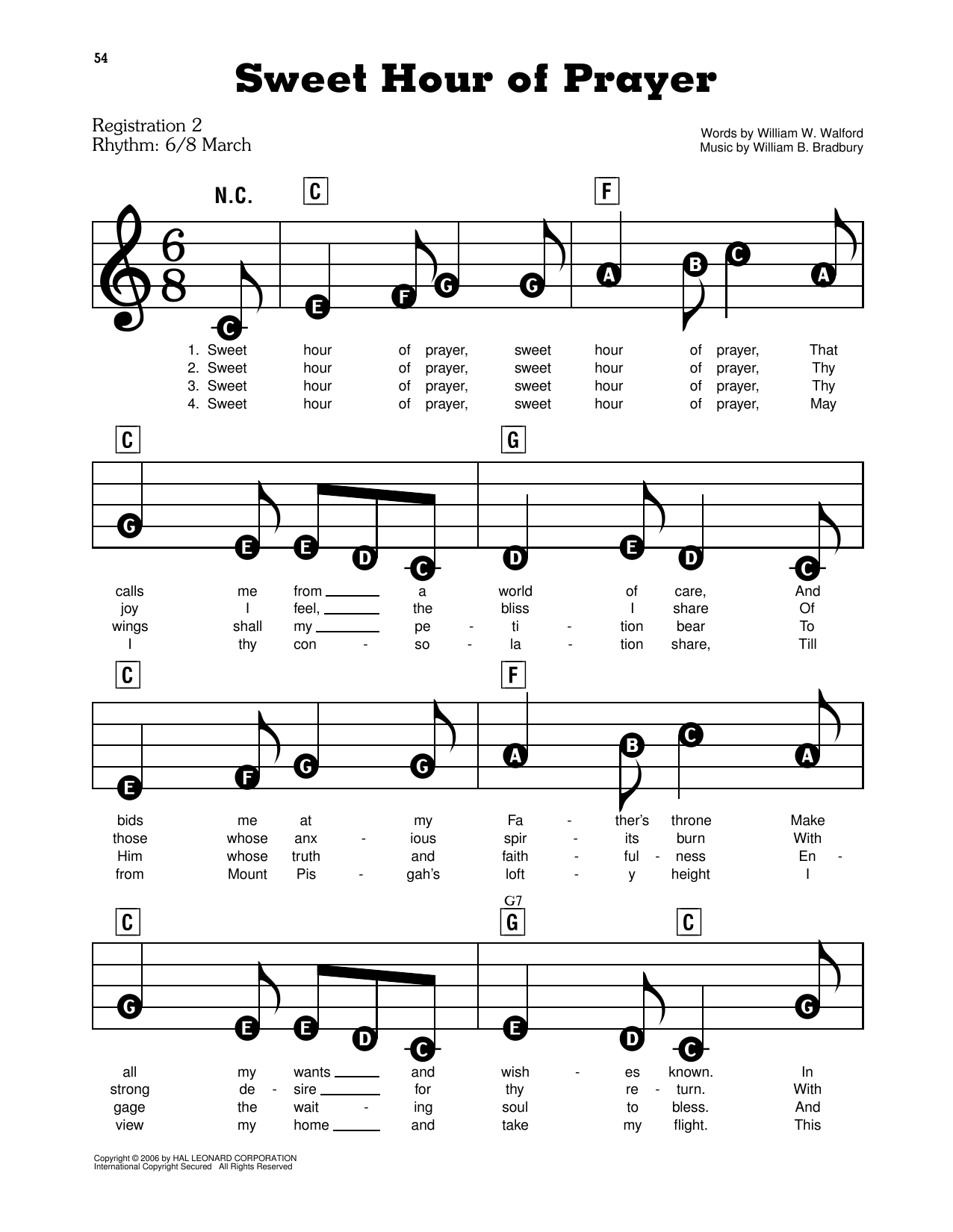
Sweet Hour Of Prayer: E-Z Play Today

As performed by William B. Bradbury

Item: 35-DS01833263

Digital Download
$4.99
Description

Sweet Hour Of Prayer: E-Z Play Today isn't in MakeMusic Cloud just yet...but it could be. Let us know you'd like to see it, and you'll help shape what comes next. In the meantime, start a free trial and dive into thousands of interactive titles your students can play along with today.

Sample Audio
No sample audio found.
Sample Video
Additional Details
Publisher: Hal Leonard
Page Count: 2
SKU: 35-DS01833263

More about this title

About the Artist: William B. Bradbury

William B. Bradbury (1816–1868) shaped American sacred music during the 19th century through his prolific output of hymns and devotional songs. His melodies became embedded in Protestant worship across the country, valued for their accessibility and emotional directness. Bradbury's gift lay in writing music that felt immediate and singable without sacrificing genuine musical substance, making his work enduringly useful for both choir and congregation.

Why we love this

This arrangement brings a beloved hymn within reach of pianists at all levels. The E-Z Play format preserves the harmonic integrity of Bradbury's original while keeping the left hand manageable, letting student musicians focus on phrasing and character rather than wrestling with notation.

What to expect

Quiet devotion fills these pages. The music unfolds with a gentle, contemplative warmth that invites introspection without demanding virtuosity. There's an unpretentious dignity here, the kind that comes from music written for sincere singing rather than concert showmanship.

Who it's for

Beginning and intermediate piano students will find this arrangement straightforward to learn and genuinely satisfying to perform. It also works well for adult learners returning to music or church pianists building a repertoire of accessible sacred standards.

How to get the most out of it

  • Shape the melody phrase by phrase rather than measure by measure. Bradbury's lines breathe naturally in longer arcs, so resist the urge to articulate every bar line.
  • Let the harmony in the accompaniment speak for itself. The chords already carry emotional weight; clarity matters more than volume.
  • Take time in the opening measures to establish the hymn's reverent quality. First impressions set the listener's entire experience of the piece.

How to use it

Pair this with other 19th-century hymn settings for a sacred music service or chapel program. It also makes an excellent prelude or postlude for school assemblies, and the two-page length makes it ideal for students preparing for recitals where they want to balance technical challenges with musical maturity.

Skills your students will build

  • Melodic phrasing and breath planning in hymn-style music
  • Left-hand independence and accompaniment texture
  • Harmonic awareness through chord recognition
  • Performance of sacred music with reverence and emotional restraint

You May Also Like