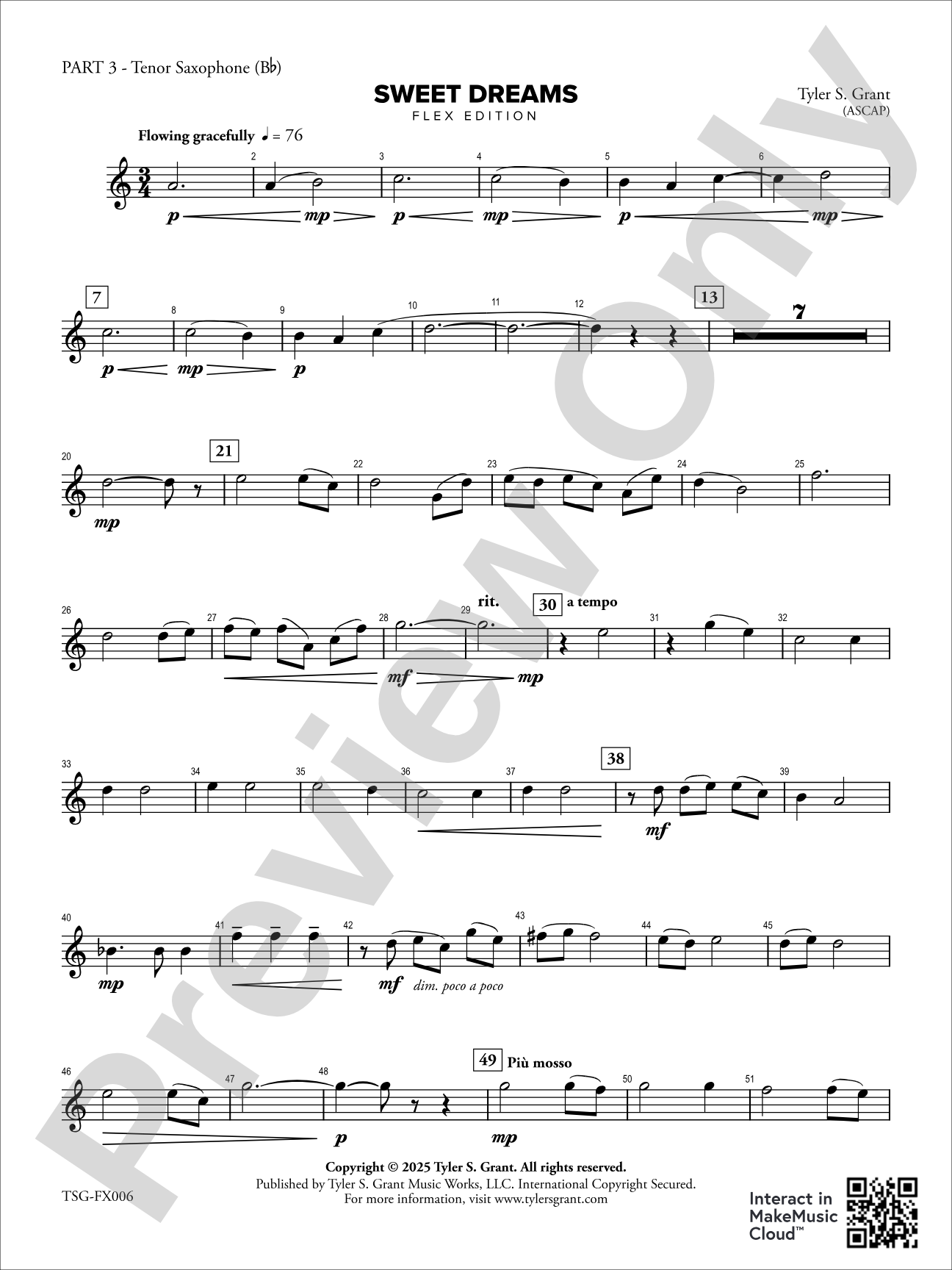
Sweet Dreams by Tyler S. Grant is a beautiful lullaby that uses lush melodies and textures to paint a picture of the innocence of a sleeping baby. The wide range of expression will stretch the boundaries of your ensemble's musicianship.(4:00)
Discover MakeMusic Cloud: thousands of interactive titles your students can play along with today.
Tyler S. Grant has built a reputation as a composer and arranger whose work appears consistently on honor ensemble programs and publisher's choice lists nationwide. His compositions have been performed at major venues including Carnegie Hall, the Meyerson Symphony Center, and the Midwest Clinic, and his Panoramic Fanfare won the Dallas Wind Symphony's 2014 "Call for Fanfares" Competition. Since 2010, he has maintained a steady output of commissions and publications while conducting clinics across more than 15 states.
Grant studied instrumental music education and conducting at the University of Alabama under Professor Randall Coleman, crediting composer Brian Balmages as a key mentor in developing his voice. Beyond composing, he has served as a clinician with over 100 school programs and contributed to Alfred Music's Sound Innovations series. His work spans concert bands, orchestras, and chamber ensembles at all levels.
Why we love this
Sweet Dreams strikes that rare balance between accessibility and expressive depth. The flexible instrumentation means you can realize Grant's lush harmonic language regardless of who shows up on your roster, and the four-minute arc gives your band a complete emotional arc to work with. Directors consistently choose this piece because it teaches musicianship through genuine songwriting rather than technical hurdles.
What to expect
A gentle journey into restful space. The piece unfolds like watching someone drift into sleep, with warm textures and unhurried phrasing that invite your ensemble to find maturity in restraint rather than virtuosity.
Who it's for
Concert bands at the 2.5 level working on expressive control and harmonic balance. It works equally well for ensembles in mid-season programming or preparing for festival adjudication, and the flexible instrumentation adapts to your specific instrumentation needs without compromising the composer's intent.
How to get the most out of it
Shape the opening melody with a long-line approach; resist the urge to breathe between phrases unless the score indicates it, so the lullaby character remains unbroken.
Balance the inner voices carefully during the harmonic layers. This piece rewards attention to secondary melodic lines that support but never overwhelm the primary voice.
Work dynamic control in sectionals before full rehearsal. The wide range of expression Grant asks for requires players to execute subtle changes with conviction.
Let the accompaniment breathe. Too-rigid rhythm section playing will make this feel mechanical instead of organic.
How to use it
Position this as a concert opener or closer where it can anchor an emotional context for what surrounds it. The piece also works as a calming interlude between high-energy selections, and many directors program it for youth band or middle school level ensembles working to develop musicianship in contest settings.
Skills your students will build
Sustained phrase shaping across long melodic lines
Voicing awareness and balance in multi-layered textures
Dynamic control and subtle expression changes
Reading flexible instrumentation scores and adapting to missing parts
Ensemble listening for blend and intonation in slower tempos
You May Also Like
Scan to Complete Your Purchase
Use your phone's camera to scan the code below
You'll log in on your phone and the order will be added to your account