
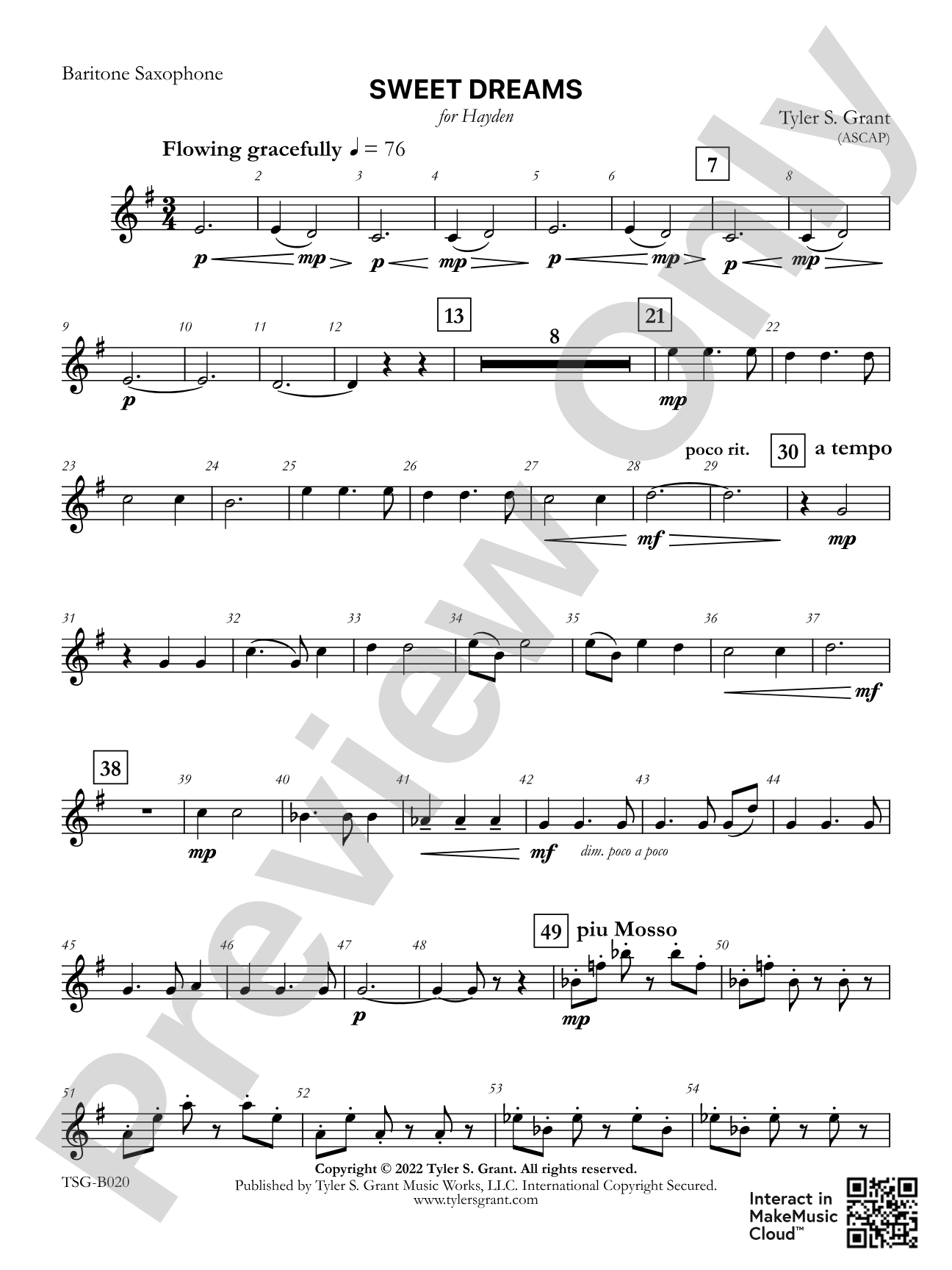

Sweet Dreams: E-flat Baritone Saxophone
By Tyler S. Grant
Grade: 2
Item: 98-PC-TGB020_BTX
$4.50
Pickup currently not available
Description
Sweet Dreams by Tyler S. Grant is a beautiful lullaby that uses piano, mallet percussion, crotales, and a number of other combinations to create lush orchestrations that paint a picture of the innocence of a sleeping baby. The wide range of expression will stretch the boundaries of your ensemble's musicianship. Recorded by the Atlanta Wind Symphony. (5:00)


Sweet Dreams: E-flat Baritone Saxophone isn't in MakeMusic Cloud just yet...but it could be. Let us know you'd like to see it, and you'll help shape what comes next. In the meantime, start a free trial and dive into thousands of interactive titles your students can play along with today.
Request This Title
Tell us you want it.
Start Your Free Trial
Explore everything that's ready to play right now.
Sample Audio
1
Audio File
--:--
0:00
0:00
Sample Video
Additional Details
Series:
Tyler S. Grant Music Works
Publisher:
Tyler S. Grant Music Works, LLC.
SKU:
98-PC-TGB020_BTX
More about this title
About the Composer: Tyler S. Grant

Tyler S. Grant builds his reputation through consistent output and widespread recognition across the concert band world. His compositions appear regularly on state and all-state honor ensemble programs, and his works have earned national accolades including the Dallas Wind Symphony's 2014 Fanfare Competition. He maintains an active commission schedule and releases new publications annually for bands and orchestras.
Beyond the page, Grant is deeply invested in music education through conducting and clinic work. He has led ensemble development sessions with over 100 school programs across 15 states and served as a contributing author for Alfred Music's Sound Innovations series. His conducting credits include The Midwest Clinic and all-state bands throughout the Southeast and Mountain regions. Grant holds a bachelor's degree in instrumental music education from the University of Alabama, where he studied conducting with Randall Coleman.
Why we love this
Grant's orchestration here proves that Grade 2 repertoire doesn't mean simple. The combination of piano, mallets, crotales, and selective instrumental doubling creates genuine musical texture without overwhelming younger ensembles. The piece sits at a level where students hear themselves making something genuinely beautiful rather than executing technical demands, which builds real investment in the music.
What to expect
Sweet Dreams unfolds like a parent watching over a sleeping child, each instrumental color adding a layer of tenderness. The lullaby framework gives the ensemble permission to play softly without sounding thin; instead, the orchestration feels intimate and carefully crafted. There's vulnerability here, which is rare territory for Grade 2 band music.
Who it's for
Grade 2 concert bands with access to mallets, piano, and crotales will find this piece immediately rewarding. It works equally well for developing ensembles seeking genuine musical expression and for experienced Grade 2 groups looking to deepen their interpretive skills. Directors programming for contests, festivals, or concert showcases will find a piece that impresses without technical posturing.
How to get the most out of it
- Balance the mallet parts carefully against the wind section; these instruments carry the melodic weight at times and need to cut through without overwhelming the ensemble's soft dynamic work.
- Use the piano part as your foundation for tempo stability, especially during rubato-inflected sections. Mark your conducting beats clearly so the band can follow the lullaby's natural breathing.
- Listen to the Atlanta Wind Symphony recording before your first read-through to absorb the character of the piece, particularly how they shape the phrase endings and manage dynamic transitions.
- Rehearse the transition points between instrumental combinations separately; band members need to understand when they're accompanying versus when they're carrying the main idea.
How to use it
Open a spring concert with this piece to establish an introspective mood, or use it as a palate cleanser between more energetic works. It programs beautifully alongside other Grant compositions or other accessible concert band lullabies and works particularly well in festival settings where your group needs to demonstrate musicianship alongside technical facility.
Skills your students will build
- Soft dynamics control and phrase shaping at pianissimo
- Listening to non-traditional ensemble textures (mallet prominence, piano integration)
- Balancing individual parts within sparse orchestrations
- Understanding lullaby form and expressive rubato
- Responding to emotional content in concert band literature