
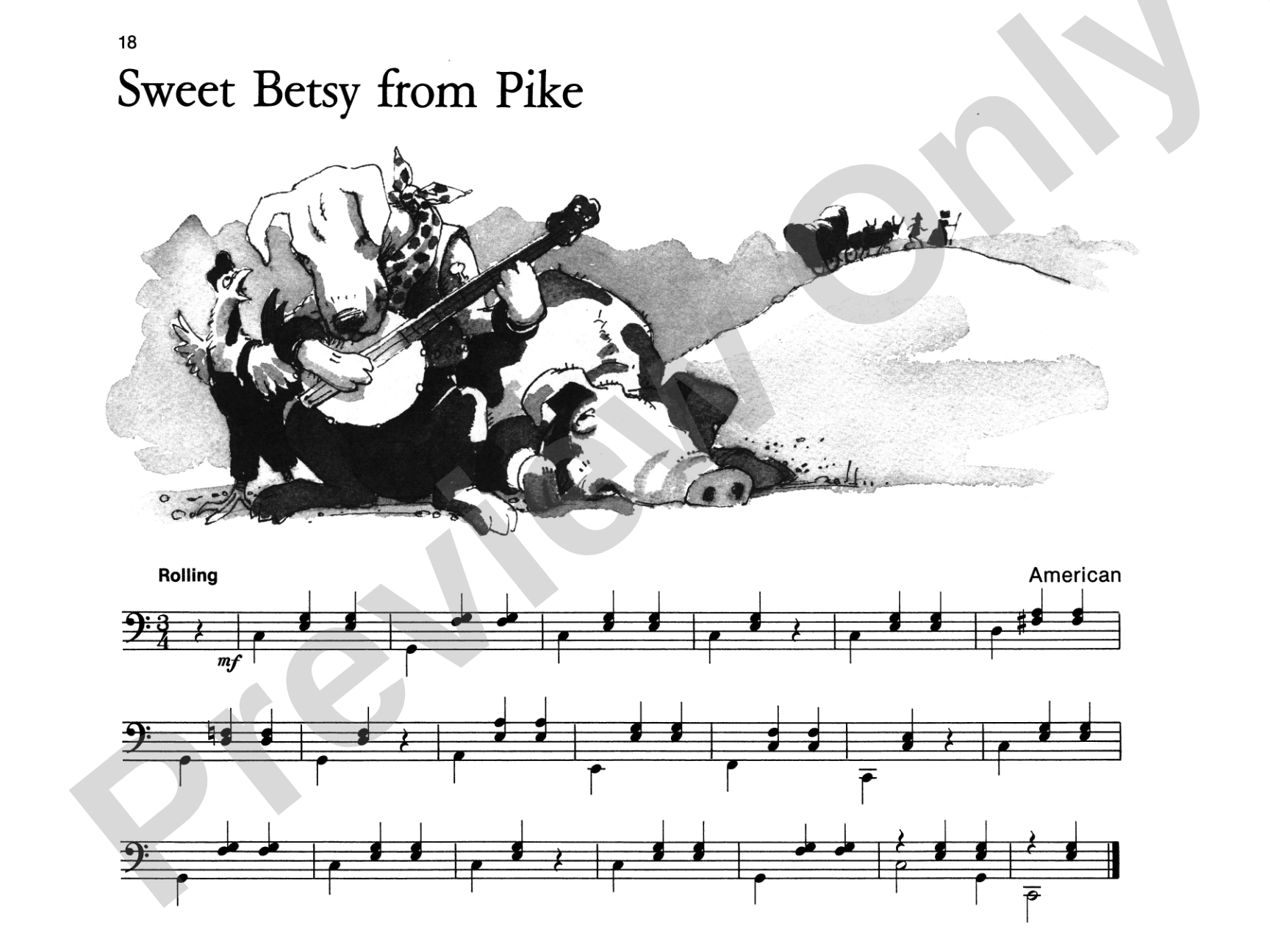

Sweet Betsy from Pike - Piano Solo with Lyrics (with Optional Duet Accompaniments): Piano Solo with Lyrics
Arranged by Lynn Freeman Olson
Level: Early Elementary / Elementary
Item: 00-PS-0017249
$4.99
Pickup currently not available
Related Items
'Tis the Gift to Be Simple - Piano Solo with Lyrics (with Optional Duet Accompaniments): Piano Solo with Lyrics |
$4.99
|
View | |
All Through the Night - Piano Solo with Lyrics (with Optional Duet Accompaniments): Piano Solo with Lyrics |
$4.99
|
View | |
De Colores - Piano Solo with Lyrics (with Optional Duet Accompaniments): Piano Solo with Lyrics |
$4.99
|
View | |
Donkey Riding - Piano Solo with Lyrics (with Optional Duet Accompaniments): Piano Solo with Lyrics |
$4.99
|
View | |
Du, Du Liegst Mir Im Herzen - Piano Solo with Lyrics (with Optional Duet Accompaniments): Piano Solo with Lyrics |
$4.99
|
View | |
Home on the Range - Piano Solo with Lyrics (with Optional Duet Accompaniments): Piano Solo with Lyrics |
$4.99
|
View | |
Hush, Little Baby - Piano Solo with Lyrics (with Optional Duet Accompaniments): Piano Solo with Lyrics |
$4.99
|
View | |
In and Out the Window - Piano Solo with Lyrics (with Optional Duet Accompaniments): Piano Solo with Lyrics |
$4.99
|
View | |
Old Joe Clarke - Piano Solo with Lyrics (with Optional Duet Accompaniments): Piano Solo with Lyrics |
$4.99
|
View | |
Poor Wayfarin' Stranger - Piano Solo with Lyrics (with Optional Duet Accompaniments): Piano Solo with Lyrics |
$4.99
|
View | |
Raisins with Almonds - Piano Solo with Lyrics (with Optional Duet Accompaniments): Piano Solo with Lyrics |
$4.99
|
View | |
Sakura - Piano Solo with Lyrics (with Optional Duet Accompaniments): Piano Solo with Lyrics |
$4.99
|
View | |
Shoo, Fly, Don't Bother Me - Piano Solo with Lyrics (with Optional Duet Accompaniments): Piano Solo with Lyrics |
$4.99
|
View | |
There Was a Little Shepherd - Piano Solo with Lyrics (with Optional Duet Accompaniments): Piano Solo with Lyrics |
$7.99
|
View | |
First Favorite Folk Songs: Piano Book |
$7.99
|
View |
Description
Easy five-finger arrangements of the world's most popular melodies, designed to encourage independent reading. Duet accompaniments provide a fuller sound and a chance for involvement by a teacher, friend or family member. A Federation Festivals 2024-2028 selection.


Sweet Betsy from Pike - Piano Solo with Lyrics (with Optional Duet Accompaniments): Piano Solo with Lyrics isn't in MakeMusic Cloud just yet...but it could be. Let us know you'd like to see it, and you'll help shape what comes next. In the meantime, start a free trial and dive into thousands of interactive titles your students can play along with today.
Request This Title
Tell us you want it.
Start Your Free Trial
Explore everything that's ready to play right now.
Sample Audio
No sample audio found.
Sample Video
No sample videos found.
Additional Details
Publisher:
Alfred Music
Page Count:
32
SKU:
00-PS-0017249
More about this title
About the Arranger: Lynn Freeman Olson
Lynn Freeman Olson earned recognition as a composer and arranger of accessible piano music for young students. Her arrangements prioritize clarity and independence, removing barriers that often frustrate early learners while preserving the integrity of beloved melodies.
Olson's work appears regularly in festival selections and teaching studios across North America, where her understanding of what early elementary pianists can accomplish informs every note she writes.
Why we love this
This collection strips away the frustration of traditional beginner arrangements without sacrificing genuine musicianship. The five-finger layout lets students play real songs immediately, building confidence that transfers directly to standard repertoire. Including optional duet parts transforms solo practice into a social experience, which matters enormously for retention and joy at this level.
What to expect
These arrangements capture the straightforward charm of folk melodies without condescension. Playing through them feels like discovering something real and complete, not a simplified watered-down version. There's genuine satisfaction in the sound, even at a slow tempo.
Who it's for
Early elementary pianists beginning independent reading, typically ages 6-8, who benefit from recognizable, singable melodies and physically manageable hand positions. Teachers and family members will find the duet accompaniments ideal for supporting these students during practice without requiring advanced playing skills.
How to get the most out of it
- Encourage steady tempo over perfect accuracy during first readings; these melodies are strong enough to carry a few stumbles, and confidence matters more than precision.
- When playing duets, have the accompanist play the harmony part while the student focuses on their melodic line; this prevents cognitive overload and lets the student hear how their part fits into a larger sound.
- Sit together at the piano during duet work to normalize shared musical space; proximity makes rhythm synchronization easier and creates a collaborative rather than evaluative feeling.
- Highlight the lyrics on the page; having words underneath the notes helps early readers connect the melody to language they already know, anchoring their understanding.
How to use it
Feature this collection in young student recitals where families appreciate hearing recognizable songs performed by their children. Use individual pieces as rewards for completing method book units, or assign them as confidence-builders between more challenging technical studies. The Federation Festivals 2024-2028 selection status makes these perfect candidates for festival-entry preparation.
Skills your students will build
- Reading single melodic lines in treble clef without ledger lines
- Playing five-finger patterns with consistent hand position
- Maintaining steady tempo with repetitive, predictable rhythm patterns
- Connecting written notes to familiar melodies and lyrics
- Playing duets while maintaining independence from the accompanist's part
- Building tone control and phrasing through singable melodic material