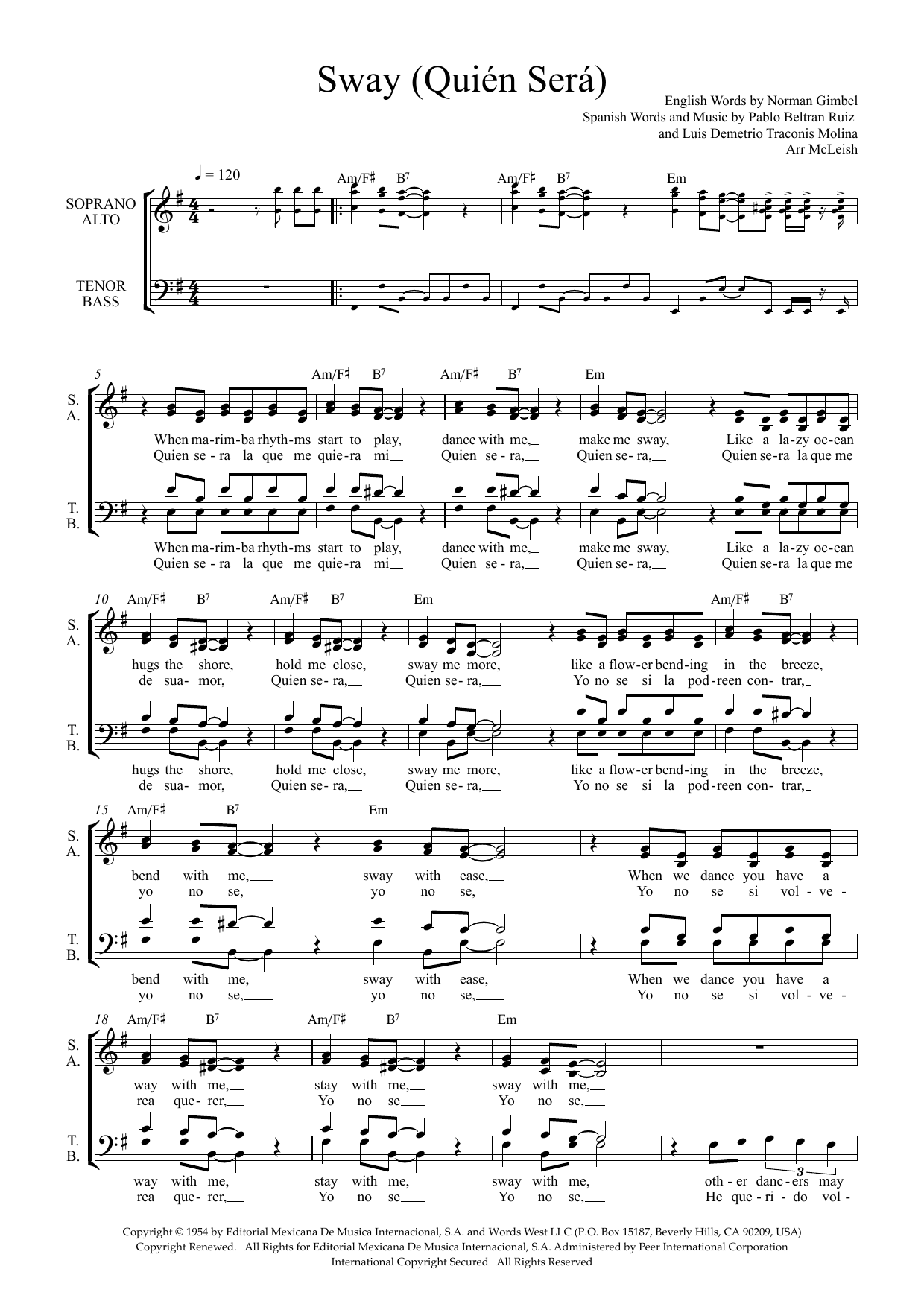
Sway (Quien Será) (arr. Craig McLeish) Sheet Music Preview

Sway (Quien Será) (arr. Craig McLeish): SATB Choral Octavo

As performed by Dean Martin / Arranged by Craig McLeish

Item: 35-DS00457617

Digital Download
$1.99
Description

Sway (Quien Será) (arr. Craig McLeish): SATB Choral Octavo isn't in MakeMusic Cloud just yet...but it could be. Let us know you'd like to see it, and you'll help shape what comes next. In the meantime, start a free trial and dive into thousands of interactive titles your students can play along with today.

Sample Audio
No sample audio found.
Sample Video
Additional Details
Publisher: Hal Leonard
Page Count: 2
SKU: 35-DS00457617

More about this title

About the Artist: Dean Martin

Dean Martin rose to prominence as one of the most versatile entertainers of the mid-20th century, equally at home crooning jazz standards, acting in films, and performing on television. His effortless vocal style and impeccable phrasing made him a defining voice of the Great American Songbook, and his interpretations of classics like "Sway" became definitive recordings that continue to influence singers across genres.

Why we love this

Craig McLeish's arrangement captures the sophisticated ease of Martin's original while making it genuinely accessible for SATB choirs. The Latin-influenced rhythmic foundation gives students something tangible to lock onto, and the short length means you can add this to a concert without the rehearsal commitment of a full extended work.

What to expect

Warm and inviting, with an easy Latin sway underneath classic pop-vocal smoothness. There's a romantic lightness to this piece, the musical equivalent of dancing close to someone without overthinking it.

Who it's for

This arrangement works for any SATB choir looking to add a touch of jazz sophistication without stepping into serious arranging territory. It suits ensembles that enjoy pop and jazz standards but may lack a dedicated show choir or jazz ensemble.

How to get the most out of it

  • Keep the Latin percussion feel alive even in the ensemble sections. A light, dance-like bounce in the rhythm gives the piece its character without overplaying the groove.
  • Balance the solo line (if featured) against the harmonic support; the verses should feel conversational rather than drowning in block harmony.
  • Let the swaying quality of the melody guide your phrasing. Resist the urge to phrase in strict 4-bar chunks; instead, follow the natural contours of the tune.
  • Pay attention to vowel consistency across the choir, especially in the sustained chords. A unified "oh" or "ah" sound will enhance the lyrical quality.

How to use it

Slip this between heavier classical or contemporary work on a spring concert to give your audience a moment of pure entertainment. It also pairs naturally with other jazz or American Songbook standards if you're building a themed set.

Skills your students will build

  • Phrasing and breath control in a legit singing context
  • Latin rhythmic feel and coordination with the ensemble
  • Balance between solo line and choral harmony
  • Stylistic interpretation of a jazz standard

You May Also Like