
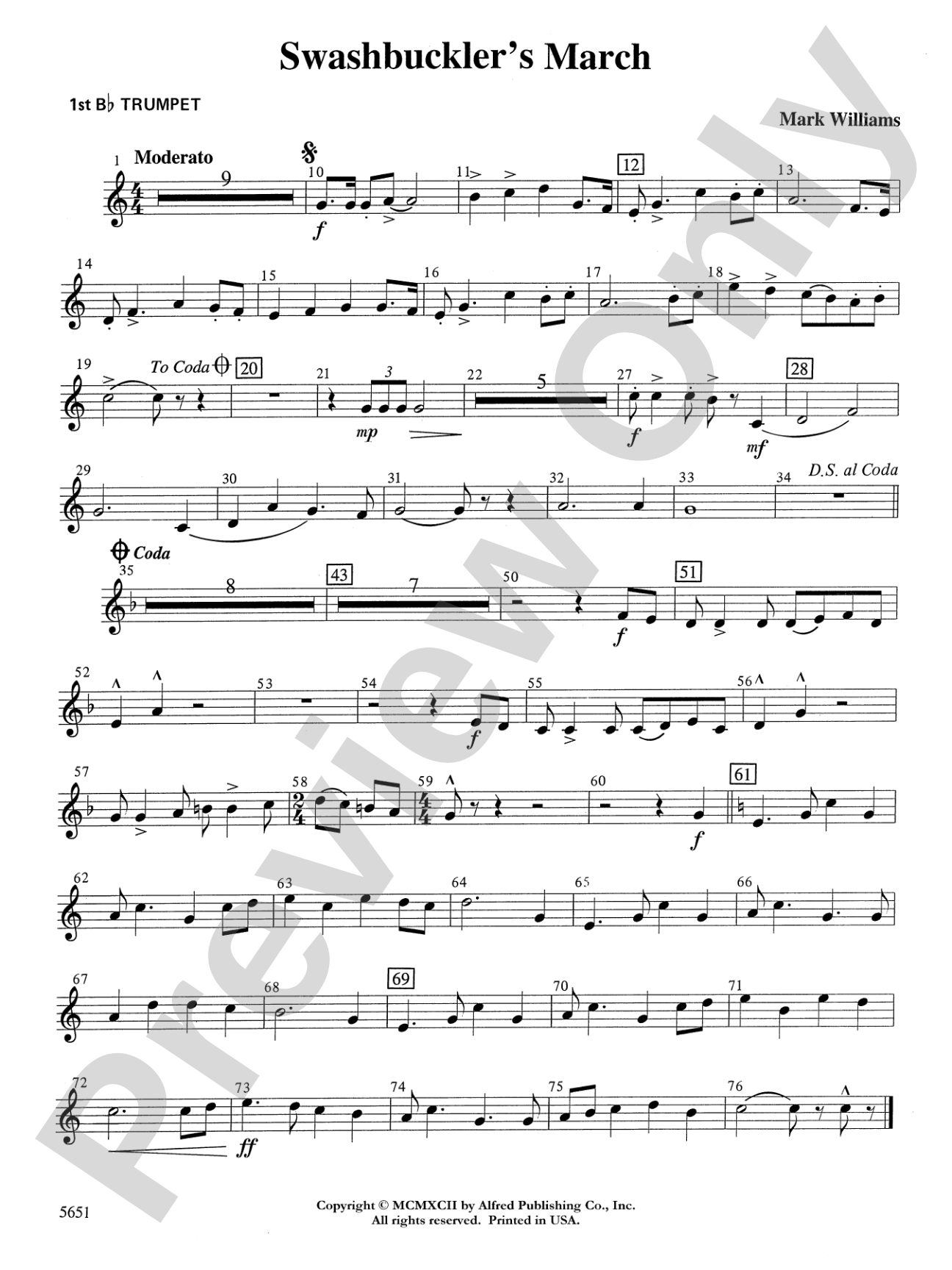

Swashbuckler's March: 1st B-flat Trumpet
By Mark Williams
Grade: 1.5 (Easy)
Item: 00-PC-0001903_T1
$3.00
Pickup currently not available
Description
This high-spirited march begins with a catchy melody that will immediately grab your listeners. Syncopation and light scoring make for an exhilarating second strain. Woodwinds take the lead at the trio with a majestic theme before the brass create a dogfight-style dialog between the two choirs of instruments. A recap of the trio brings the band together for a rousing close! (Grade 1 1/2---Easy)


Don't just read it, hear it, play along with it, and watch your students grow with it. In MakeMusic Cloud, Swashbuckler's March: 1st B-flat Trumpet comes alive with professional accompaniment, adjustable tempo, and built-in practice tools that turn solo practice into real progress.
Open in the Player
Jump straight in and assign it today.
Start Your Free Trial
Open this title and explore the full library in minutes.
Sample Audio
1
Audio File
--:--
0:00
0:00
Sample Video
No sample videos found.
Additional Details
Series:
Challenger Band Series
Publisher:
Alfred Music
Page Count:
122
SKU:
00-PC-0001903_T1
More about this title
About the Composer: Mark Williams

Mark Williams composed over 200 works for school bands, orchestras, and choirs while establishing himself as one of the most prolific voices in music education. His credentials included a Bachelor of Arts in Education and Master of Education from Eastern Washington University, and he spent his career teaching elementary band in Washington schools and guest conducting across 34 states, five Canadian provinces, and Australia. Beyond the concert hall, Williams served as woodwind performer and arranger for the 560th Air Force Band and held the position of Conductor and Artistic Director for the Spokane British Brass Band.
Williams earned widespread recognition for his compositions, winning the Western International Band Clinic's Gralia Competition and multiple ASCAP Special Awards. He co-authored the Accent on Achievement Band Method, a foundational resource for generations of band students. His work is distinguished by accessibility, clarity of orchestration, and genuine musicality at every level.
Why we love this
Williams writes marches with genuine personality and orchestral sophistication. The dialogue between woodwind and brass sections gives young ensembles a satisfying musical conversation to navigate, while the syncopated second strain keeps the energy kinetic without becoming rhythmically burdensome. At Grade 1.5, it balances immediate impact with musical substance, making it rewarding for both students and audiences.
What to expect
From its opening moments, Swashbuckler's March radiates theatrical energy and playfulness. The syncopated second strain dances with exuberance, while the trio brings a moment of stately grandeur before brass and woodwind sections lock into a spirited back-and-forth that feels like characters trading quips on stage.
Who it's for
This march belongs in the repertoire of any concert band at the Grade 1.5 level, whether you're building your first library or refreshing your contest and concert programming. It works equally well for community bands, middle school ensembles, and professional groups seeking accessible but authentic works that engage both players and listeners.
How to get the most out of it
- Shape the opening melody with confidence but without rushing. Let the catchy line settle into the ensemble's ears before the first strain closes.
- Emphasize the syncopated figures in the second strain by bringing out the backbeat feel in percussion and low brass; this lightness is what gives the section its exhilaration.
- Prepare woodwinds to play the trio theme with singing tone and clear articulation, as they will carry the musical weight before brass take over the dialogue.
- Balance the dogfight between brass choirs carefully in rehearsal so each voice remains distinct rather than blending into one heavy texture. Use sectionals to ensure each choir knows its independence.
How to use it
Open a concert with this march to establish a bright, approachable mood that draws audiences in immediately. Its compact length and high entertainment value make it an ideal companion to a longer work, or program it alongside other Grade 1.5 repertoire to showcase the full range of your ensemble's developing abilities.
Skills your students will build
- Reading syncopated rhythms within straightforward harmonic progressions
- Balancing independent melodic lines between woodwind and brass sections
- Maintaining rhythmic precision and ensemble cohesion across tempo-steady march form
- Controlling dynamics and tone quality to project character through a march structure