
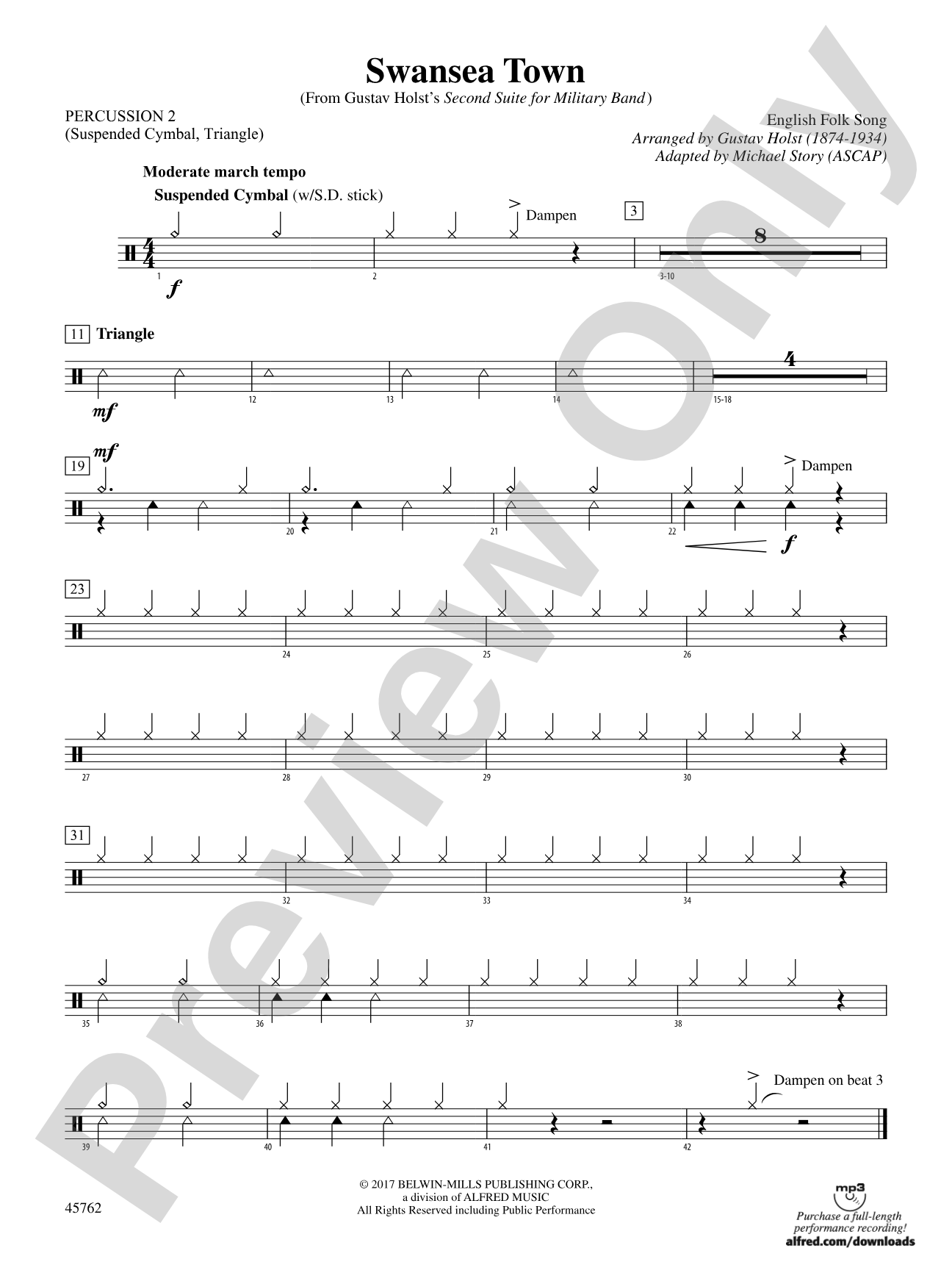

Swansea Town: 2nd Percussion
From Gustav Holst's Second Suite for Military Band
English Folk Song / arr. Gustav Holst / adapted by Michael Story
Grade: 0.5 (Very Easy)
Item: 00-PC-0017574_PC2
$3.00
Pickup currently not available
Description
The charming folk song chosen by Gustav Holst is found early in his revered Second Suite. Scored for first year players, this is a sea shanty originally from southern England. Historic and musical, this adaptation will be enjoyed by all! (1:30) This title is available in MakeMusic Cloud.


Don't just read it, hear it, play along with it, and watch your students grow with it. In MakeMusic Cloud, Swansea Town: 2nd Percussion comes alive with professional accompaniment, adjustable tempo, and built-in practice tools that turn solo practice into real progress.
Open in the Player
Jump straight in and assign it today.
Start Your Free Trial
Open this title and explore the full library in minutes.
Sample Audio
1
Audio File
--:--
0:00
0:00
Sample Video
Additional Details
Series:
Belwin Very Beginning Band
Publisher:
Alfred Music
Page Count:
130
SKU:
00-PC-0017574_PC2
More about this title
About the Arranger: Gustav Holst
Gustav Holst (1874-1934) was an English composer whose Second Suite in F Major stands as a cornerstone of early band repertoire. Known for his ability to craft music that serves both educational and artistic purposes, Holst drew on folk traditions and classical forms to create works that bands of all levels could access without sacrificing musical integrity.
Michael Story is a prolific arranger and composer whose work appears throughout educational band literature. His arrangements honor the original compositions while tailoring them specifically for young ensembles, maintaining the character and pedagogical value that make pieces endure in the classroom.
Why we love this
This arrangement captures everything that makes Holst's Second Suite a staple: lyrical melody, clear harmonic progression, and an irresistible folk character that engages first-year players immediately. The sea shanty subject matter brings narrative and cultural history into rehearsal, and the 1:30 duration is perfectly proportioned for program variety without overshadowing larger works. Young bands sound genuinely musical performing this, which builds confidence and keeps motivation high.
What to expect
Salty and seasoned, like a folk melody that has traveled across generations and oceans. The straightforward harmonic language and transparent orchestration create warmth without clutter, while the tune itself carries the narrative weight of a traditional sea shanty. Players and audiences alike feel the satisfaction of performing a genuine masterwork.
Who it's for
First-year concert band students and beginning instrumentalists ready to move beyond warm-up exercises into actual repertoire. Directors looking for a piece that sounds complete and musical while remaining technically accessible for Grade 0.5 ensembles.
How to get the most out of it
- Balance the melody between principal voices while keeping inner parts supported; the charm of a folk tune depends on its singability, so encourage players to think like vocalists shaping a continuous phrase.
- Establish a steady, unhurried tempo that allows the sea shanty character to emerge without rushing; this is a song sailors would have sung, not a march.
- Pay attention to the articulation markings that distinguish the character sections; they create variety and help young players understand how articulation shapes musical intent.
- Use the full score to identify where individual sections double or support each other, then highlight those relationships in sectional rehearsals so students understand their role in the whole.
How to use it
Open a concert with this to establish an approachable, engaging tone while showcasing early musicianship. Pair it with other folk-based or lighter works in a thematic program about cultural music, or use it as a confidence builder in a mixed-difficulty concert where it lets younger or newer students shine without technical demands that would require weeks of preparation.
Skills your students will build
- Sustaining lyrical phrasing across entire phrases despite limited breath capacity
- Balancing individual voice parts within transparent, four-part harmony
- Reading and executing basic articulation markings (legato and staccato) as expressive choices
- Understanding how folk melody functions as the organizing principle of a musical work
- Responding to tempo and character established through a conductor's preparation and beat