Swanee River: Optional Trombone 2 Sheet Music Preview

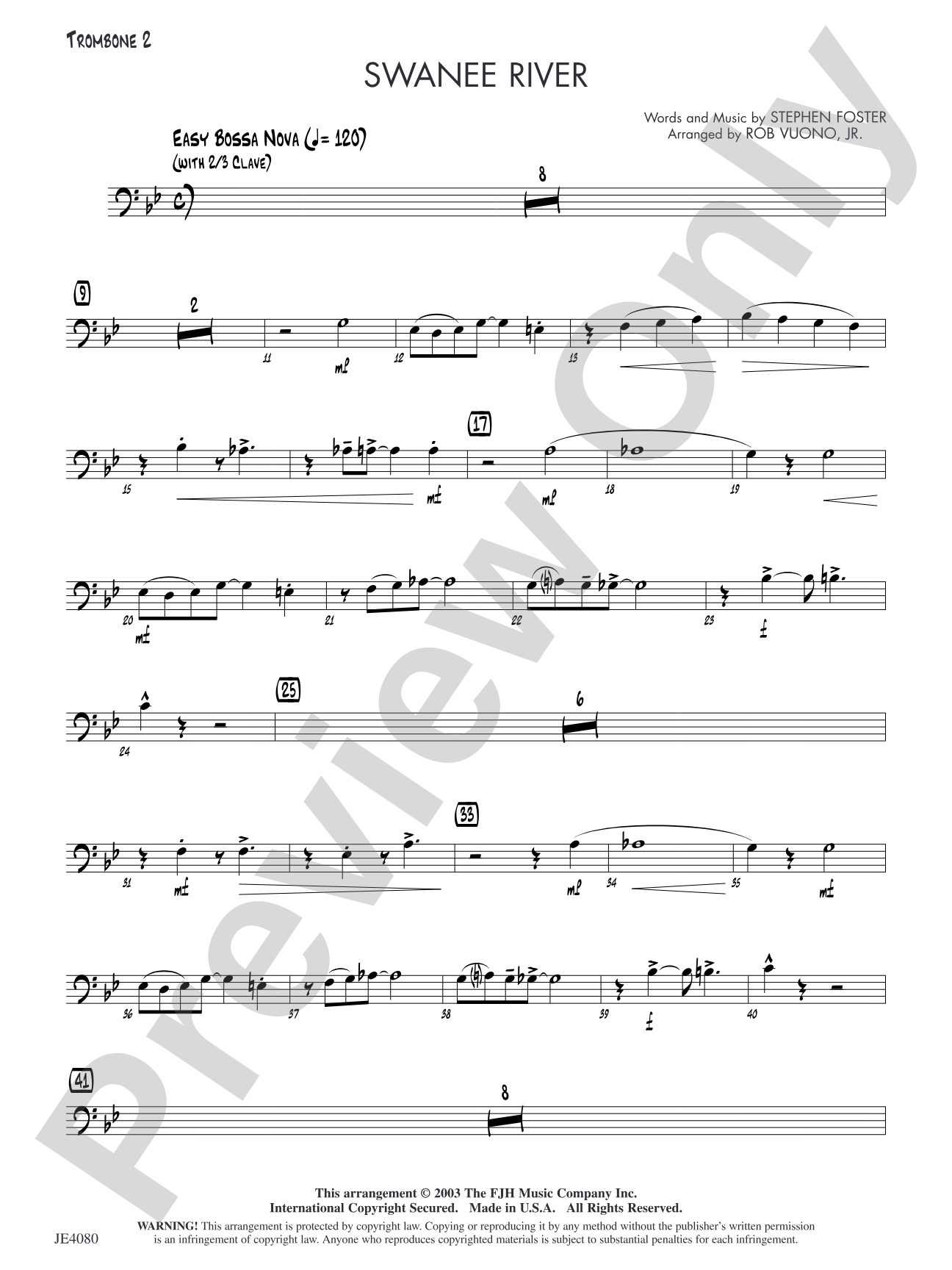
Swanee River: Optional Trombone 2

By Stephen C. Foster / arr. Rob Vuono, Jr.

Grade: 1.5

Item: 98-PC-DJE4080_OTN2

Digital Download
$7.00
Description
Rob Vuono continues to show why his beginning jazz arrangements are so popular. This clever arrangement with a bossa flavor is ideal for teaching basic concepts of this unique style. Very easy to play, and a good change of pace from the swing and rock charts programmed on your concert.

Swanee River: Optional Trombone 2 isn't in MakeMusic Cloud just yet...but it could be. Let us know you'd like to see it, and you'll help shape what comes next. In the meantime, start a free trial and dive into thousands of interactive titles your students can play along with today.

Sample Audio
0:00
0:00
Sample Video
Additional Details
Series: FJH Beginning Jazz Ensemble
Publisher: The FJH Music Company, Inc.
SKU: 98-PC-DJE4080_OTN2

More about this title

About the Composer: Stephen C. Foster

Stephen C. Foster (1826-1864) composed some of the most enduring melodies in American music, creating songs that became the soundtrack to 19th-century popular culture. His gift for memorable, singable lines made his work instantly accessible to amateur and professional musicians alike, a quality that has kept his compositions alive in classrooms and concert halls for nearly two centuries.

For music educators, Foster's legacy offers something invaluable: tunes so strong they can sustain virtually any arrangement or stylistic treatment. His melodic clarity and rhythmic directness make his work ideal for teaching fundamental concepts across multiple genres and ensembles.

Why we love this

Rob Vuono's approach here is genuinely pedagogical. He takes a beloved American standard and plants it firmly in the bossa nova tradition without complication, giving young jazz musicians a chance to absorb Latin rhythmic feel and ensemble textures alongside repertoire they already know. The arrangement proves that introducing new stylistic territory doesn't require new melodies.

What to expect

Warm and unhurried, with the gentle groove of a bossa nova samba underneath a melody that singers have loved for generations. The arrangement balances familiarity with discovery, letting the ensemble experience a new rhythmic language while standing on solid musical ground.

Who it's for

Beginning jazz ensembles ready to expand beyond swing and straight-ahead rock feels. This works for players in their first or second year of jazz band experience who have solid note-reading skills but haven't yet tackled complex rhythmic feels. It's also excellent for mixed-age groups where you want everyone contributing meaningfully without advanced improvisation or technical demands.

How to get the most out of it

  • Focus the ensemble on the clave rhythm underneath the melody. Have rhythm section players tap their part while singing the head so they feel how the bossa grove sits against what the horns are playing.
  • Keep the tempo relaxed and grounded. Bossa nova loses its character if rushed; a patient approach lets the swing and Latin elements breathe together.
  • Balance the ensemble so the melody sits comfortably above the rhythm section. Young players often push too hard on the head; remind them this arrangement is built on foundation, not volume.
  • Use this as an opportunity to discuss comping. Have the pianist and guitarist pay attention to the voicings in the score and understand how they support rather than compete with the solo instruments.

How to use it

Use this as a stylistic pivot point in a concert, especially one that leans heavily on swing and rock. It gives your audience a taste of Latin jazz energy without overwhelming younger players, and it provides a natural moment to educate listeners about how American standards migrate across genres. Pair it with other Foster melodies arranged in different styles to show the adaptability of great melodic writing.

Skills your students will build

  • Understanding bossa nova groove and clave rhythm
  • Comping and harmonic support in Latin styles
  • Balancing melody and accompaniment in a small-group setting
  • Playing with relaxed swing feel in a non-straight-eighths context

You May Also Like