Swan Song (arr. André Bachmann) Sheet Music Preview

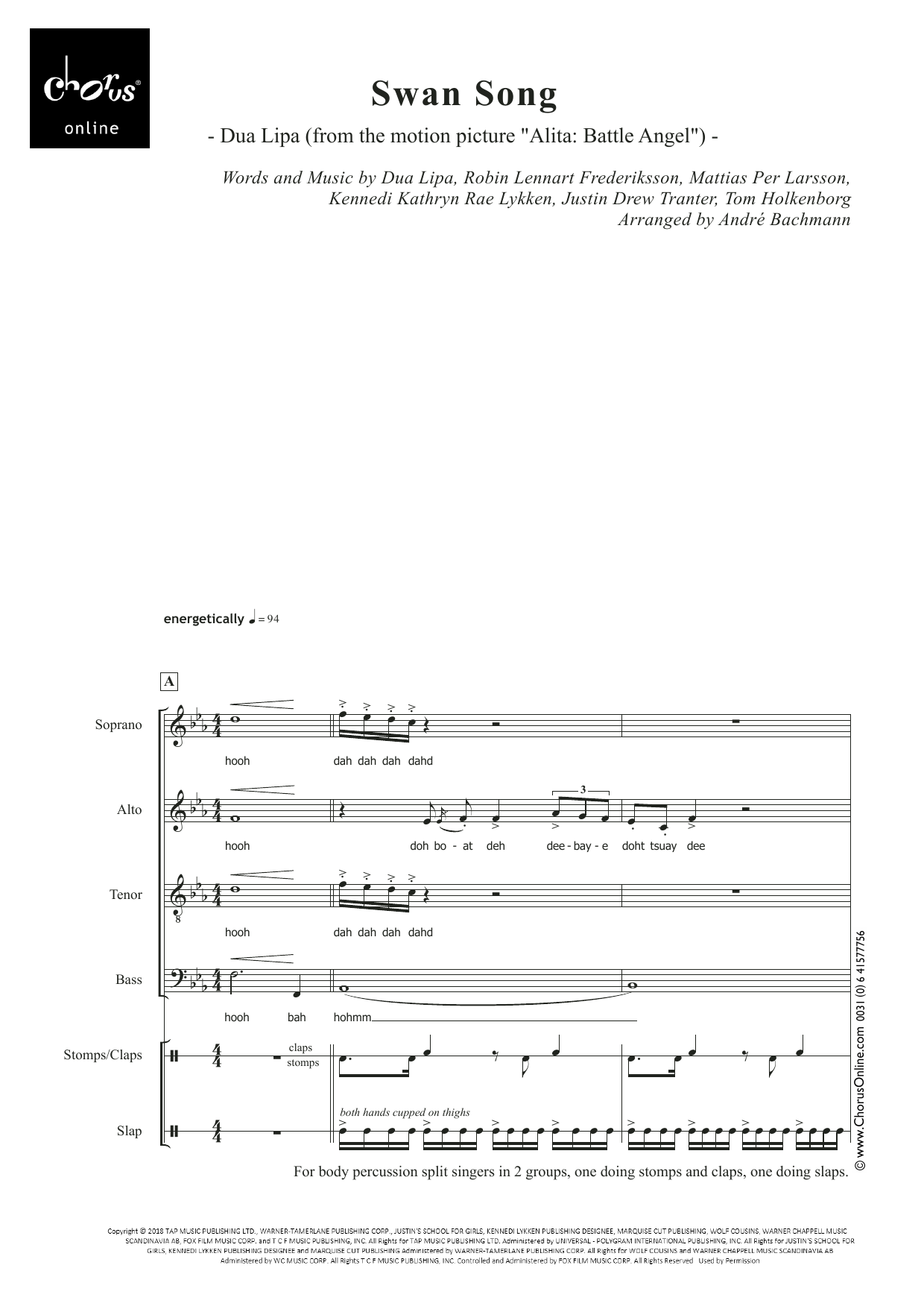
Swan Song (arr. André Bachmann): SATB Choral Octavo

As performed by Dua Lipa / Arranged by André Bachmann

Item: 35-DS00490987

Digital Download
$2.99
Description

Swan Song (arr. André Bachmann): SATB Choral Octavo isn't in MakeMusic Cloud just yet...but it could be. Let us know you'd like to see it, and you'll help shape what comes next. In the meantime, start a free trial and dive into thousands of interactive titles your students can play along with today.

Sample Audio
No sample audio found.
Sample Video
Additional Details
Publisher: Hal Leonard
Page Count: 15
SKU: 35-DS00490987

More about this title

About the Artist: Dua Lipa

Dua Lipa emerged in the 2010s as one of pop music's most distinctive voices, blending confident vocal delivery with genre-bending production. Her work spans dance-pop, disco-influenced arrangements, and introspective ballads, making her catalog a rich resource for contemporary choral adaptation.

Why we love this

Bachmann's arrangement captures what makes this song resonate: a melody that sits naturally in the choral voice, allowing four-part writing to enhance rather than complicate the emotional core. Contemporary pop this well-suited to SATB doesn't come around often, and it arrives with built-in appeal that draws singers into serious work on blend, tuning, and musicality.

What to expect

The arrangement inhabits the space between vulnerability and strength, with harmonic support that lets the inherent melody breathe. Without instrumental backing, every chord choice becomes visible, which means the arrangement rewards close listening and intentional phrasing from the singers.

Who it's for

Choirs seeking contemporary repertoire that respects both the original's emotional weight and the pedagogical demands of serious four-part writing. This works for high school ensembles through community choirs ready to tackle pop material with textural sophistication.

How to get the most out of it

  • Balance the melodic material between voice parts so that the song's contour remains audible even as each section carries harmonic responsibility.
  • Shape the phrase endings with intentional releases; the arrangement likely relies on clarity of articulation to prevent the a cappella texture from feeling muddy.
  • Lock the vowel sounds across all four parts during sustained harmonies to achieve the resonance and blend that makes a cappella arrangements sing.

How to use it

Consider placing this alongside other contemporary works in a concert that bridges classical and pop traditions, or feature it as the emotional anchor in a program exploring personal reflection and resilience. The a cappella setting makes it suitable for settings where acoustic intimacy matters: smaller venue concerts, chamber-style programming, or moments designed for reflection rather than spectacle.

Skills your students will build

  • Balancing four-part harmony in a cappella context without losing melodic shape
  • Intonation in sustained chords with no instrumental reference
  • Phrasing and expression in contemporary pop idiom
  • Part independence while maintaining choral blend

You May Also Like