
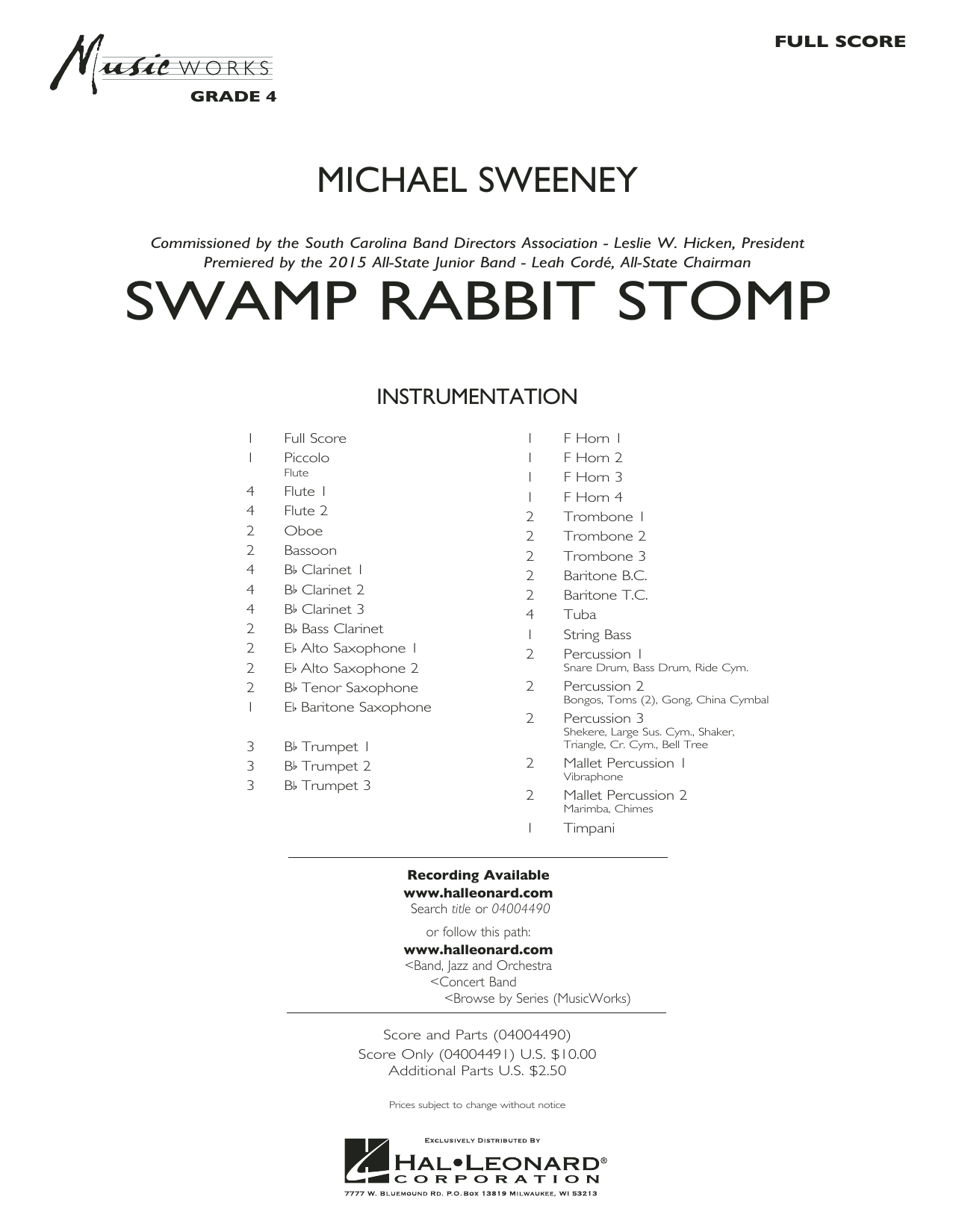

Swamp Rabbit Stomp: Concert Band Conductor Score & Parts
By Michael Sweeney
Grade: 4
Item: 35-PK00331447
$85.00
Pickup currently not available
Buy Extra Parts (Digital PDF Download)
Parts Added to Cart!
Description
Written to celebrate the natural scenic beauty of the famed Swamp Rabbit Trail in South Carolina, and commissioned by the 2015 South Carolina All-State Junior Band, Michael Sweeney's "Swamp Rabbit Stomp" is a joyous romp of rhythm and harmony. Exploring layers of sounds as well as an expanded role for the percussion section, this work also calls for a middle section where all members of the band perform with egg shakers. A substantial work, but with a dash of fun! Dur: 7:15


Swamp Rabbit Stomp: Concert Band Conductor Score & Parts isn't in MakeMusic Cloud just yet...but it could be. Let us know you'd like to see it, and you'll help shape what comes next. In the meantime, start a free trial and dive into thousands of interactive titles your students can play along with today.
Request This Title
Tell us you want it.
Start Your Free Trial
Explore everything that's ready to play right now.
Sample Audio
No sample audio found.
Sample Video
No sample videos found.
Additional Details
Publisher:
Hal Leonard
SKU:
35-PK00331447
More about this title
About the Composer: Michael Sweeney
Michael Sweeney stands among the most prolific and performed composers of contemporary concert band music. His works span the full spectrum of educational levels, from grade 2 through advanced, and his instinct for what engages both student musicians and audiences has made him a fixture in festival programs and all-state events across the country.
Sweeney's compositional voice balances accessibility with substance. He writes idiomatically for each instrument, builds rhythmic sophistication gradually, and understands exactly when to add layers of complexity versus when to let a melody breathe. His commissions for state festivals and honor bands reflect the trust that music educators place in his ability to create works that challenge students while remaining genuinely enjoyable to perform.
Why we love this
Sweeney crafts this work as a celebration rather than a showpiece, which means your students get to perform something substantial without the anxiety of technical pyrotechnics. The egg shaker moment is a stroke of genius: it transforms every ensemble member into an active sound designer for an entire section, builds ensemble awareness through unconventional means, and gives students a memory they'll carry beyond graduation day.
What to expect
Joy and motion drive this piece from its first moment. The rhythmic energy recalls folk traditions and outdoor festival spirit, while the harmonic language is sophisticated enough to keep experienced listeners engaged. When the egg shakers enter, the texture opens into something almost celebratory and slightly mischievous.
Who it's for
Grade 4 bands that are ready for a work with real harmonic depth and unconventional scoring demands. This suits ensembles comfortable with extended percussion roles and teachers looking for concert repertoire that entertains audiences while genuinely developing musicianship.
How to get the most out of it
- Establish the foundational pulse in your first rehearsals before layering the harmonic content. Once the rhythm section has the stomp locked in, other sections will find their parts much more naturally.
- Record a scratch track of the egg shaker section early and have students listen to it daily. This unusual texture needs to become familiar in their ears so they stay confident during that passage.
- Bring out the expanded percussion writing without letting it overwhelm the band. These parts drive the energy, but the melodic lines above still need to sing through.
- Pay attention to the dynamic architecture across the full seven minutes. Sweeney builds momentum carefully, and rushing or over-playing the early sections will rob the piece of its natural arc.
How to use it
Reserve this for a festival or spring concert where you want a program centerpiece that appeals across the room. Its seven-minute length and substantial scoring make it an ideal anchor for a concert's second half, positioned after lighter works and before any closing selections.
Skills your students will build
- Maintaining rhythmic independence while surrounding voices carry different subdivisions
- Blending and balancing with expanded percussion section textures
- Identifying and emphasizing harmonic movement across sustained passages
- Performing with unconventional sound sources as integral ensemble members
- Sustaining musicianship and focus across extended formal sections