
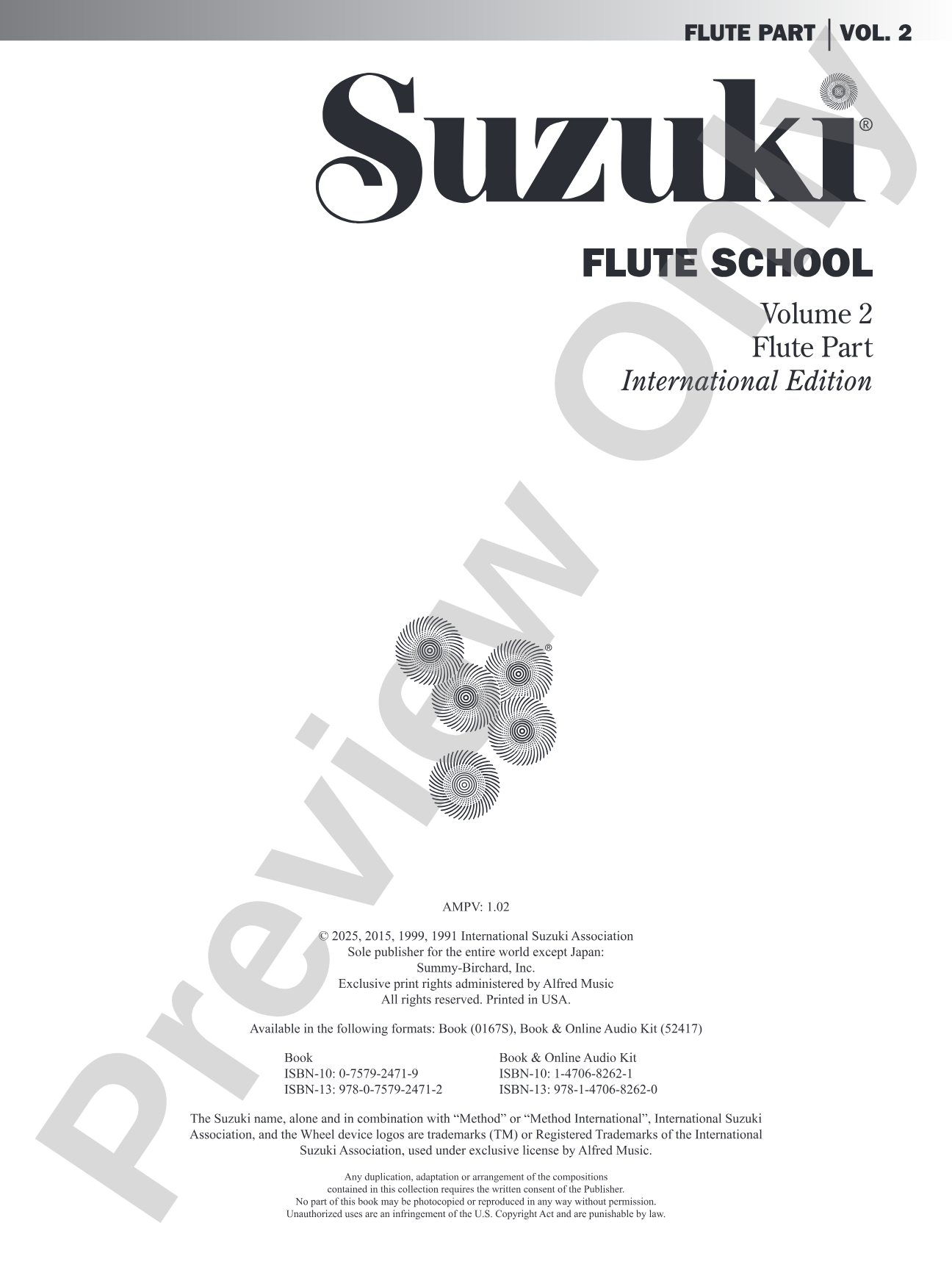

Suzuki Flute School, Volume 2: Flute
International Edition
Item: 00-PB-0000913

$14.99
Pickup currently not available
Related Items
Suzuki Flute School, Volume 2 (International Edition): Flute Book |
$14.99
|
View |
Description
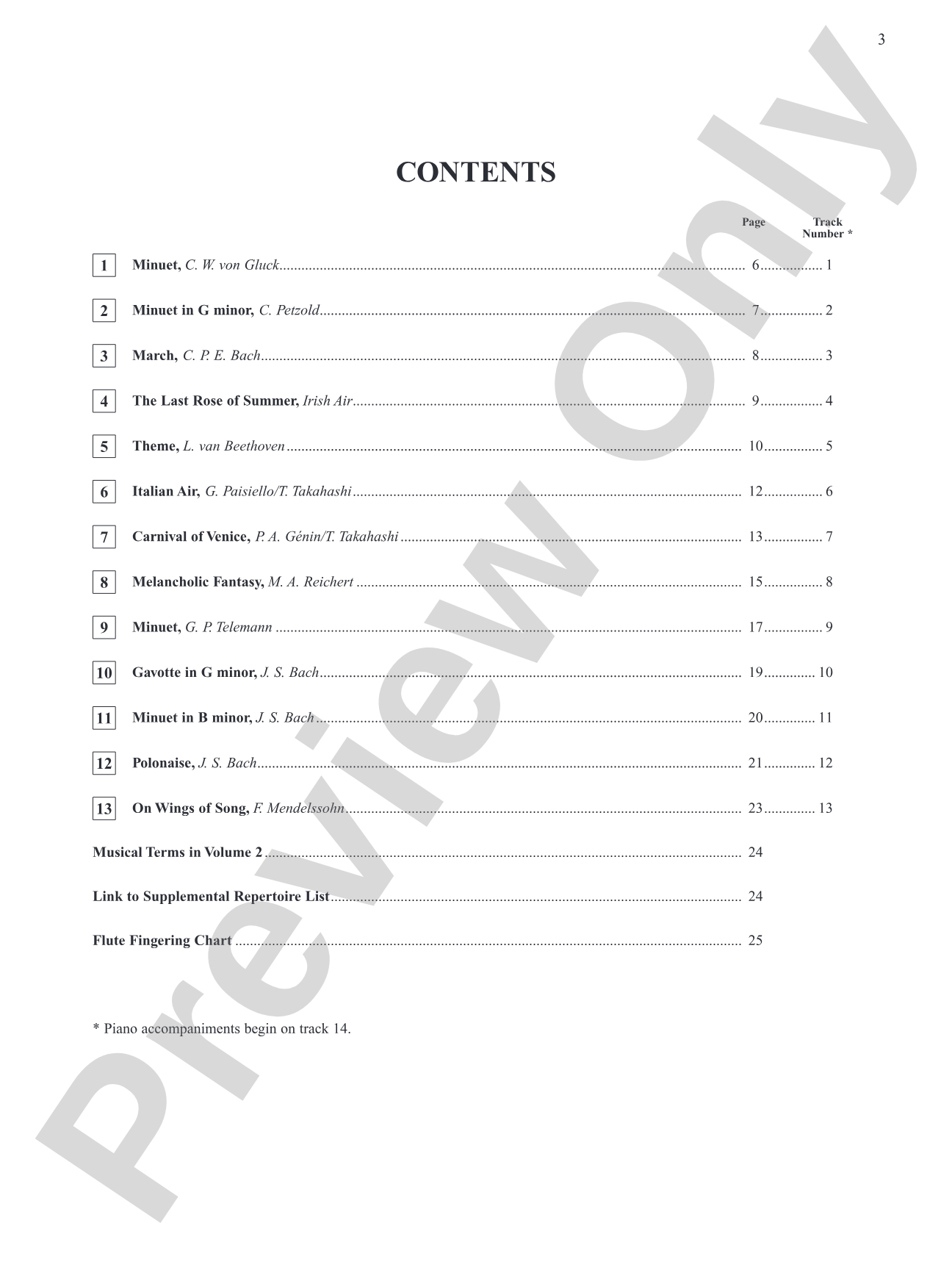
The Suzuki Method® of Talent Education is based on Dr. Shinichi Suzuki's view that every child is born with ability, and that people are the product of their environment. According to Dr. Suzuki, a world-renowned violinist and teacher, the greatest joy an adult can know comes from developing a child's potential so he/she can express all that is harmonious and best in human beings. Students are taught using the "mother-tongue" approach. Titles: Minuet from Orfée et Eurydice (Gluck) * Theme from Sonata in B Major for Piano and Flute, Anh. 4 (Beethoven) * Minuet, BWV Anh. II 115 (Bach) * March, BWV Anh. II 122 (Bach) * Minuet from Orchestra Suite in B Minor, BWV 1067 (Bach) * The Last Rose of Summer (Irish Air) * Theme from Melancholic Fantasy (Reichert) * Allegretto from Carnaval de Venice (Genin) * Minuet (Telemann) * Gavotte (Bach) * Polonaise (Bach) * On Wings of Song from Six Songs, Op. 34, No. 2 (Mendelssohn). This title is available in MakeMusic Cloud. A Federation Festivals 2020-2024 selection.


Don't just read it, hear it, play along with it, and watch your students grow with it. In MakeMusic Cloud, Suzuki Flute School, Volume 2: Flute comes alive with professional accompaniment, adjustable tempo, and built-in practice tools that turn solo practice into real progress.
Open in the Player
Jump straight in and assign it today.
Start Your Free Trial
Open this title and explore the full library in minutes.
Sample Audio
No sample audio found.
Sample Video
No sample videos found.
Additional Details
Series:
Suzuki Flute School
Publisher:
Alfred Music
Page Count:
16
SKU:
00-PB-0000913
More about this title
About the Creator: Shinichi Suzuki
Dr. Shinichi Suzuki revolutionized music education by rejecting the idea that talent is innate and fixed. Instead, he argued that ability develops through environment and consistent exposure, much like language acquisition in childhood. His method, which began with violin instruction in post-war Japan, rests on parental involvement, listening, repetition, and a carefully sequenced curriculum that builds technique alongside musical understanding.
The Suzuki approach spread globally because it treats every child as capable of growth. Rather than selecting students by perceived talent, teachers work with all students using the "mother-tongue" method, where young musicians absorb music through listening and imitation before formal notation becomes central. This philosophy transformed how millions of families approach music learning.
Why we love this
Volume 2 introduces flutists to a genuine repertoire spanning four centuries without abandoning the pedagogical structure that makes Suzuki so effective. Students encounter Bach, Beethoven, and Mendelssohn not as abstract names but as living voices in a progression designed for their developing hands and ears. The mix of baroque dance forms, classical miniatures, and folk material keeps young players engaged while building solid intonation and phrasing habits.
What to expect
Stepping into a courtly salon where dance rhythms and singing melodies feel natural under your fingers. The music balances technical challenge with genuine beauty, offering young flutists the satisfaction of sounding like real musicians rather than students practicing exercises.
Who it's for
Students in their second year of flute study, typically ages 7-9, who are ready to move beyond simple two-note melodies into actual baroque and classical literature. Teachers using the Suzuki method will find this volume essential; it's also valuable for traditionally trained flutists seeking carefully graded classical repertoire that avoids pedagogical arrangements.
How to get the most out of it
- Listen to the recorded accompaniment daily before your lesson, even without playing along. Your ears are learning the harmonic context and phrase shape, which direct how you'll shape the melody.
- Pay attention to the minuets and gavottes as studies in articulation and weight distribution. These dances have specific character; a Bach minuet sits differently than a Telemann one.
- Work with your teacher on connecting phrases across the rests in the classical pieces. Beginners often treat silence as a stopping point rather than a breathing space within a larger musical thought.
- Slow the tempo of "Allegretto from Carnaval de Venice" enough to hear each note clearly before increasing speed. Genin's passage work only sings when each pitch is secure.
How to use it
These pieces work beautifully in early-year student recitals or school assemblies, where the mix of baroque and classical material shows growth without overwhelming shorter attention spans. You might also weave individual selections into a family concert celebrating multiple Suzuki volumes, letting younger students perform alongside more advanced classmates.
Skills your students will build
- Baroque phrasing and ornamentation in minuets and gavottes
- Sustained tone over longer phrases in classical themes
- Articulation clarity in dance forms and faster passages
- Listening for harmonic context while playing melody
- Intonation accuracy in upper register extensions
- Rhythmic precision in structured meters without metric shifts