"Surprise" Symphony: 2nd B-flat Trumpet Sheet Music Preview

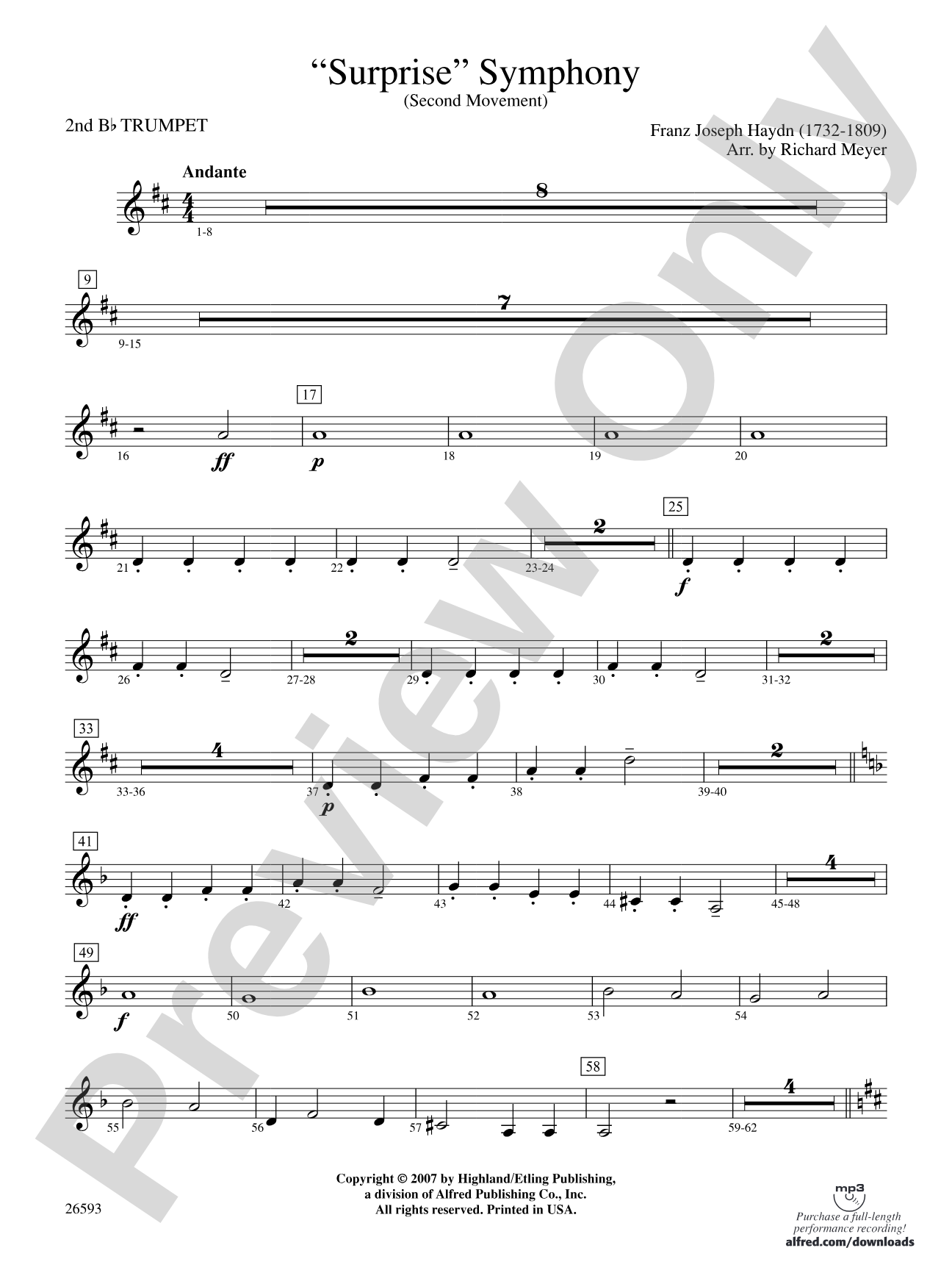
"Surprise" Symphony: 2nd B-flat Trumpet

By Franz Joseph Haydn / arr. Richard Meyer

Grade: 2

Item: 00-PC-0001102_T2

Digital Download
$3.00
Description
A striking new arrangement! Perfect for developing a light classical style and to study Theme and Variations form. Learning opportunities include "terraced-style" dynamics, staccato and tenuto playing, and major/minor tonalities. Everyone plays the melody at sometime during this arrangement. All string parts stay in first position, and wind parts adhere to very practical ranges. This title is available in MakeMusic Cloud.

Don't just read it, hear it, play along with it, and watch your students grow with it. In MakeMusic Cloud, "Surprise" Symphony: 2nd B-flat Trumpet comes alive with professional accompaniment, adjustable tempo, and built-in practice tools that turn solo practice into real progress.

Sample Audio
0:00
0:00
Sample Video
Additional Details
Series: Highland/Etling First Philharmonic
Publisher: Alfred Music
Page Count: 103
SKU: 00-PC-0001102_T2

More about this title

About the Composer: Franz Joseph Haydn

Franz Joseph Haydn (1732-1809) shaped the Classical symphony into its defining form. His prolific output across all genres, his relentless experimentation with orchestral color and structure, and his gift for memorable melodic writing made him the most influential instrumental composer of the late 18th century.

Haydn's willingness to surprise audiences—both in concert halls and at the court of Prince Nikolaus Esterhazy, where he served as Kapellmeister for nearly 30 years—earned him the nickname "Papa Haydn." His symphonies balance structural sophistication with genuine warmth, making them ideal models for students learning how composers organize extended musical forms.

Why we love this

This arrangement delivers authentic Classical writing without sacrificing accessibility. Meyer's orchestration keeps every section engaged and audible while preserving Haydn's distinctive humor and structural clarity, making it an ideal entry point for orchestras ready to study how a masterwork actually works from the inside.

What to expect

Elegant and purposeful, with moments of genuine surprise tucked into its symmetrical phrasing. The music moves with the confidence of a minuet at court but always keeps you slightly off balance, exactly as Haydn intended.

Who it's for

Conductors building a young orchestra's foundation in Classical style will find this arrangement invaluable. String players who need first-position work and wind players seeking practical ranges can grow musically without struggling against the chart.

How to get the most out of it

  • Shape the terraced dynamics as distinct timbral blocks rather than gradual crescendos. Each dynamic level should feel intentional and architectural.
  • Isolate the staccato and tenuto passages in sectional rehearsals to establish ensemble precision. These articulation contrasts are what give Classical style its clarity.
  • Let the melody line find its natural singer, even in the tutti sections. Every part gets its moment; the orchestra should feel that ownership.
  • Use the major/minor key shifts as dramatic anchors during rehearsals. Help students hear them as structural signposts, not accidental changes.

How to use it

Open a concert with this piece when you want to establish ensemble discipline and give audiences a clear listen to what an orchestra can sound like in balance. It also works beautifully as a centerpiece between heavier Romantic repertoire, providing both musical contrast and a study in formal clarity.

Skills your students will build

  • Recognizing and executing terraced dynamics (distinct levels rather than continuous crescendo)
  • Articulation contrast between staccato and tenuto in Classical context
  • Reading major/minor key relationships and harmonic function
  • Ensemble balance and transparency in a tutti texture
  • Theme and Variations form (structure, repetition, development)
  • First-position string playing with musical intentionality
  • Wind doubling in practical ranges within full orchestra texture

You May Also Like