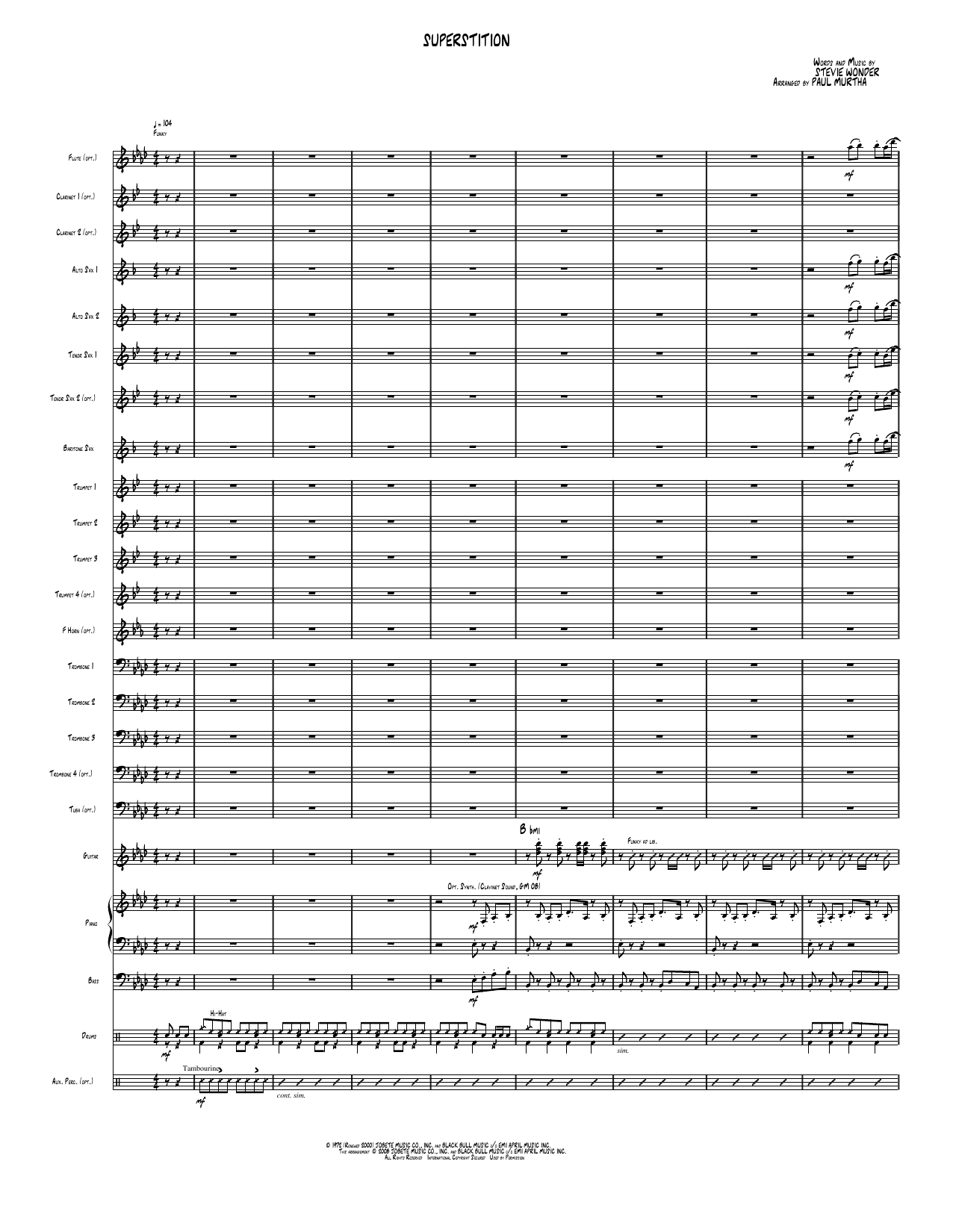
Superstition (arr. Paul Murtha) Sheet Music Preview

Superstition (arr. Paul Murtha): Jazz Ensemble Conductor Score & Parts

By Stevie Wonder / Arranged by Paul Murtha

Grade: 2

Item: 35-PK00426988

Digital Download
$40.00

Buy Extra Parts (Digital PDF Download)

Product Price Quantity
Superstition - Full Score $40.00

Parts Added to Cart!

Description
Superstition

Superstition (arr. Paul Murtha): Jazz Ensemble Conductor Score & Parts isn't in MakeMusic Cloud just yet...but it could be. Let us know you'd like to see it, and you'll help shape what comes next. In the meantime, start a free trial and dive into thousands of interactive titles your students can play along with today.

Sample Audio
No sample audio found.
Sample Video
Additional Details
Publisher: Hal Leonard
SKU: 35-PK00426988

More about this title

About the Composer: Stevie Wonder

Stevie Wonder stands as one of the most influential musicians of the past fifty years, a keyboardist and songwriter whose harmonic sophistication and rhythmic sensibility shaped contemporary music across multiple genres. His work demonstrates how deep musicality and accessible melody can coexist, making his compositions valuable teaching tools for students exploring funk grooves, jazz voicings, and the interplay between structured arrangement and expressive performance.

Wonder's prolific output includes countless standards that have become jazz repertoire staples. His ability to craft memorable hooks within complex harmonic contexts gives student musicians concrete examples of how to balance commercial appeal with musical substance, a lesson that translates directly to the concert hall and the jazz ensemble classroom.

Why we love this

Paul Murtha's arrangement captures the infectious groove and harmonic character of Superstition while keeping the ensemble writing accessible for Grade 2 players. Your students will engage immediately with a tune they likely already know, which means they can focus on locking into the funk feel, responding to sectional cues, and understanding how arrangement serves the song rather than overshadowing it.

What to expect

The arrangement sits in that sweet spot where funk and jazz meet. Minor key sensibility, persistent groove, and enough harmonic movement to keep ears interested without overwhelming players who are still building their jazz vocabulary. The feel is propulsive and modern, yet the tune has enough structural clarity that even younger players can hear the form unfold.

Who it's for

Jazz ensembles at the middle school or early high school level, or non-traditional jazz programs where students have strong reading skills but limited small-group experience. Directors looking to build ensemble cohesion with a song that generates natural enthusiasm and rewards precise rhythmic execution.

How to get the most out of it

  • Establish the groove pocket first in rehearsal before layering articulation. Have the rhythm section play alone until the pulse feels inevitable, then add ensemble parts one section at a time.
  • Pay attention to the hi-hat and snare backbeat as your primary timekeeping reference. The piano and bass should lock into that grid rather than trying to lead it.
  • Emphasize the space between notes rather than rushing through passages. Funk is about the silence as much as the sound; students often fill gaps that should breathe.
  • Record a rehearsal and listen back to check that the melodic lines sit on top of the groove rather than fighting against it. Tighter rhythm sections make student soloists sound better immediately.

How to use it

Program this as an opener on a jazz concert where you want immediate energy and audience connection, or use it as a midseason confidence builder for ensembles still developing their swing vocabulary. The accessibility makes it ideal for demonstrations at recruiting events or jazz festivals where you need a piece that sounds polished quickly.

Skills your students will build

  • Locking into a funk groove and understanding the relationship between written rhythm and pocket feel
  • Reading and executing syncopated rhythms in a pop idiom
  • Responding to sectional cues and ensemble balance in a non-traditional jazz context
  • Distinguishing between straight eighths and swing eighths through listening and adjustment
  • Building ensemble cohesion through repetitive groove figures

You May Also Like