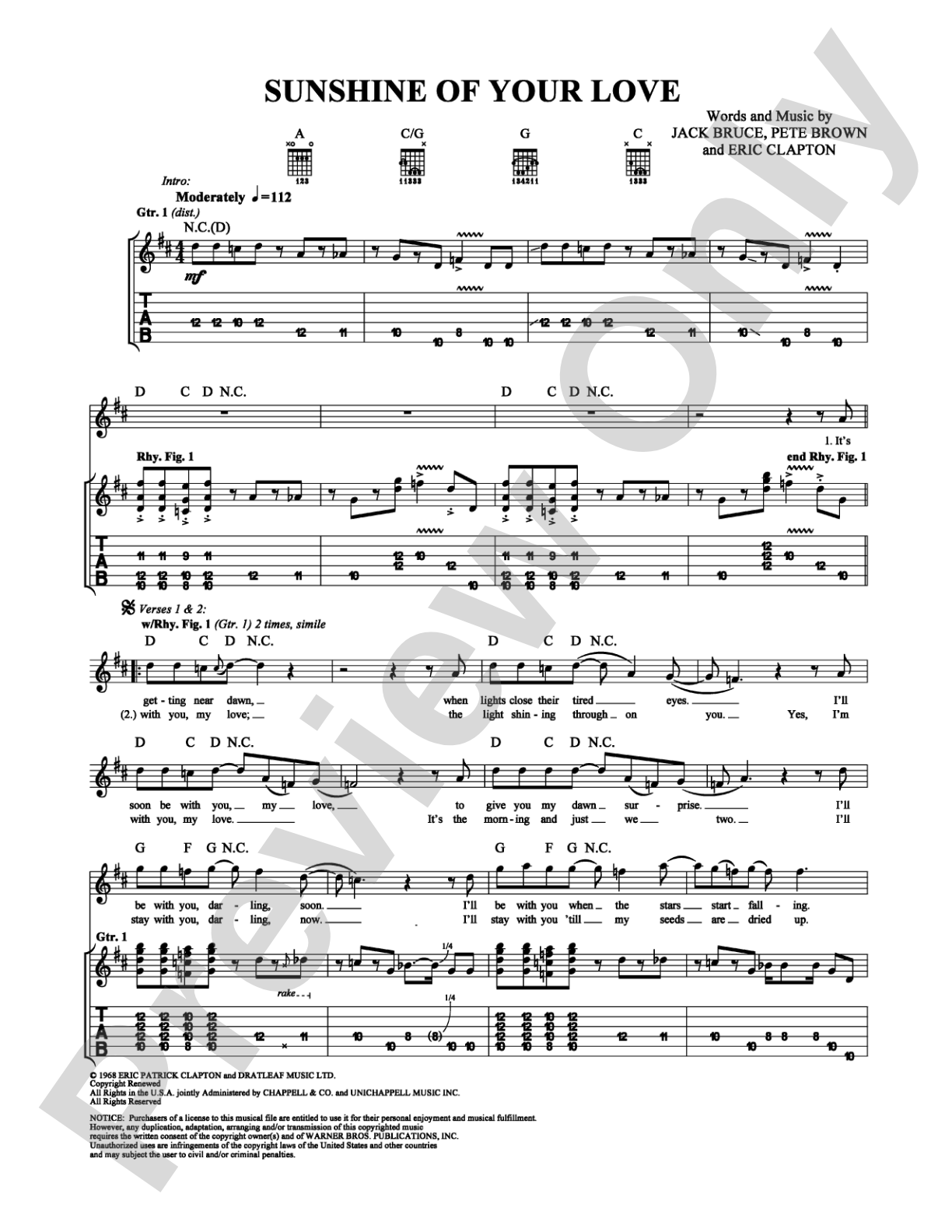
Sunshine of Your Love: Guitar TAB Digital Sheet Music

Sunshine of Your Love: Guitar TAB Digital Sheet Music

Pete Brown, Eric Clapton, Jack Bruce, Cream

Item: 00-PS-0003478

Digital Download
$2.99
Description

Sunshine of Your Love: Guitar TAB Digital Sheet Music isn't in MakeMusic Cloud just yet...but it could be. Let us know you'd like to see it, and you'll help shape what comes next. In the meantime, start a free trial and dive into thousands of interactive titles your students can play along with today.

Sample Audio
No sample audio found.
Sample Video
Additional Details
SKU: 00-PS-0003478

More about this title

About the Artist: Cream

Cream emerged from the London blues scene in 1966 as rock music's first supergroup, bringing together Jack Bruce (bass, vocals), Ginger Baker (drums), and Eric Clapton (guitar). The trio pioneered heavy blues rock and extended improvisational arrangements that influenced generations of rock musicians. Their brief four-year run produced some of the most enduring guitar-driven rock compositions ever recorded, with Clapton's expressive playing and the band's rhythmic intensity becoming touchstones for rock education and performance.

Released in 1968 on the album Wheels of Fire, "Sunshine of Your Love" became one of Cream's signature pieces and a staple of rock guitar instruction. The track showcases Clapton's melodic sensibility within a blues-rock framework, making it a natural choice for students exploring classic rock repertoire and developing their lead guitar voice.

Why we love this

This track sits at the sweet spot between accessibility and authentic musicianship. Students encounter real rock guitar idioms—phrasing, dynamics, and rhythmic feel—without drowning in technical overload. The iconic riff and vocal melody are instantly recognizable, which motivates learners while the underlying blues changes and chord-driven arrangement offer room to grow.

What to expect

The song pulses with confident, blues-soaked groove. The riff has swagger and forward momentum, propelled by a rock-solid rhythm section underneath Clapton's unhurried, conversational guitar voice. There's warmth in the harmonic color and maturity in the restraint—this is rock music that relies on feel and phrasing rather than showing off.

Who it's for

This TAB is ideal for intermediate electric guitar students ready to tackle real rock classics with clear notation. Players familiar with basic chord progressions and single-note lines will find this engaging without becoming discouraging. Guitar teachers use this piece frequently as a bridge between simplified arrangements and full-band contexts.

How to get the most out of it

  • Lock into the groove with precision on the main riff; the pocket matters more than speed. Focus on even rhythmic spacing and let the syncopation breathe rather than rushing.
  • Pay attention to Clapton's phrasing around the vocal melody. Notes land slightly behind the beat in places, creating that classic blues-rock feel. Copying the exact timing makes the difference between playing the notes and playing the song.
  • Work the dynamic contrast between verse and chorus sections. The main riff sits lower in register and texture, while solos can open up higher on the fretboard. This range shift keeps the arrangement fresh.
  • Use the chord progression as your anchor during lead passages. Understanding the underlying changes (mostly D major based) helps you craft melodic choices that land on strong harmonic moments rather than fighting the changes.

How to use it

Program this as a showcase piece in a rock guitar recital or ensemble performance, pairing it with other 1960s-70s classics to frame an era. The piece also works perfectly as a solo feature in a mixed-ensemble concert, allowing a guitarist to step forward while keeping the arrangement simple enough for a rhythm section to support live. In a classroom context, use it as a repertoire anchor when teaching blues changes and rock phrasing fundamentals.

Skills your students will build

  • Reading guitar TAB notation and coordinating it with standard notation
  • Understanding 12-bar blues changes and their application in rock contexts
  • Developing rhythmic phrasing and behind-the-beat articulation typical of blues-rock style
  • Single-note melodic soloing over chord changes
  • Balancing dynamics and tone control across different sections of a song

You May Also Like