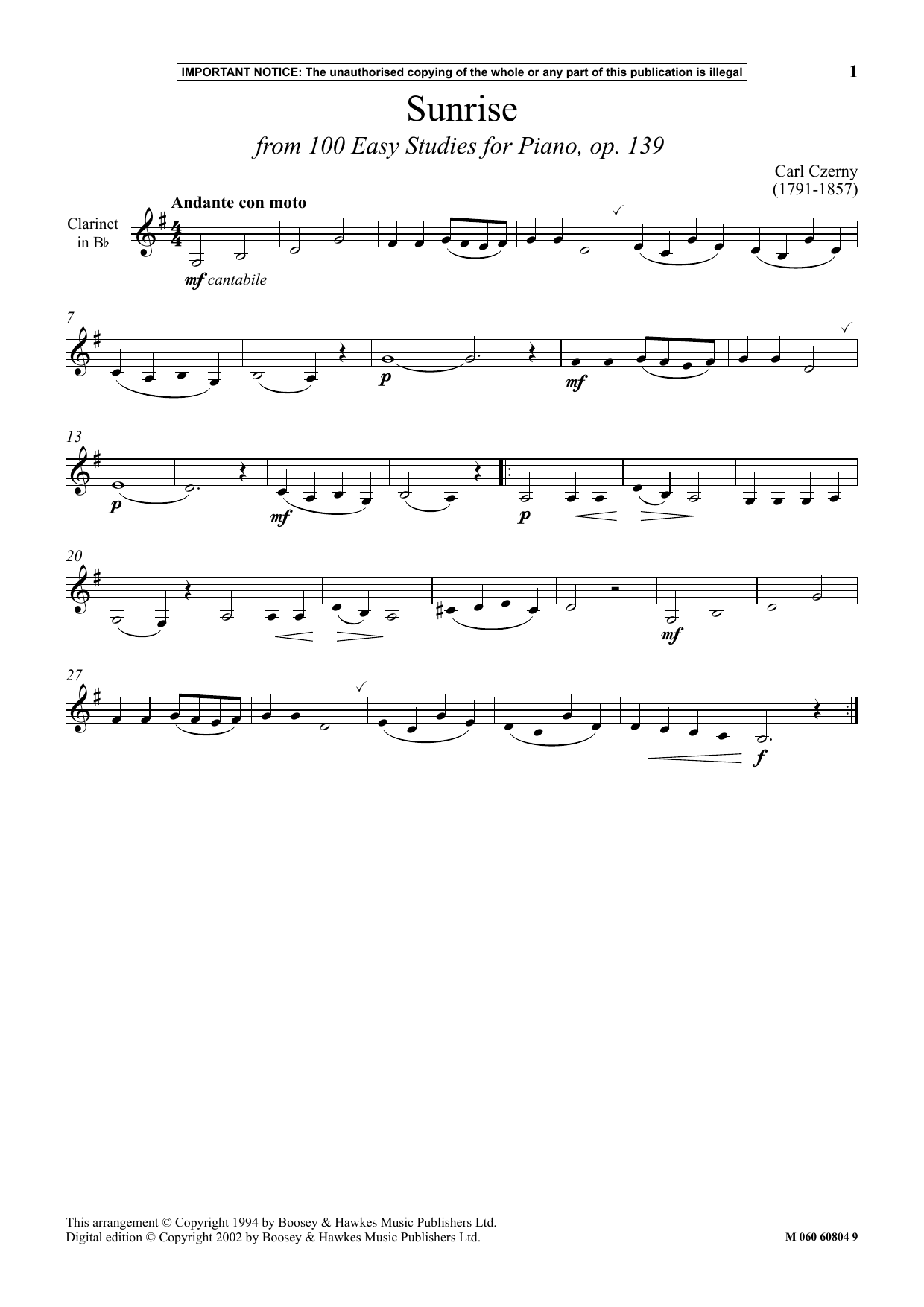
Sunrise (from 100 Easy Studies For Piano, Op. 139) Sheet Music Preview

Sunrise (from 100 Easy Studies For Piano, Op. 139): Instrumental Solo

As performed by Carl Czerny

Item: 35-DS00239122

Digital Download
$3.99
One moment…
Description

Discover MakeMusic Cloud: thousands of interactive titles your students can play along with today.

Sample Audio
No sample audio found.
Sample Video
Additional Details
Publisher: Hal Leonard
Page Count: 3
SKU: 35-DS00239122

More about this title

About the Artist: Carl Czerny

Carl Czerny (1791–1857) was an Austrian pianist, composer, and pedagogue whose prolific output shaped how generations of students learned the instrument. His etudes and studies remain foundational to piano technique because he understood exactly what the hand needs to practice at each developmental stage. Beyond his technical mastery, Czerny had an ear for melody that kept even the simplest exercises musical and engaging.

Czerny's Op. 139 collection represents his mature approach to early-level repertoire. Written late in his career, these studies balance the practical demands of technique building with genuine musical satisfaction. Teachers value them because students actually want to play them, not just endure them.

Why we love this

Sunrise captures what makes Czerny's pedagogical writing so enduring: a piece that teaches real musicianship while the student is focused on mastering the mechanics. The three-page length is substantial enough to feel like genuine repertoire, not a throwaway exercise. It deserves a spot in early recitals where students need something that sounds both polished and achievable.

What to expect

Sunrise unfolds with quiet majesty, invoking the gradual brightening of dawn through gentle figure work and rising melodic contours. The piece balances lyrical passages with passages that reward clean, articulate fingerwork, creating a sense of calm momentum rather than struggle. There's an inherent optimism in the writing, a feeling of gentle ascent that makes students feel they are making real musical statements.

Who it's for

Students in the early intermediate stages who have solid finger independence and are ready to sustain musical phrasing across longer phrases. This works equally well for repertoire building or as a technical study that keeps musicality at the forefront. It fits naturally into the learning arc between basic technique exercises and more ambitious classical repertoire.

How to get the most out of it

  • Listen for the way the melodic shape rises and falls. Let the phrasing breathe naturally rather than treating each measure as an isolated technical challenge.
  • Keep the hand position stable through the technical passages so that finger work remains precise without tension creeping into the wrist or forearm.
  • Experiment with subtle dynamic shaping to bring out the title's imagery. A gradual crescendo through the first section, then a softer receding in the middle, helps the piece tell its story.

How to use it

Feature this as a solo work on a student recital or informal concert where you want to showcase musicianship alongside technical growth. It also pairs well in a thematic program exploring nature or descriptive music, serving as an accessible counterpart to more advanced character pieces. Consider it for spring or end-of-year performances where lighter, sunrise-adjacent programming feels seasonally appropriate.

Skills your students will build

  • Sustaining melodic line while managing accompanying figurations
  • Finger independence and articulation in scalar and broken-chord passages
  • Phrasing and dynamic shaping across longer musical spans
  • Pedaling coordination (if the student is ready to add it)
  • Sight-reading fluency in early intermediate repertoire

You May Also Like