
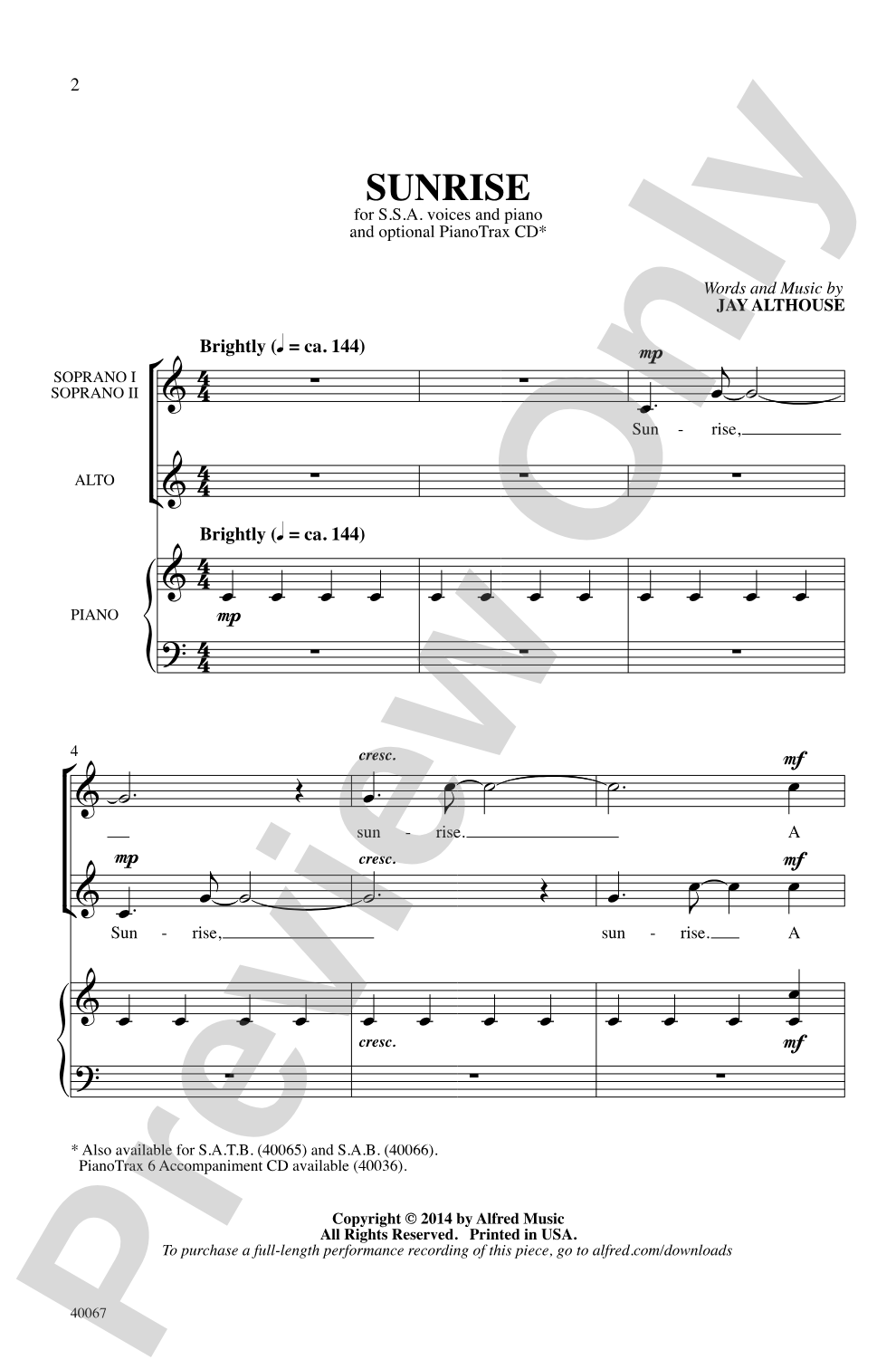

Sunrise: SSA Choral Octavo
Words and music by Jay Althouse
Item: 00-PO-0001779
$1.85
Minimum order quantity: 20 copies
Pickup currently not available
Description
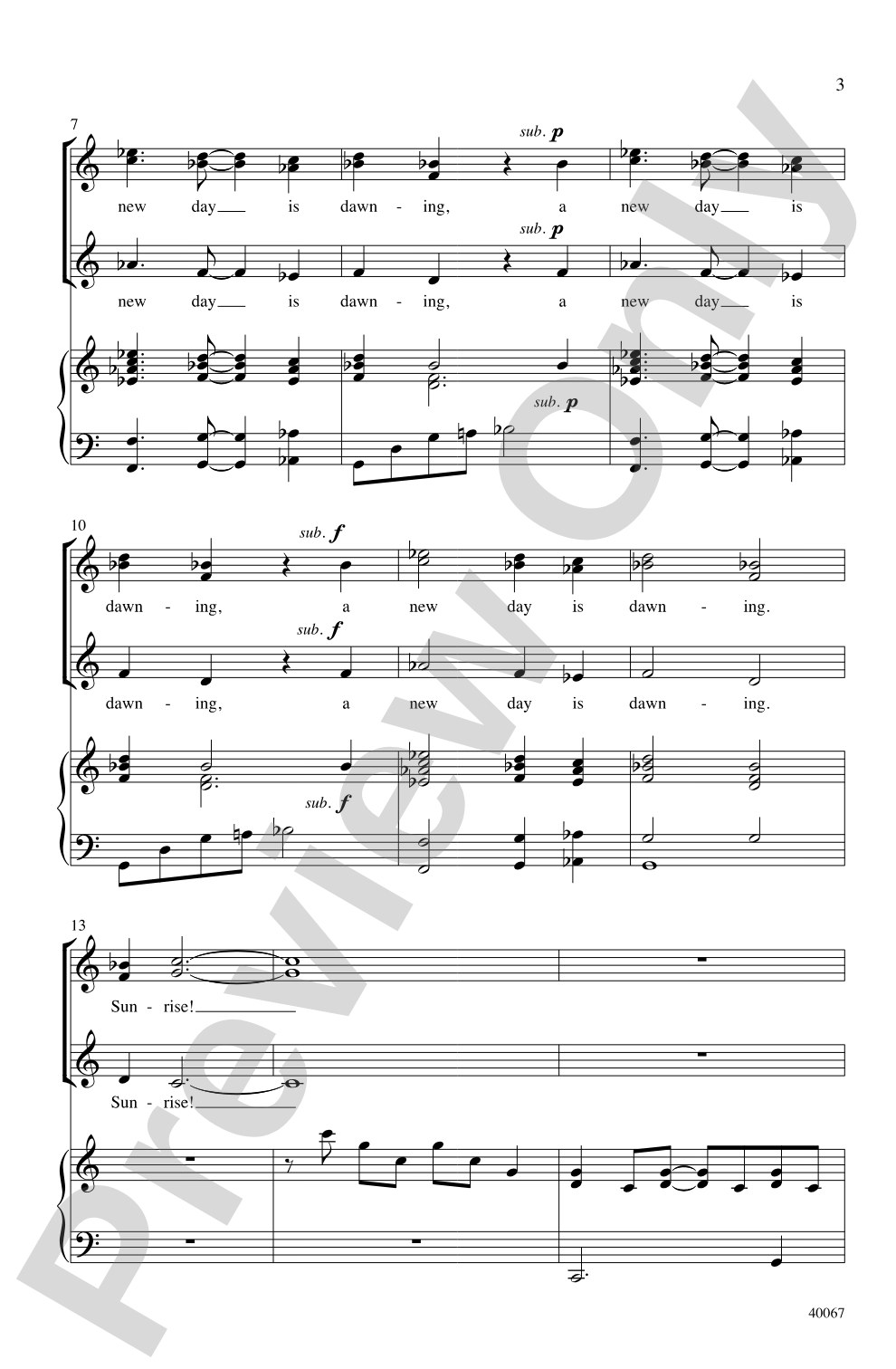
Jay's poetic text is a rhapsodic ode to the dawning of a day. Bright chords and vibrant syncopations depict the rising of the sun. This outstanding concert work will easily come together to make your group shine.


Sunrise: SSA Choral Octavo isn't in MakeMusic Cloud just yet...but it could be. Let us know you'd like to see it, and you'll help shape what comes next. In the meantime, start a free trial and dive into thousands of interactive titles your students can play along with today.
Request This Title
Tell us you want it.
Start Your Free Trial
Explore everything that's ready to play right now.
Sample Audio
1
Audio File
--:--
0:00
0:00
Sample Video
No sample videos found.
Additional Details
Series:
Alfred Choral Designs
Publisher:
Alfred Music
Page Count:
12
SKU:
00-PO-0001779
More about this title
About the Composer: Jay Althouse

Jay Althouse holds degrees in Music Education and Music from Indiana University of Pennsylvania, where he was later honored with the Distinguished Alumni award. His eight-year tenure as a rights and licenses administrator at a major educational music publisher gave him deep insight into the needs of choral programs, and he served on the Executive Board of the Music Publishers Association of America during that period.
With over 800 choral compositions in print, Althouse has become a prolific voice in choral music for ensembles at every level. His works receive consistent performance across English-speaking countries, and he maintains membership in ASCAP as a writer, regularly earning the organization's Special Award for compositions. Beyond composing, he has co-created children's musicals with Sally K. Albrecht, curated respected vocal solo collections, co-authored widely used classroom resources like The Complete Choral Warm-up Book and Accent on Composers, and contributed to major civic moments including the 2009 presidential inauguration. He resides in Wake Forest, North Carolina, and serves on the National Advisory Board of the Folk Art Society of America.
Why we love this
Althouse's gift for setting words to music shines here; the text itself invites emotional investment, and the syncopations and bright harmonic language feel fresh without demanding excessive rehearsal time. This is concert-ready material that your singers will enjoy performing, and the piece has a genuine quality that prevents it from ever feeling manufactured or thin.
What to expect
Warmth and energy radiate from the opening moments as the harmony builds toward something luminous. The syncopations suggest movement and awakening without ever feeling frantic, creating a sense of gradual unfolding that mirrors its subject perfectly.
Who it's for
This octavo works beautifully for treble choirs at the intermediate to advanced level who want a substantial concert piece that balances accessibility with musical substance. Programs seeking repertoire that feels contemporary in spirit without alienating conservative audiences will find strong material here.
How to get the most out of it
- Shape the text as poetry first. The 'rhapsodic ode' quality depends on phrase continuity and dynamic sensitivity rather than rhythmic precision alone.
- Balance the syncopations so they enliven rather than muddy the harmonic clarity. Light articulation on rhythmic figures keeps the energy moving without heaviness.
- Use the bright chords to their fullest; encourage tall vowels on the highest moments to let the registral effect land naturally.
- Mark and rehearse the transition points where texture shifts. Smooth ensemble understanding of these moments prevents them from feeling abrupt.
How to use it
Program this as a spring or end-of-year concert highlight, or position it alongside sacred dawn or morning-themed repertoire for thematic programming. The piece also works well in festival or competition settings where its combination of musicality and technical accessibility plays to judges' expectations.
Skills your students will build
- Reading syncopated rhythms in treble voicing
- Sustaining harmonic color across phrase lines
- Balancing individual voice parts in SSA texture
- Interpreting poetic text through dynamic and tonal shaping