
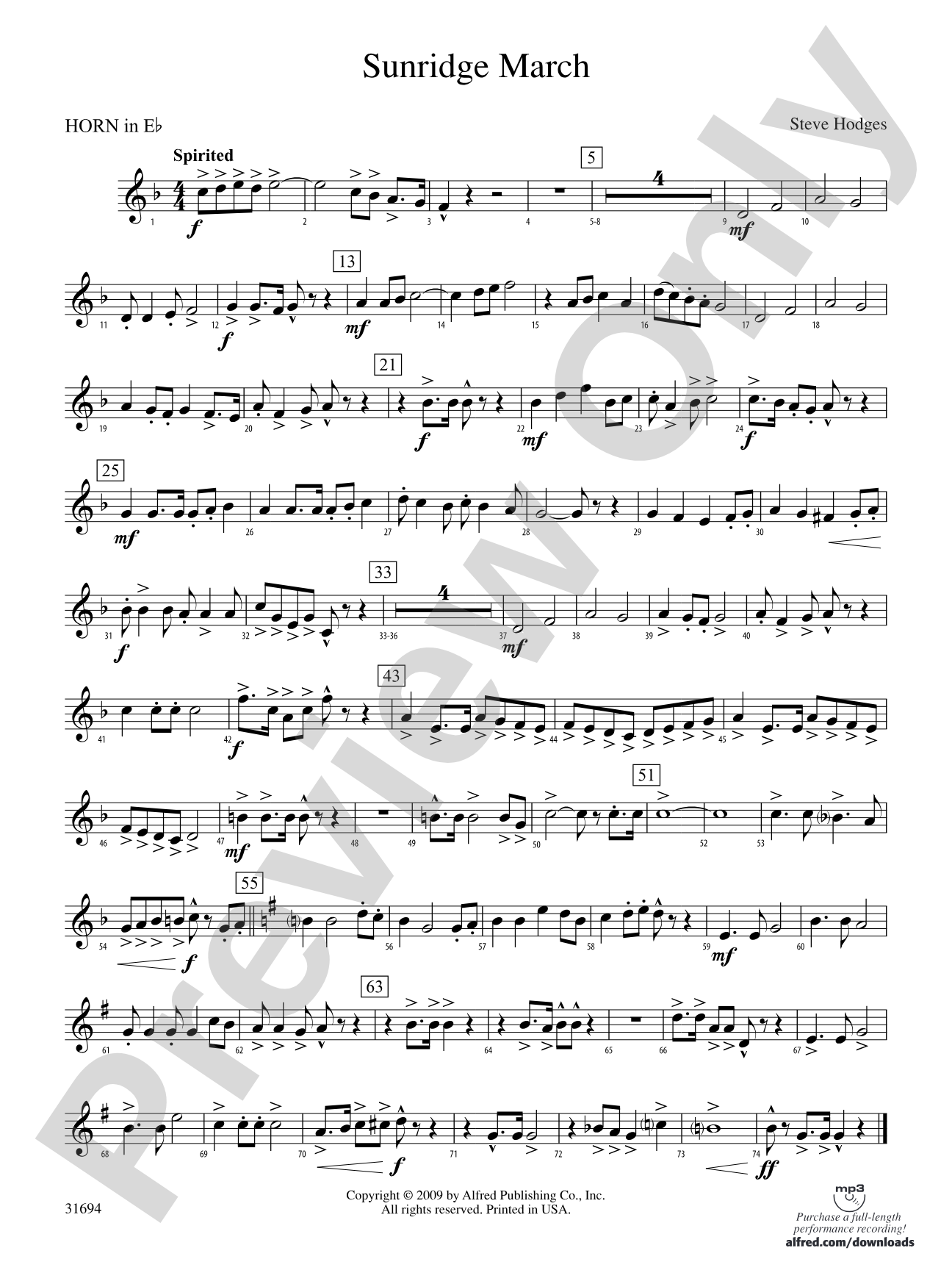

Sunridge March: (wp) 1st Horn in E-flat
By Steve Hodges
Grade: 1.5 (Easy)
Item: 00-PC-0001795_wpEH1
$3.00
Pickup currently not available
Description
Sunridge March is a spirited concert march that provides an energetic opening to any concert or festival. Each section of the band participates in the upbeat melodies and countermelodies with the percussion section, providing a solid rhythmic foundation. An effective modulation from A-flat to B-flat sets the piece up for a dynamic and exciting conclusion.


Don't just read it, hear it, play along with it, and watch your students grow with it. In MakeMusic Cloud, Sunridge March: (wp) 1st Horn in E-flat comes alive with professional accompaniment, adjustable tempo, and built-in practice tools that turn solo practice into real progress.
Open in the Player
Jump straight in and assign it today.
Start Your Free Trial
Open this title and explore the full library in minutes.
Sample Audio
1
Audio File
--:--
0:00
0:00
Sample Video
No sample videos found.
Additional Details
Series:
Challenger Band Series
Publisher:
Alfred Music
Page Count:
124
SKU:
00-PC-0001795_wpEH1
More about this title
About the Composer: Steve Hodges

Steve Hodges holds degrees from Western Oregon University (Bachelor of Science) and Central Washington University (Master of Music Education). He spent four decades as a public school band and choir director before retiring, during which time he developed a keen sense of what works in ensemble settings across all ability levels.
Since 1986, Hodges has composed over 120 concert band works published by Alfred Music, alongside choral arrangements with Staff Music and Shawnee Press. His compositions have appeared at festivals and state music conventions worldwide, and he has received commissions from honor bands and schools across North America. His music has also been licensed by major cable networks including TBS and ESPN. Hodges is an ASCAP member and continues to engage with community music in The Dalles, Oregon.
Why we love this
Hodges understands what Grade 1.5 bands can actually execute, and this march proves it. The piece moves your ensemble forward with clear melodic writing that keeps all sections engaged without overwhelming beginners, yet the modulation from A-flat to B-flat gives you a genuine harmonic moment that feels like real compositional architecture. It's the kind of opener that launches a concert with confidence rather than apology.
What to expect
Sunridge March radiates the optimism and forward momentum of classic American march writing. Bright, energetic melodies cascade through the band with a sense of purpose, underpinned by a rock-solid rhythmic foundation that makes the percussion section feel like the heartbeat driving everything forward. The modulation in the final section opens into a brighter harmonic territory that feels both triumphant and genuinely exciting.
Who it's for
This march sits comfortably in the hands of Grade 1.5 ensembles that are ready to move beyond simple fanfares into genuine concert literature. Directors building a program that needs a strong, accessible opening will find all parts equally playable, which means you can start your concert with the entire band fully contributing rather than resting anyone.
How to get the most out of it
- Establish a crisp, marchlike pulse from the downbeat. The percussion foundation matters here, so lock your snare and bass drum articulation early in rehearsal.
- Balance the melodic voices between woodwinds and brass. Neither section should overwhelm the other during the countermelody passages.
- Prepare the modulation by gradually building intensity through the section that precedes it. The shift from A-flat to B-flat should feel earned, not sudden.
- Let the final section breathe slightly. After the key change, resist the urge to rush. The dynamic conclusion works best when it has room to build.
How to use it
Open a concert or festival appearance with this piece. Its accessibility and spirited character set an ideal tone for an audience arrival, and the seven-minute arc gives your ensemble a chance to settle into their first major work before moving into your signature repertoire. It also programs well as a companion to more substantial Grade 2 works, demonstrating your band's breadth.
Skills your students will build
- Balanced ensemble blend across woodwind and brass sections
- Maintaining steady rhythmic pulse in march style
- Reading and executing countermelodies against primary melodies
- Understanding and executing key modulations
- Dynamic control from opening through climactic sections