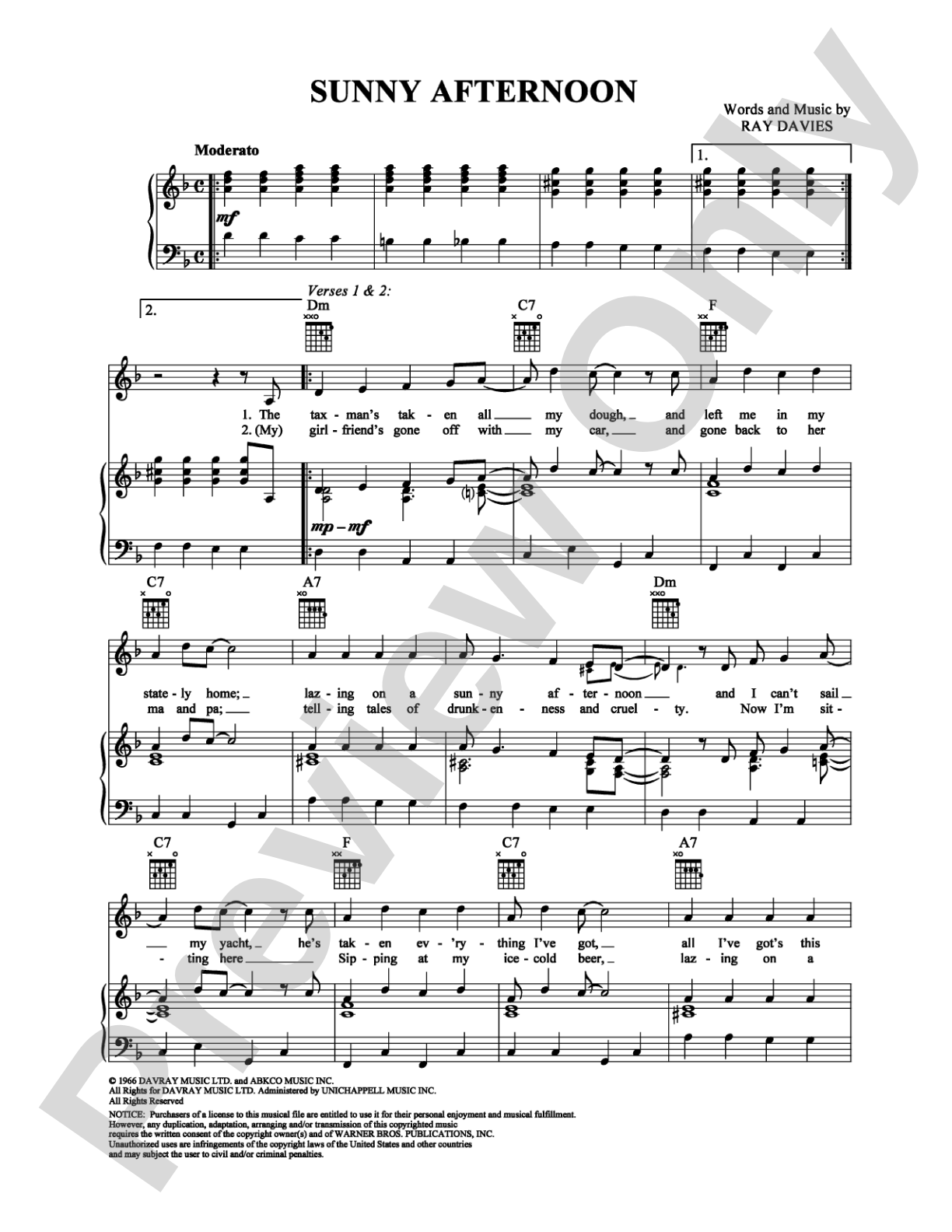
Sunny Afternoon: Piano/Vocal/Chords Digital Sheet Music

Sunny Afternoon: Piano/Vocal/Chords Digital Sheet Music

The Kinks, Ray Davies

Item: 00-PS-0007759

Digital Download
$3.99
Description

Sunny Afternoon: Piano/Vocal/Chords Digital Sheet Music isn't in MakeMusic Cloud just yet...but it could be. Let us know you'd like to see it, and you'll help shape what comes next. In the meantime, start a free trial and dive into thousands of interactive titles your students can play along with today.

Sample Audio
No sample audio found.
Sample Video
Additional Details
SKU: 00-PS-0007759

More about this title

About the Artist: The Kinks

The Kinks emerged from London in the early 1960s as pioneers of the British Invasion, with brothers Ray and Dave Davies at the creative center. Their approach to songwriting combined accessible melodies with sharp social observation, influencing generations of rock musicians and songwriters. The band's catalog spans decades and includes some of popular music's most enduring compositions, many of which have become standards in music education and performance.

Why we love this

This 1966 track sits perfectly at the intersection of sophistication and accessibility. The chord progression invites harmonic exploration without overwhelming students, and the memorable melody makes it engaging for young musicians developing their interpretation skills across both instrumental and vocal contexts.

What to expect

Effortless sophistication. The song unfolds with the ease of a lazy afternoon, balancing wry observation with genuine warmth. There's lightness in the melody and craft beneath the surface—nothing complicated, but nothing accidental either.

Who it's for

Pianists and singers working at the intermediate level who want to perform music rooted in rock history but written with strong harmonic and melodic foundations. Teachers seeking repertoire that bridges classical technique and popular music appeal will find this especially useful for singers developing interpretation and for pianists building accompaniment skills.

How to get the most out of it

  • Anchor the groove with a steady rhythmic pocket in the left hand; the piece's appeal depends on forward motion, not rushing or dragging the tempo.
  • Shape the vocal line with conversational phrasing rather than operatic sustain. The lyrics drive the song's narrative, and clarity of text matters as much as note accuracy.
  • Balance the piano texture so chord voicings support rather than overshadow the melody. This is accompaniment work, not a concerto showcase.
  • Experiment with the rhythmic feel on the accompaniment figure; slight swing or a loose jazz interpretation can reveal different dimensions of the arrangement.

How to use it

This works beautifully in recitals focused on twentieth-century popular song or rock composition. Pair it with other singer-songwriter material from the era, or program it as a bridge between classical and contemporary styles. It's also an excellent study piece for piano students learning to accompany singers and understanding the relationship between chord voicing and vocal line.

Skills your students will build

  • Reading and interpreting piano/vocal/chord notation
  • Accompanying a vocal line with sensitive harmonic support
  • Shaping vocal phrasing with text-driven interpretation
  • Understanding groove and rhythmic consistency in popular music contexts
  • Analyzing song form and harmonic structure in rock composition

You May Also Like