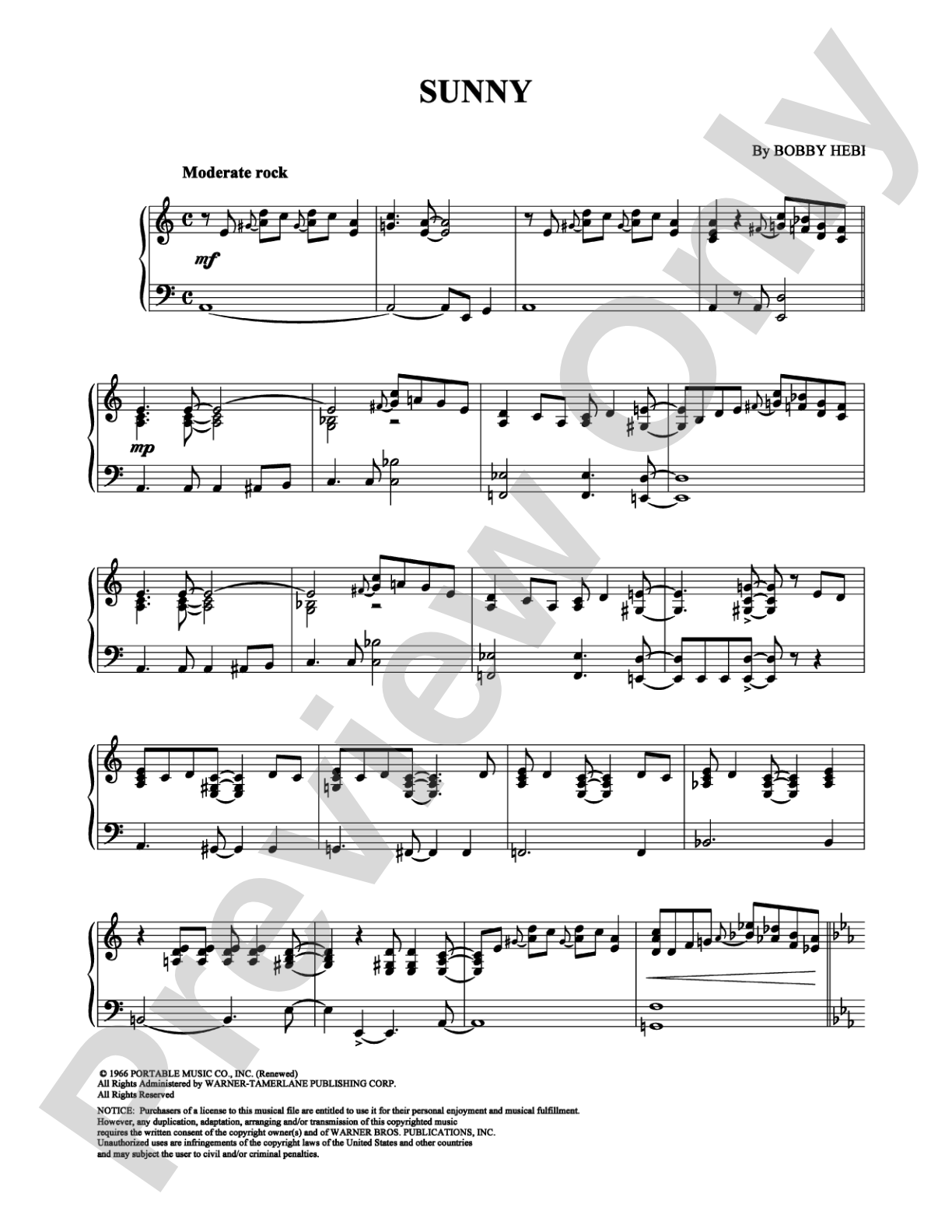
Sunny: Piano Digital Sheet Music

Sunny: Piano Digital Sheet Music

Bobby Hebb

Item: 00-PS-0007808

Digital Download
$2.95
Description

Sunny: Piano Digital Sheet Music isn't in MakeMusic Cloud just yet...but it could be. Let us know you'd like to see it, and you'll help shape what comes next. In the meantime, start a free trial and dive into thousands of interactive titles your students can play along with today.

Sample Audio
No sample audio found.
Sample Video
Additional Details
SKU: 00-PS-0007808

More about this title

About the Artist: Bobby Hebb

Bobby Hebb composed "Sunny" in 1966, crafting one of the most enduring and universally beloved standards of the modern jazz era. The song's immediate success came from its irresistible melodic simplicity paired with sophisticated harmonic movement, making it equally at home in jazz clubs, pop radio, and concert halls.

Hebb's gift lay in writing melodies that sound effortless yet withstand endless reinterpretation. "Sunny" has been recorded hundreds of times across genres and languages, from Herb Alpert to Etta James to countless jazz pianists, each finding something fresh in its deceptively straightforward structure.

Why we love this

This standard lands squarely in the sweet spot between accessibility and substance. The melody is immediately singable and memorable, yet the harmonic changes reward close listening and offer genuine challenge for pianists learning jazz voicings and comping. It's the kind of tune that sounds simple until you sit down to learn it.

What to expect

Warm, approachable, and gently optimistic. The melody has an almost naive charm that belies the harmonic intelligence underneath; playing it feels like having a conversation with someone genuinely friendly. There's lightness in the touch, a sense of ease and openness that invites the listener in rather than dazzles them.

Who it's for

Jazz pianists developing their standards repertoire, classical pianists expanding into jazz idioms, and students learning functional harmony through real tunes rather than abstract exercises. It's equally valuable for students just discovering jazz piano and experienced performers seeking a dependable recital vehicle.

How to get the most out of it

  • Listen to multiple recorded versions before settling on your interpretation. The tune's strength is its adaptability; comparing approaches by Bill Evans, Herbie Hancock, and others reveals how much personality you can bring without losing the song's essential character.
  • Pay attention to the rhythmic feel of the melody. The phrasing sits just slightly behind the beat in many classic recordings, giving it a relaxed, conversational quality that straight rhythmic playing can undercut.
  • Explore the chord extensions and reharmonization possibilities. Once you've mastered the changes as written, try substituting altered dominants, secondary ii-V progressions, or upper structure triads to deepen harmonic awareness.
  • Balance transparency with fullness in your voicings. This tune works beautifully with relatively sparse, clear comping; avoid the temptation to over-voice every change.

How to use it

Feature this in a jazz standards recital or mixed concert where you want to bridge classical and jazz audiences. It pairs naturally with other mid-century standards, works as an intermission piece or concert opener, and provides the perfect vehicle for demonstrating solo piano improvisation over a known harmonic structure.

Skills your students will build

  • Reading and performing jazz harmony, including chord substitutions and extensions
  • Comping and accompaniment patterns idiomatic to jazz piano
  • Melody phrasing and rhythmic placement relative to the beat
  • Jazz reharmonization and improvisation over a fixed harmonic progression
  • Listening to and learning from recorded interpretations of the same tune

You May Also Like