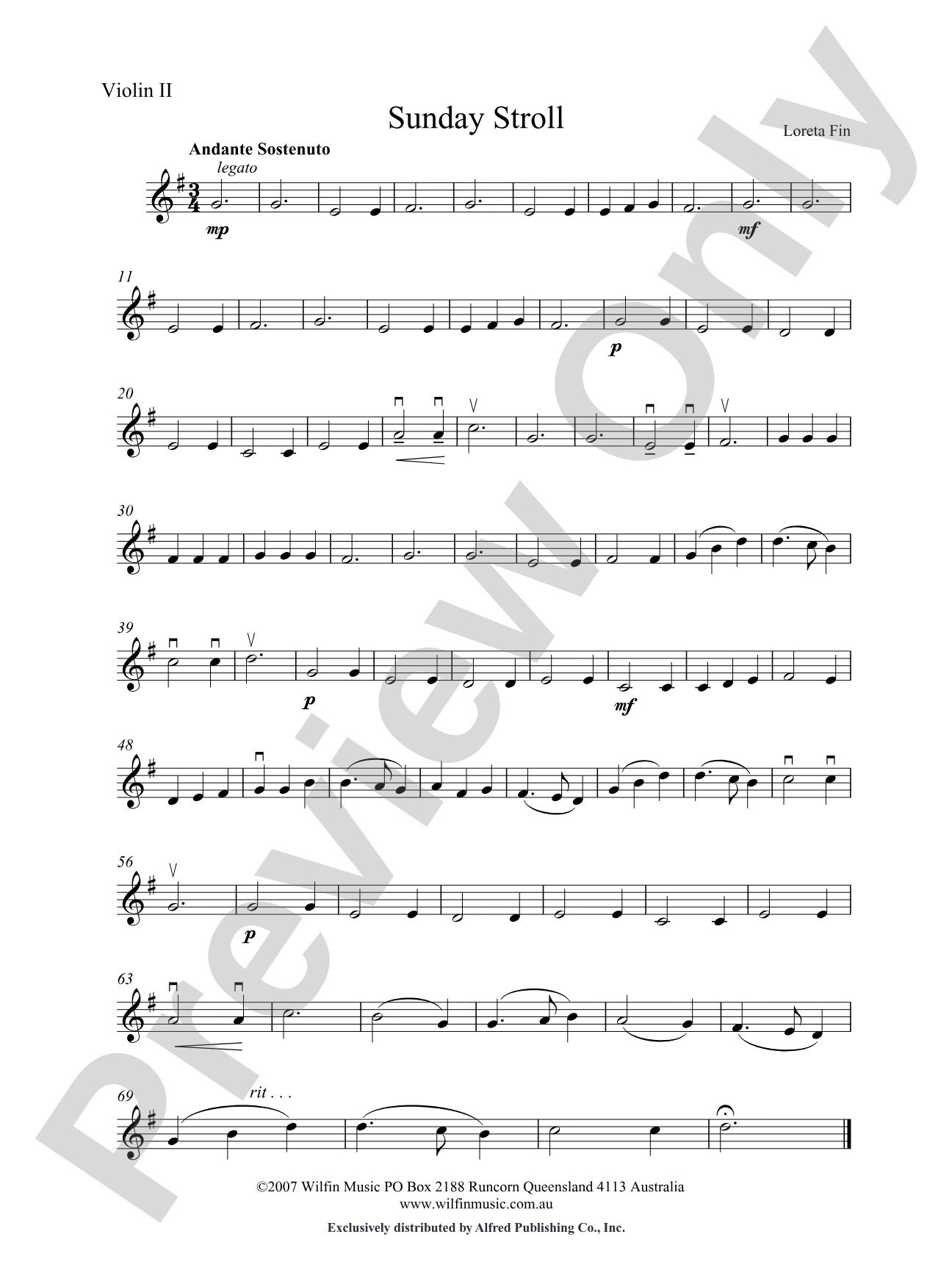
Sunday Stroll: 2nd Violin Sheet Music Preview

Sunday Stroll: 2nd Violin

By Loreta Fin

Grade: 1.5

Item: 76-PC-0000040_VN2

Digital Download
$5.99
Description
This piece features pretty melodies, using slurs and dotted rhythms, while teaching bow division between half notes and quarter notes. The music is not difficult, but students should be encouraged to work on developing a beautiful full sound.

Sunday Stroll: 2nd Violin isn't in MakeMusic Cloud just yet...but it could be. Let us know you'd like to see it, and you'll help shape what comes next. In the meantime, start a free trial and dive into thousands of interactive titles your students can play along with today.

Sample Audio
No sample audio found.
Sample Video
Additional Details
Series: Wilfin String Orchestra: Young String Ensemble Series
Publisher: Wilfin Music
Page Count: 66
SKU: 76-PC-0000040_VN2

More about this title

About the Composer: Loreta Fin

Loreta Fin

Loreta Fin is an Australian violist and string educator whose career spans performance, teaching, and composition. A graduate of the Sydney Conservatorium of Music, she performed as concertmaster with the Sydney Youth Orchestra and has maintained a professional chamber and orchestral career while serving as Principal Viola with the Queensland Pops Orchestra for over 25 years. She has performed alongside world-class artists across multiple continents.

Since 1993, Fin has directed the strings program at Somerville House School in Brisbane, earning recognition as a mentor and adjudicator at national and international conferences. Her compositional output includes over 100 works for string ensembles published worldwide. She served the Australian Strings Association for 25 years, including terms as State and National President, and received the National Award for Services to Music and String Teaching in Australia. Fin currently serves as State Advisor for Strings and regularly conducts the State and National Honours Ensembles Programs in Brisbane.

Why we love this

Fin understands the learning curve of young string players intimately, and it shows in every bar. The melodic writing is genuinely appealing rather than pedagogically dutiful, which means your students will want to play it well instead of simply playing through it. The bow technique demands are perfectly calibrated to challenge developing technique without overwhelming beginning players.

What to expect

A leisurely walk through a pleasant landscape: unhurried, graceful, with moments of gentle articulation that keep the ear engaged. The music breathes naturally, shaped by lyrical lines that invite expressive playing while remaining technically straightforward.

Who it's for

This score is designed for young string orchestras at the 1.5 grade level, where players have foundational bow control but are still refining tone quality and rhythmic precision. Conductors working with intermediate-beginning ensembles will find it accessible enough to teach fundamental concepts without oversimplifying the musical content.

How to get the most out of it

  • Encourage singers to listen for legato phrasing through the slurs rather than thinking of them as technical hurdles. Smooth tone connection makes the melody shine.
  • Subdivide the dotted rhythm exercises in rehearsal first without bows. Once the figure is secure, connect it to bow movement so students understand the rhythmic shape before executing it with the arm.
  • Work the bow division transitions between half notes and quarter notes separately. Have the ensemble hold steady bow speed through the half note, then accelerate slightly into the quarter-note figures to maintain evenness.

How to use it

Program this early in a concert to establish an accessible, confident tone for your audience while showcasing emerging musicianship. It also works well as a teaching piece at a chamber music festival or as a balance to more technically demanding repertoire in a mixed-level concert.

Skills your students will build

  • Bow division between half notes and quarter notes
  • Legato phrasing through slurred passages
  • Dotted rhythm coordination across the ensemble
  • Tone development and sustaining full, resonant sound
  • Dynamic balance in melodic writing

You May Also Like