Sunday Song: 2nd Violin Sheet Music Preview

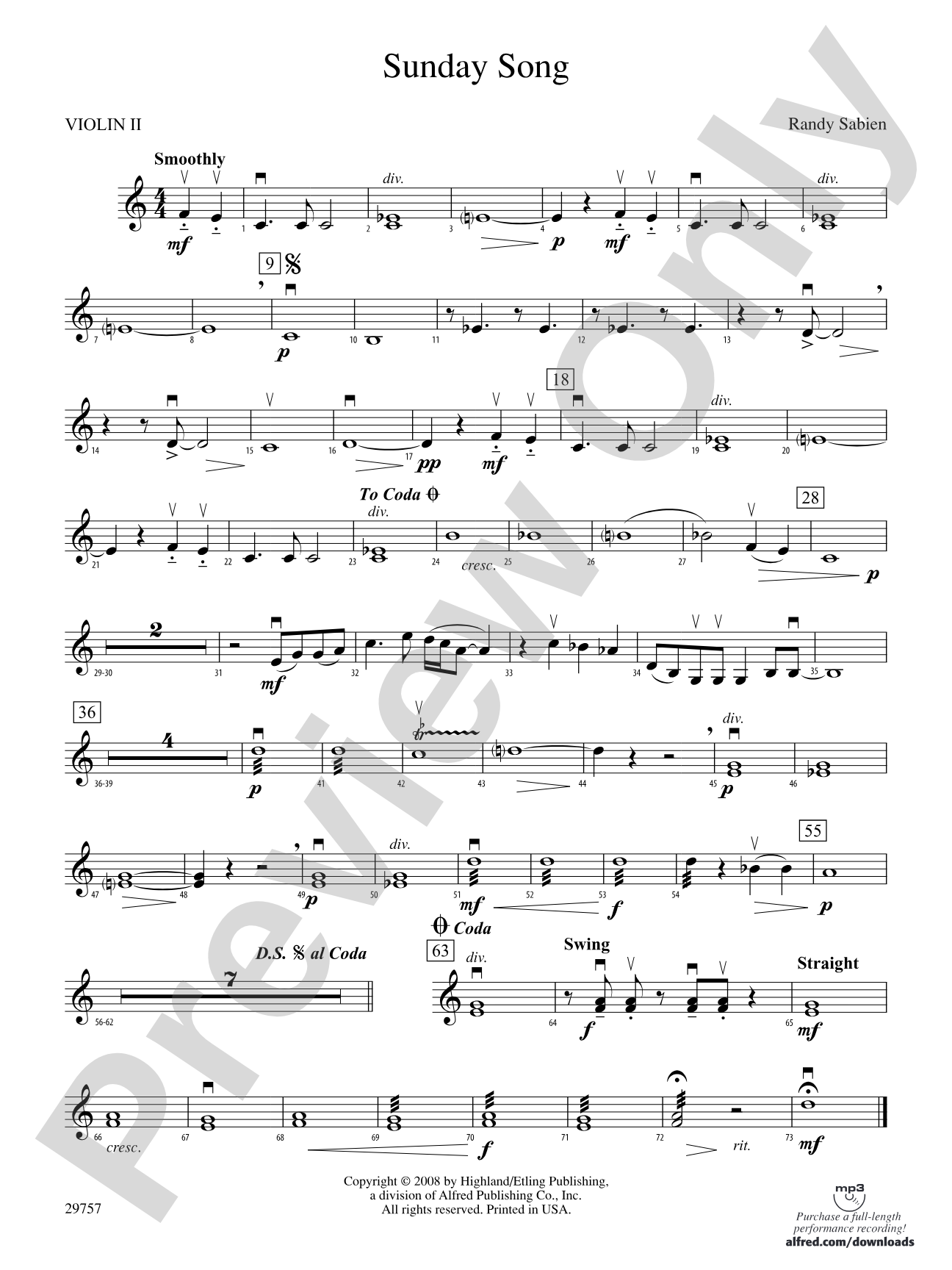
Sunday Song: 2nd Violin

By Randy Sabien

Grade: 3

Item: 00-PC-0001603_VN2

Digital Download
$5.99
Description
This lovely and time-tested jazz ballad will provide easy access to jazz for your students. Because it is a ballad, the string parts sound more classical, so it is an easy way to slip into a jazz style without changing traditional techniques. Written-out solos are provided, but students may improvise them instead! The piece is dedicated to legendary jazz violinist Johnny Frigo, who was featured on the initial recording. (4:00)

Don't just read it, hear it, play along with it, and watch your students grow with it. In MakeMusic Cloud, Sunday Song: 2nd Violin comes alive with professional accompaniment, adjustable tempo, and built-in practice tools that turn solo practice into real progress.

Sample Audio
0:00
0:00
Sample Video
Additional Details
Series: Highland/Etling String Alternatives
Publisher: Alfred Music
Page Count: 72
SKU: 00-PC-0001603_VN2

More about this title

About the Composer: Randy Sabien

Randy Sabien is a prolific composer and arranger whose work spans string education, jazz accessibility, and contemporary concert music. His string writing combines technical clarity with musical warmth, making advanced styles approachable for student ensembles without compromising artistic integrity.

Why we love this

Sabien has crafted a genuine entry point into jazz vocabulary for string players without requiring them to abandon the classical technique they've spent years developing. The ballad tempo and written-out solos eliminate the intimidation factor while the optional improvisation sections invite students to take creative risks in a low-pressure setting.

What to expect

Warm, nostalgic, and inviting. The ballad unfolds like a lyrical conversation, with the kind of gentle sophistication that feels both accessible and genuinely musical. There's an ease to the writing that allows students to focus on phrasing and sensitivity rather than technical scrambling.

Who it's for

String orchestra directors seeking to introduce jazz repertoire to students who have strong classical fundamentals but limited experience with swing rhythms and blues tonality. This works equally well for middle school programs ready for concert-level sophistication and high school ensembles looking to expand their stylistic range beyond the standard classical canon.

How to get the most out of it

  • Shape the melody with subtle dynamic contours rather than rigid adherence to the printed dynamics; jazz ballads breathe when singers and instrumentalists alike lean into the natural rise and fall of the phrase.
  • If students choose to improvise the solos instead of reading the written versions, establish the chord changes clearly in rehearsal and use the conductor score as a flexible guide rather than a strict metronomic anchor.
  • Balance the string sections carefully so that the melody voice sits prominently without drowning out harmonic movement in the inner voices; jazz writing often relies on transparent texture to create forward momentum.

How to use it

Pair this with a classical string concerto on the same concert to showcase your ensemble's versatility and demonstrate how period-specific playing techniques evolve. It also works beautifully as a standalone feature that gives soloists a moment to shine while keeping the full ensemble engaged.

Skills your students will build

  • Jazz articulation and phrasing in a classical string context
  • Reading and interpreting swing rhythm notation
  • Solo improvisation over blues-based chord changes (optional)
  • Balancing melody and harmonic accompaniment in ensemble texture
  • Responding to flexible tempo and rubato in ensemble playing

You May Also Like