Sunday Sheet Music Preview

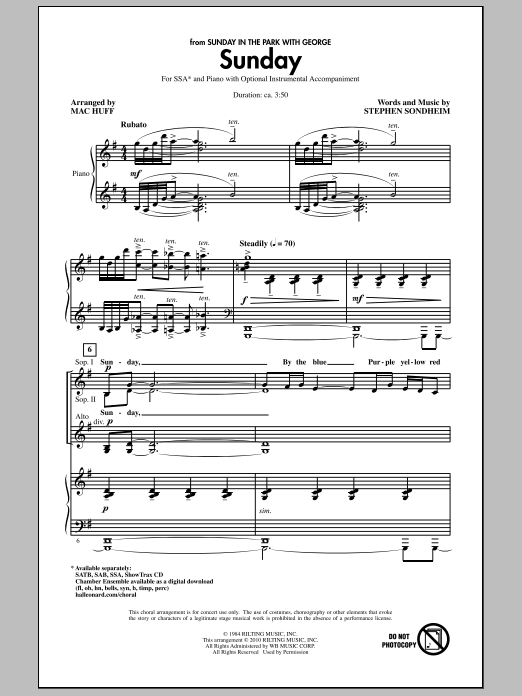
Sunday: SSA Choral Octavo

By Stephen Sondheim / Arranged by Mac Huff

Item: 35-DS00153813

Digital Download
$2.99
Description

Sunday: SSA Choral Octavo isn't in MakeMusic Cloud just yet...but it could be. Let us know you'd like to see it, and you'll help shape what comes next. In the meantime, start a free trial and dive into thousands of interactive titles your students can play along with today.

Sample Audio
No sample audio found.
Sample Video
Additional Details
Publisher: Hal Leonard
Page Count: 7
SKU: 35-DS00153813

More about this title

About the Composer: Stephen Sondheim

Stephen Sondheim stands as one of the most significant musical theater composers of the twentieth century, known for his sophisticated harmonic language, intricate rhythmic structures, and lyrics of remarkable wit and psychological depth. His work fundamentally changed what Broadway audiences could expect from the form, pushing the medium toward greater complexity and emotional nuance while maintaining accessibility and theatrical impact.

Why we love this

Mac Huff's arrangement opens up Sondheim's deceptively intricate composition to a broader range of choirs. The SSA voicing preserves the intimacy of the material while the arranger's skillful hand ensures that the harmonic sophistication remains intact, making this a piece that rewards serious musical attention without becoming unreachable.

What to expect

Sunday offers a moment of stillness and reflection, intimate yet never sentimental. The piece carries the quality of someone pausing mid-life to take stock, finding both acceptance and quiet melancholy in the ordinariness of a day.

Who it's for

This arrangement suits choirs with a solid foundation in part singing and comfort with moderately complex harmony. It works particularly well for groups seeking to program meaningful contemporary theater music that challenges musicianship without sacrificing artistry.

How to get the most out of it

  • Honor the lyrical quality by treating eighth notes as flowing rather than mechanical; the pulse should feel conversational, not metronomic.
  • Balance the upper voices carefully in sections where they move independently. Sondheim's writing often layers vulnerability across all three parts simultaneously.
  • Shape phrases around the text rather than bar lines. Where the lyric breathes is where the music should breathe.
  • The accompaniment supports rather than drives; allow singers to shape the tempo slightly within a stable harmonic framework.

How to use it

Program this as a centerpiece of a concert exploring contemporary musical theater or as part of a Sondheim retrospective that spans his range. Its seven pages make it substantial enough to command attention without overwhelming a mixed program, and it pairs well with other twentieth-century art song arrangements.

Skills your students will build

  • Reading and sustaining independent vocal lines in a three-part texture
  • Interpreting harmonic movement that shifts emotional weight between voice parts
  • Maintaining lyrical integrity while navigating rhythmic and intervallic complexity
  • Balancing ensemble blend with individual phrase characterization

You May Also Like