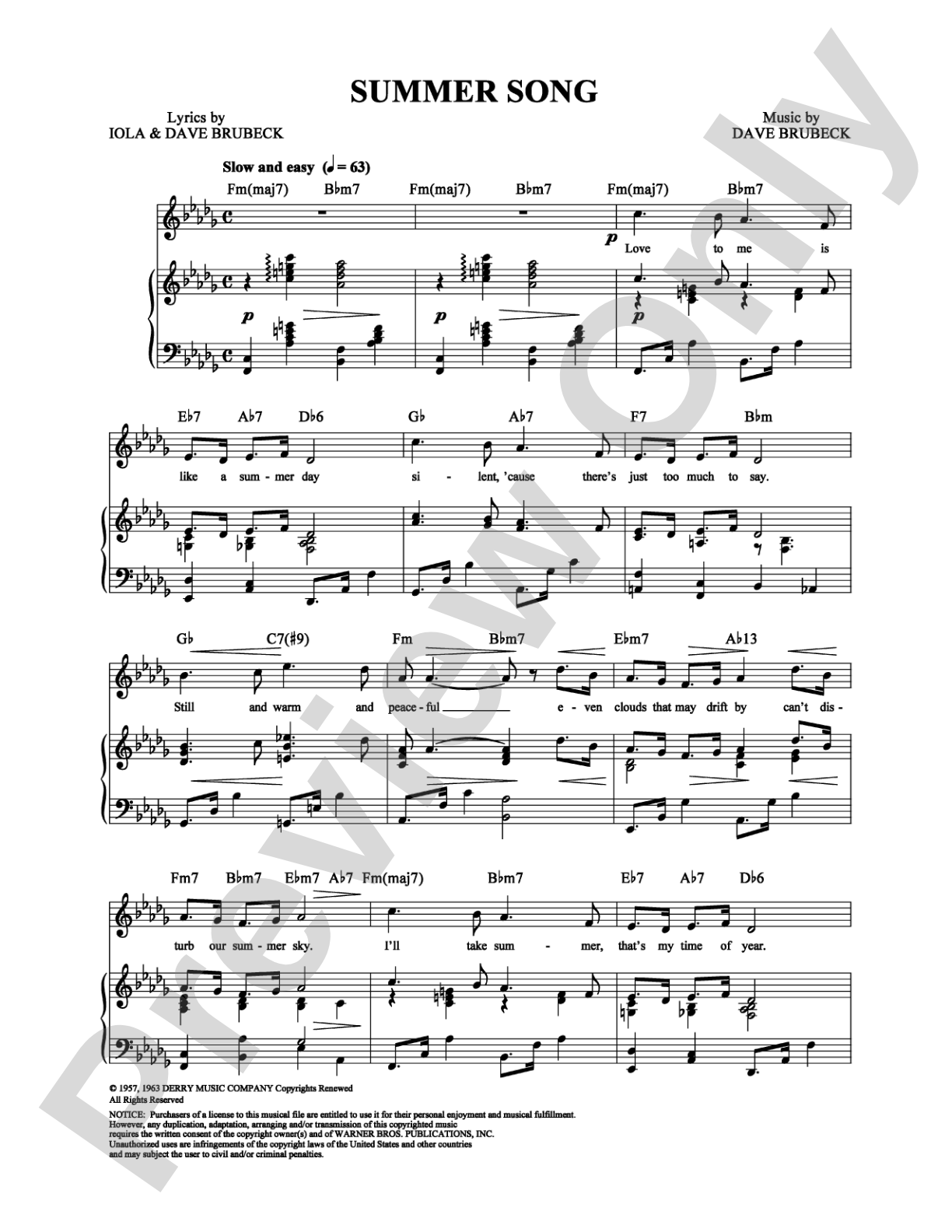
Summer Song: Piano/Vocal/Chords Digital Sheet Music

Summer Song: Piano/Vocal/Chords Digital Sheet Music

Dave Brubeck

Item: 00-PS-0000980

Digital Download
$3.99
Description

Summer Song: Piano/Vocal/Chords Digital Sheet Music isn't in MakeMusic Cloud just yet...but it could be. Let us know you'd like to see it, and you'll help shape what comes next. In the meantime, start a free trial and dive into thousands of interactive titles your students can play along with today.

Sample Audio
No sample audio found.
Sample Video
Additional Details
SKU: 00-PS-0000980

More about this title

About the Artist: Dave Brubeck

Dave Brubeck

Dave Brubeck was a pianist and composer who shaped modern jazz through his distinctive harmonic language and willingness to blend classical training with improvisation. After studying with Darius Milhaud at Mills College following World War II, Brubeck developed a compositional voice that drew equally from both traditions, creating works that ranged from the jazz standard "Take Five" to large-scale choral and orchestral compositions. His 1959 album "Time Out" became the first jazz recording to sell over a million copies, establishing him as a major cultural force.

Beyond his musical innovations, Brubeck was instrumental in dismantling racial barriers in mid-twentieth-century America through integrated performances and collaborations. His sacred works, including the mass "To Hope!" and oratorios such as "The Voice of the Holy Spirit" and "Beloved Son," have been recorded by major orchestras and performed internationally. He received the Grammy Lifetime Achievement Award, the Presidential Medal of the Arts, and was inducted into the American Classical Music Hall of Fame in 2003, cementing his legacy across jazz, classical, and liturgical music.

Why we love this

Brubeck's gift for melody shines through in "Summer Song," offering singers and pianists a jazz standard that sits comfortably between accessibility and sophistication. The piece captures his ability to write vocal lines that swing naturally while remaining singable, and the chord symbols provide pianists room to interpret without losing the song's harmonic elegance. Programming a Brubeck work signals musical substance while keeping the evening's energy warm and approachable.

What to expect

"Summer Song" glows with warmth and unhurried ease, the kind of tune that feels like a conversation between friends on a long afternoon. The melody unfolds naturally across the changes, supported by Brubeck's characteristically sophisticated yet singable harmonic language. There's both elegance and accessibility here—nothing forced, everything well-crafted.

Who it's for

This arrangement suits vocalists with jazz sensibility and pianists comfortable with lead sheet symbols and chord interpretation. It works equally well for recital singers seeking quality contemporary jazz standards and for musicians exploring Brubeck's songwriting outside the instrumental context.

How to get the most out of it

  • Balance the melody line so it floats effortlessly above the harmonic foundation; avoid letting the piano's right hand overwhelm the vocalist
  • Use the chord symbols as a springboard for subtle comping rather than strict voicing—Brubeck's jazz vocabulary invites tasteful reharmonization
  • Shape the phrase lengths with attention to lyrical breathing; treat jazz phrasing as elastic rather than metrically rigid
  • Support dynamic contrasts with the pianist's touch; lighter harmonic colors can heighten the intimacy of softer moments

How to use it

Place this in a recital program after a more formal classical work to shift the evening's temperature and invite the audience into a more intimate space. It pairs beautifully with other American jazz standards or Brubeck's sacred compositions, creating a thematic throughline around his range as a composer.

Skills your students will build

  • Reading chord symbols and realizing jazz harmonies at the keyboard
  • Singing through jazz changes with flexible phrasing
  • Balancing accompaniment and melody in an interactive musical partnership
  • Interpreting dynamics and articulation in the jazz idiom

You May Also Like