Summer Nights in Rome Sheet Music Preview

Summer Nights in Rome: Piano

By Kevin Costley

Item: 98-DW9481

Digital Download
$4.95
Description
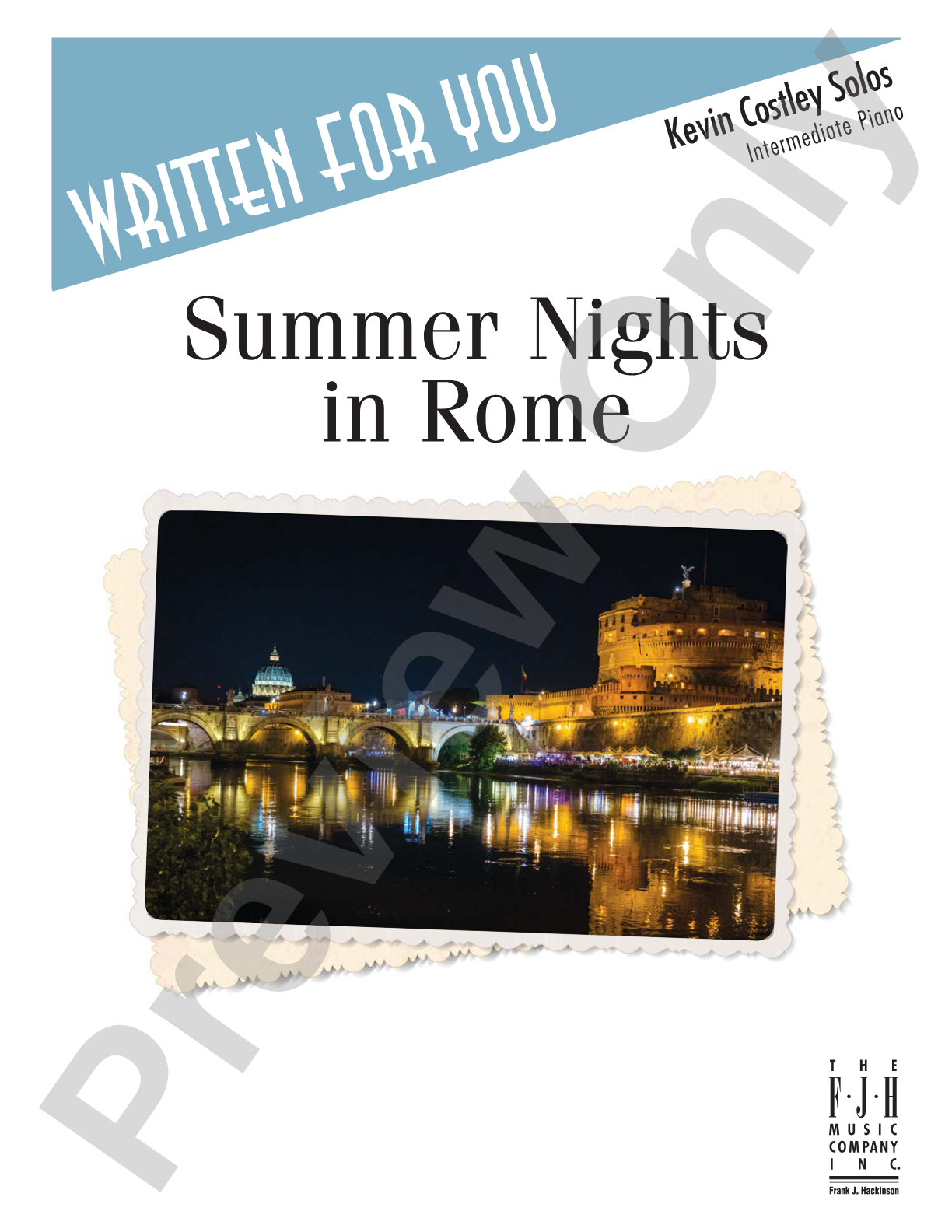
A nostalgic remembrance of a memorable trip to Rome, this bitter-sweet waltz staring in C minor, followed by a contrasting section in C major. It presents an artistic study for short phrases and legato pedaling throughout.

Summer Nights in Rome: Piano isn't in MakeMusic Cloud just yet...but it could be. Let us know you'd like to see it, and you'll help shape what comes next. In the meantime, start a free trial and dive into thousands of interactive titles your students can play along with today.

Sample Audio
No sample audio found.
Sample Video
Additional Details
Series: Written For You
Publisher: The FJH Music Company, Inc.
SKU: 98-DW9481

More about this title

Why we love this

Costley captures the bittersweet quality of travel nostalgia without relying on literal program music clichés. The deliberate shift from C minor to C major architecture gives students a clear structural anchor while the legato pedaling requirements demand the kind of sensitive touch that separates competent pianists from engaged musicians.

What to expect

The opening carries the wistfulness of memory, a minor-key waltz that seems to shimmer with detail despite its elegant simplicity. When the music moves into C major, the emotional landscape shifts but doesn't brighten entirely; instead, it opens onto a different kind of beauty, one tinged with acceptance.

Who it's for

Intermediate pianists ready to work with rubato and pedal technique as expressive tools rather than mechanical additions. Solo performers and students preparing recital material will find this piece both musically rewarding and technically straightforward enough to allow focus on interpretation.

How to get the most out of it

  • Shape the opening C minor section with attention to phrase contours rather than beat-driven playing; the waltz rhythm should breathe naturally across the bar lines.
  • Practice the legato pedal work in isolated passages before linking phrases together, ensuring the pedal changes align with harmonic shifts and not mechanical habit.
  • Let the major key section feel like a genuine emotional turn, not a relief or escape; Costley's use of contrasting tonal areas suggests reflection rather than resolution.
  • Experiment with subtle tempo flexibility within the waltz framework; a slight rubato in the minor section can enhance the nostalgic quality without disrupting the dance rhythm.

How to use it

Program this as part of a recital exploring European travel, memory, or the classical waltz tradition alongside works by Chopin or Brahms. It works equally well as a standalone encore or paired with other pieces from the Written For You series for a cohesive solo program.

Skills your students will build

  • Legato pedaling and harmonic awareness of when to change pedal
  • Phrasing in waltz meter without over-emphasizing the beat
  • Dynamic shaping within a single tonal center (C minor sustained section)
  • Transition between contrasting key areas and emotional territories
  • Rubato and tempo flexibility within dance-form constraints

You May Also Like