
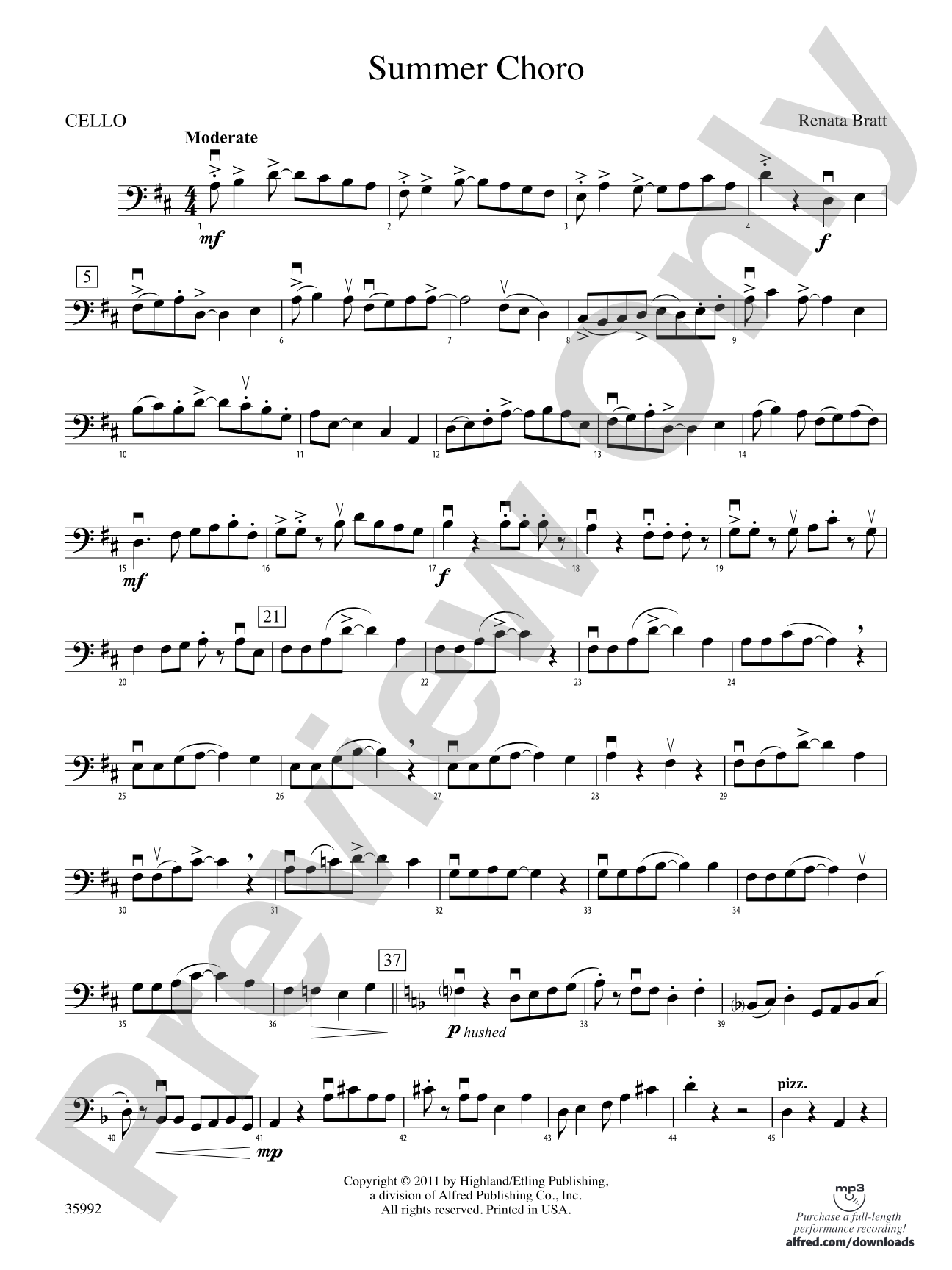

Summer Choro: Cello
By Renata Bratt
Grade: 2.5
Item: 00-PC-0015067_VC1
$5.99
Pickup currently not available
Description
When students strut these syncopated Brazilian rhythms, audiences smile and bob their heads. Written in the typical Rondo ABACA form, this original choro lets every section play both melody and accompaniment. Carefully placed accents and bowings show students how to play their lines in a convincing Latin style. Composed the day that Rio de Janeiro was chosen for the 2016 Olympic site, this tune is good for year-round use because when it's winter in North America, it's summer in South America!


Don't just read it, hear it, play along with it, and watch your students grow with it. In MakeMusic Cloud, Summer Choro: Cello comes alive with professional accompaniment, adjustable tempo, and built-in practice tools that turn solo practice into real progress.
Open in the Player
Jump straight in and assign it today.
Start Your Free Trial
Open this title and explore the full library in minutes.
Sample Audio
1
Audio File
--:--
0:00
0:00
Sample Video
No sample videos found.
Additional Details
Series:
Highland/Etling String Alternatives
Publisher:
Alfred Music
Page Count:
124
SKU:
00-PC-0015067_VC1
Instrumentation:
string
More about this title
About the Composer: Renata Bratt

Renata Bratt is a cellist, clinician, and educator whose work spans classical traditions, jazz improvisation, and fiddling styles. She serves on the American String Teachers Association Alternative String Styles Advisory Committee and has taught at the Mark O'Connor String Conference, Alasdair Fraser's Sierra Fiddle Camp, the National Cello Institute, and numerous ASTA and Suzuki conferences. Based in California, she teaches cello at Santa Cruz Waldorf Elementary School, Pacific Elementary School in Davenport, and directs beginning orchestra through the Cabrillo Youth Strings program.
Bratt's performance credits include work with folk musicians Liz Carroll and John Doyle, jazz violinists Darol Anger and Alasdair Fraser, and session work with artists including David Sanborn, Lyle Lovett, and Dionne Warwick. She received her Ph.D. in Music from the University of California at San Diego and has authored three books on cello and string ensemble playing for Mel Bay Publications. Her arrangements and original compositions for string ensembles are published through Alfred Music.
Why we love this
Bratt writes for young orchestras with genuine stylistic authority. She knows how to distribute melody and accompaniment so every stand stays engaged, and her careful bowings and accent markings give students the exact tools they need to nail the syncopation without overthinking it. The Rondo form keeps the piece driving forward while the Brazilian rhythmic vocabulary exposes students to a sound world that's both fresh and immediately satisfying to play.
What to expect
Bright, buoyant, and irresistible. Summer Choro captures the joy and forward momentum of Brazilian street music, with every section getting a turn at the melody so the piece never settles into a single texture. Students will find themselves smiling through their parts as the Rondo structure circles back with fresh energy each time.
Who it's for
String orchestras at Grade 2.5 with solid fundamentals and enough rhythmic independence to handle syncopation. Young players who are ready to move beyond standard European art music will connect immediately with the infectious energy of this original choro.
How to get the most out of it
- Lock the rhythmic pulse in rehearsal by having the entire ensemble tap the basic choro rhythm together before playing it on instruments. This builds the foundational groove that makes the syncopation sit naturally.
- Highlight the accent marks as written; they're integral to the Latin feel and should come from the bow, not just a dynamic choice.
- Balance melody against accompaniment by checking that rhythmic supporting lines remain crisp and light even when they're not featured. A choro only swings when the foundation is clear.
- Record a run-through mid-rehearsal cycle and play it back so students hear how their collective sound develops. Young players often don't realize how much character emerges once everyone settles into the style.
How to use it
Perfect as a concert closer when you want the audience leaving with genuine warmth and movement in their step. The piece works equally well on a light concert program alongside other world music selections or as a solo feature that demonstrates your orchestra's stylistic range beyond traditional repertoire.
Skills your students will build
- Syncopated rhythm reading in Latin style contexts
- Bow independence using written accents to shape phrasing
- Switching between melodic and accompaniment roles within a single piece
- Balancing ensemble sound across multiple rhythmic layers
- Basic understanding of Rondo form through performance