Suk: Four Pieces, Op. 17 (Volume I) Sheet Music Preview

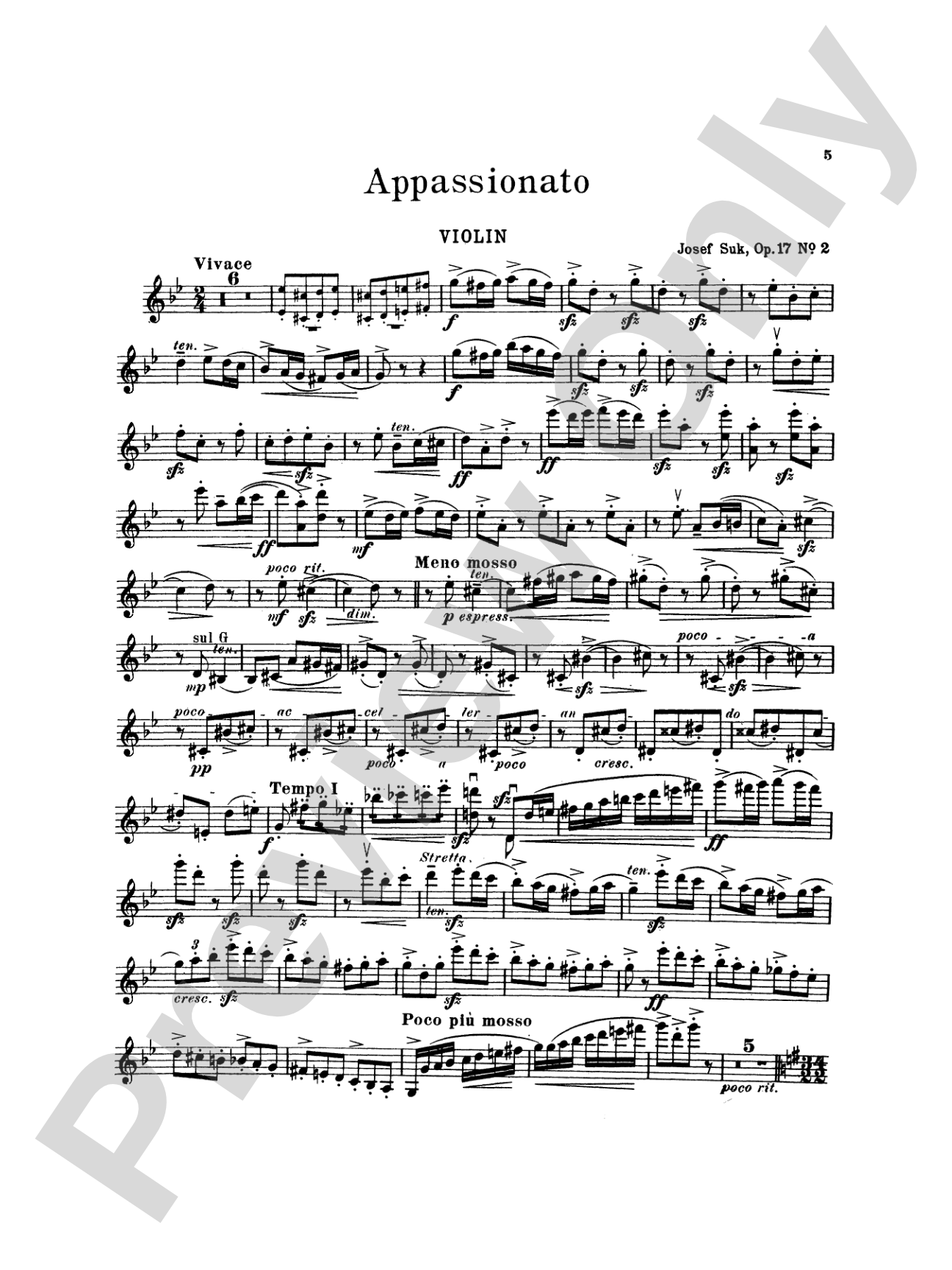
Suk: Four Pieces, Op. 17 (Volume I)

By Josef Suk

Item: 00-PC-0010250

Digital Download
$1.99
Description
Op. 17, Nos. 1, 2

Don't just read it, hear it, play along with it, and watch your students grow with it. In MakeMusic Cloud, Suk: Four Pieces, Op. 17 (Volume I) comes alive with professional accompaniment, adjustable tempo, and built-in practice tools that turn solo practice into real progress.

Sample Audio
No sample audio found.
Sample Video
Additional Details
Series: Kalmus Edition
Publisher: Alfred Music
Page Count: 8
SKU: 00-PC-0010250

More about this title

About the Composer: Josef Suk

Josef Suk (1874-1935) was a Czech composer and violinist whose music bridges the late Romantic era and early modernism. A student of Antonín Dvořák and son-in-law of the composer, Suk inherited a gift for lyrical melody while developing a more introspective, harmonically adventurous voice. His chamber and solo works remain central to the violin repertoire, prized for their emotional depth and structural sophistication.

Suk's compositional language draws on Czech nationalism and folk idiom but filters them through a deeply personal, sometimes melancholic sensibility. His violin music demands both technical security and expressive maturity from performers, rewarding careful study with works of genuine artistic substance.

Why we love this

These two pieces from Op. 17 sit at a fascinating crossroads between Dvořák's Romantic lyricism and early twentieth-century harmonic language, giving advanced students access to music that feels both familiar and genuinely modern. The writing is idiomatic for violin without being showy; Suk expects genuine musicianship rather than virtuosity for its own sake. Programming them offers a credible alternative to the standard Romantic warhorse repertoire.

What to expect

Introspective and gently melancholic, with moments of lyrical warmth. Suk's voice here is contemplative rather than virtuosic, inviting the performer into a private conversation. The harmonic language suggests shadows and shifting light, creating an expressive world that rewards patient listening.

Who it's for

Advanced high school violinists and university students ready to engage with early twentieth-century composition that respects their musical intelligence. These pieces suit recital programs, chamber concert contexts, or studio work with serious music students who want to move beyond standard Romantic repertoire without abandoning melody and emotional coherence.

How to get the most out of it

  • Listen closely to the harmonic movement beneath the melodic line; Suk's progressions are often unexpected and deserve to be shaped by phrasing rather than buried under surface ornamentation.
  • Balance the violin's voice with the piano part rather than dominating it. These pieces are dialogues, and the accompaniment often carries structural weight.
  • Approach vibrato with restraint in slower passages. Suk's writing often asks for clarity and space; excessive vibrato can obscure the harmonic complexity.
  • Work out fingerings that preserve legato across position shifts; awkward hand movements will interrupt the flowing line quality that defines these works.

How to use it

These pieces work beautifully in a recital that spans the late Romantic to early modern transition, perhaps pairing them with Dvořák on one end and Bartók or Janáček on the other. They also fit naturally into chamber concert programming alongside other Czech composers. Given their moderate length and introspective character, they serve as excellent programming ballast alongside more virtuosic or dramatic works.

Skills your students will build

  • Reading and executing early twentieth-century harmonic language with clarity
  • Sustaining long phrases with expressive control rather than technical display
  • Coordinating with piano accompaniment as an equal partner
  • Vibrato control and tone production in both sustained and flowing passages
  • Shifting smoothly while maintaining legato across extended melodic lines

You May Also Like