
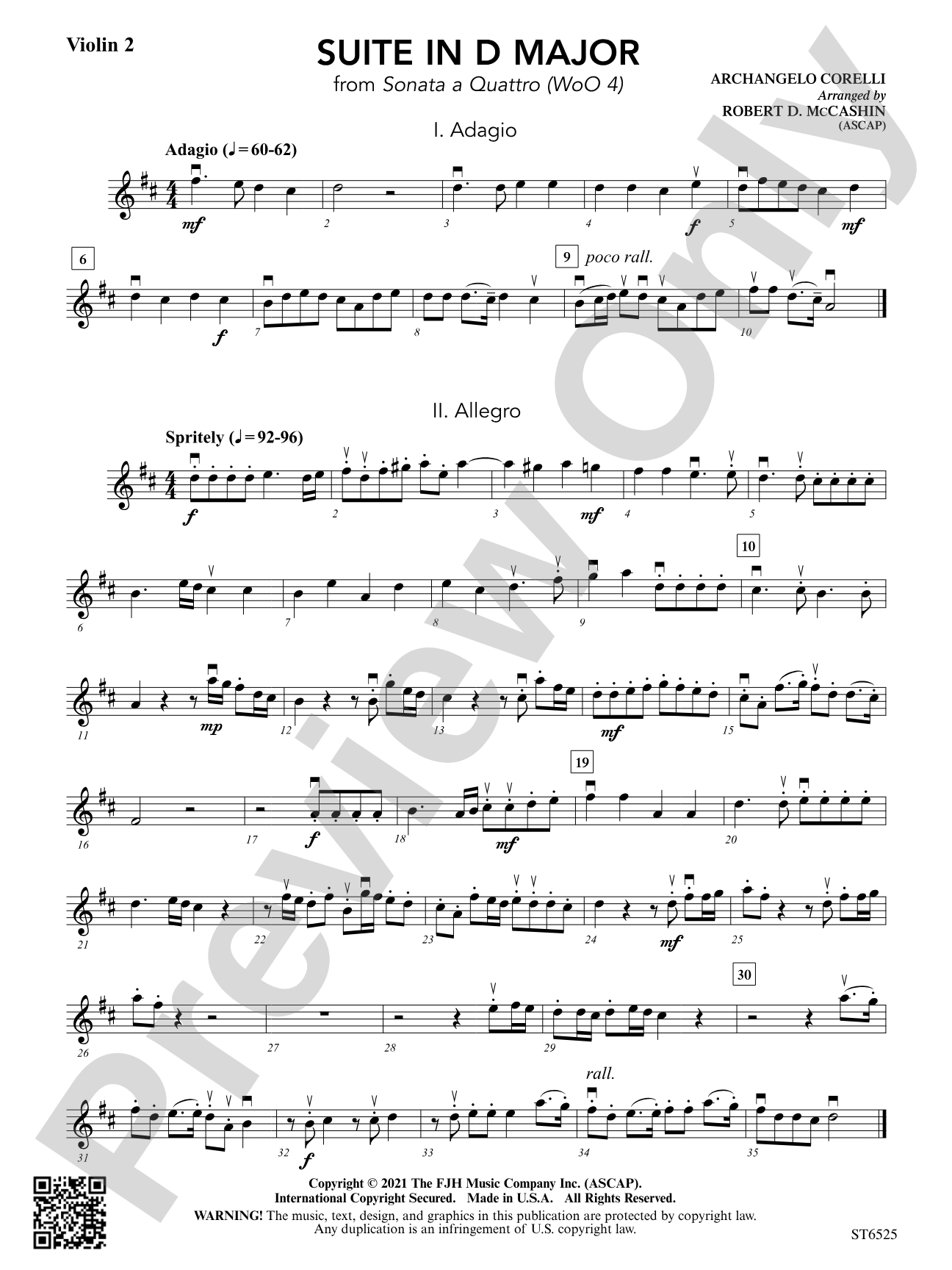

Suite in D Major (from Sonata a Quattro (WoO 4)): Violin 2
from Sonata a Quattro (WoO 4)
By Arcangelo Corelli / arr. Robert D. McCashin
Grade: 2.5;3
Item: 98-PC-DST6525_VN2
$7.00
Pickup currently not available
Description
This delightful and approachable arrangement is an ideal introduction to Corelli's compositional style. Representing four of the original five movements, this version begins with a rewarding Adagio before moving into a sprightly Allegro. The Grave that follows offers incredible opportunities to focus on phrasing before ending with the final, cheerful Allegro. Perform as a complete work or as separate movements for many options.


Don't just read it, hear it, play along with it, and watch your students grow with it. In MakeMusic Cloud, Suite in D Major (from Sonata a Quattro (WoO 4)): Violin 2 comes alive with professional accompaniment, adjustable tempo, and built-in practice tools that turn solo practice into real progress.
Open in the Player
Jump straight in and assign it today.
Start Your Free Trial
Open this title and explore the full library in minutes.
Sample Audio
1
Audio File
--:--
0:00
0:00
Sample Video
Additional Details
Series:
FJH Developing Strings
Publisher:
The FJH Music Company, Inc.
SKU:
98-PC-DST6525_VN2
More about this title
About the Composer: Arcangelo Corelli
Arcangelo Corelli (1653-1713) shaped the sound of Baroque violin and established the concerto grosso as a foundational genre in Western music. His twelve concerti grossi remain cornerstones of string orchestra repertoire, prized for their elegant proportions, balanced part-writing, and emotional directness. Corelli's influence extends beyond his own compositions; his pedagogical approach to violin technique informed generations of performers and composers across Europe.
For educators, Corelli's music offers immediate rewards. His melodies are memorable and singable, his harmonic language is clear without being simplistic, and his structural clarity makes his works natural teaching pieces. Students encounter the building blocks of Baroque style while playing music that sounds assured and musical from the first rehearsal.
Why we love this
This arrangement cuts through the intimidation factor of teaching Baroque masterworks by offering genuine musical substance at a level where your strings can succeed. McCashin's reduction preserves Corelli's elegant voice-leading and the architecture of each movement while making the part-writing accessible; your students play real music, not simplified versions. The four-movement structure gives you flexibility for full concerts, festival entries, or classroom movement studies without requiring a separate preparation.
What to expect
Corelli's voice is formal yet intimate, elegant without coldness. The Adagio moves with quiet dignity; the Allegros sparkle with aristocratic grace rather than Baroque exuberance. This is music of refinement and proportion, where each phrase feels inevitable and every harmonic motion serves an emotional purpose.
Who it's for
String orchestra conductors teaching Grade 2-3 ensembles who want to introduce students to a major figure in string writing without overwhelming them. This works equally well for competitive festivals, concert programming, or classroom study of Baroque form and style. Teachers seeking repertoire that builds musical maturity while remaining technically approachable will find this indispensable.
How to get the most out of it
- Shape the Adagio opening with long, supported lines. This movement sets the tone for the entire work; encourage students to sing through their phrases rather than play note-to-note.
- Let the first Allegro breathe. The tempo should feel energetic but not rushed; resist the urge to push the speed and sacrifice articulation clarity.
- In the Grave, balance transparency with expression. The reduced texture means every voice carries weight; tune carefully and shape harmonic motion to highlight the emotional content.
- Treat each movement as a separate statement. Brief pauses between movements allow the musical ideas to settle and give listeners time to absorb what they've heard.
How to use it
Program the entire suite on a concert dedicated to Baroque repertoire, where its clarity and balance will complement other period works. Alternatively, use individual movements as thematic concert openers or closers; the Adagio makes an exceptional opening statement, and the final Allegro provides an uplifting close. For festival entries, the complete work demonstrates mature musicianship while respecting the developmental level of growing ensembles.
Skills your students will build
- Baroque phrasing and articulation across string ensemble textures
- Voice independence while maintaining ensemble cohesion
- Tuning and balance in multi-part harmonic progressions
- Interpretation of tempo markings and their relationship to emotional content
- Musical form recognition through contrasting movement types