
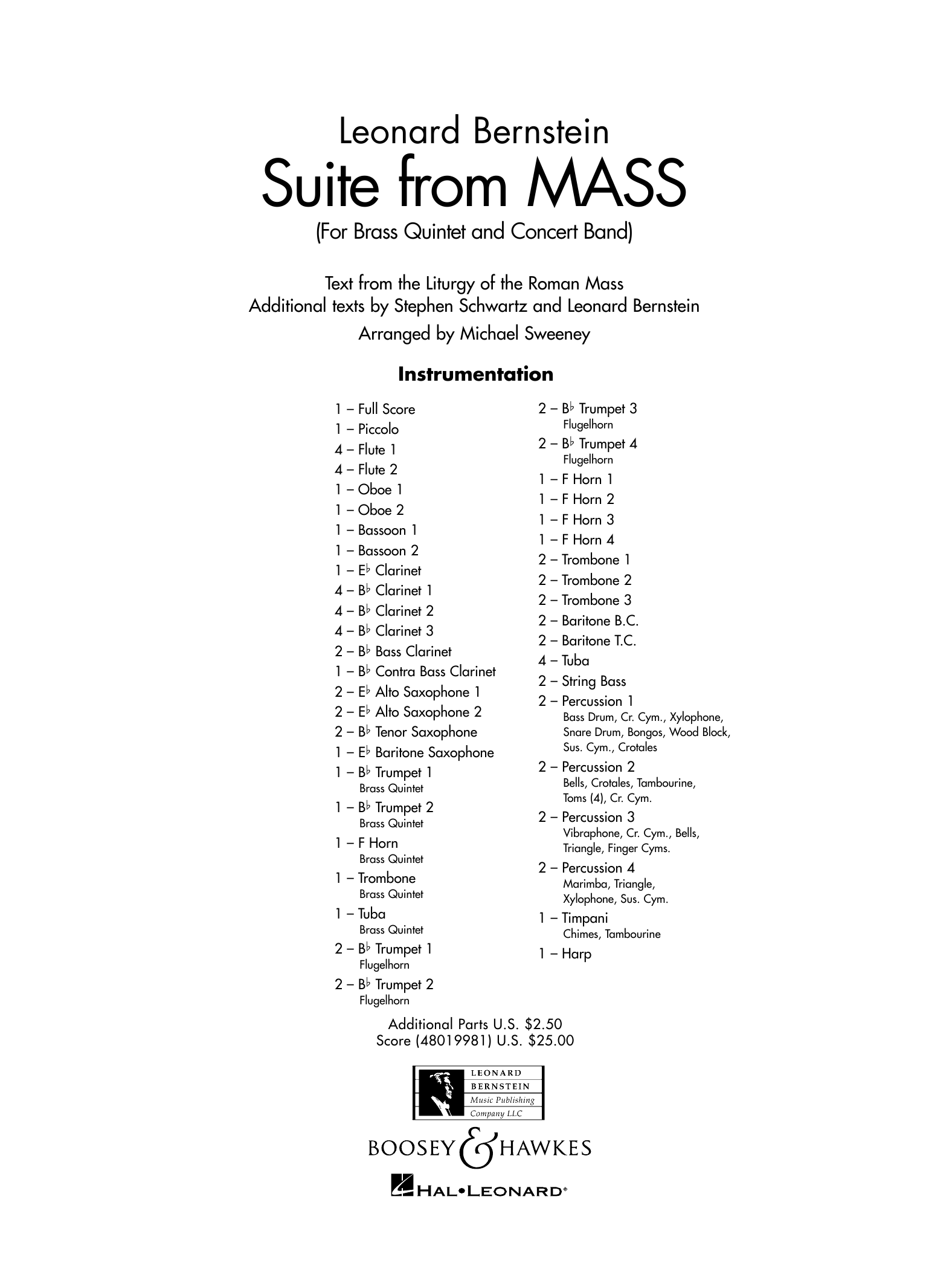

Suite from Mass (arr. Michael Sweeney): Concert Band Conductor Score & Parts
By Leonard Bernstein / By Stephen Schwartz / Arranged by Michael Sweeney
Grade: 5
Item: 35-PK01204938
$235.00
Pickup currently not available
Buy Extra Parts (Digital PDF Download)
Parts Added to Cart!
Description
Bernstein's "Mass" is a monumental 90-minute work, written in 1971 for the opening of the John F. Kennedy Center for the Performing Arts in Washington, D.C. In this suite commissioned by the Canadian Brass and the Eastman Wind Ensemble, arranger Michael Sweeney focuses on a select number of movements, often using the brass quintet to represent the vocal lines found in the original. The striking and beautiful work includes "Alleluia, Sanctus", the well-known "A Simple Song, Agnus Dei, Offertory" and "Almighty Father". Although scored for brass quintet and wind ensemble, ample cues are provided to allow this to be performed by a wind ensemble or symphonic band alone. Dur: c. 14:00 (Grade 5). Audio recorded by the Canadian Brass and the Eastman Wind Ensemble on Manhattan Music (OD 7368) -- Mark Davis Scatterday, conductor.


Suite from Mass (arr. Michael Sweeney): Concert Band Conductor Score & Parts isn't in MakeMusic Cloud just yet...but it could be. Let us know you'd like to see it, and you'll help shape what comes next. In the meantime, start a free trial and dive into thousands of interactive titles your students can play along with today.
Request This Title
Tell us you want it.
Start Your Free Trial
Explore everything that's ready to play right now.
Sample Audio
No sample audio found.
Sample Video
No sample videos found.
Additional Details
Publisher:
Hal Leonard
SKU:
35-PK01204938
More about this title
About the Composer: Leonard Bernstein
Leonard Bernstein (1918-1990) was an American composer, conductor, and educator whose work bridged classical music and popular culture with remarkable fluency. His ability to write for diverse ensembles and audiences without sacrificing musical substance made him one of the most performed composers of the late 20th century, and his Mass stands as one of his most ambitious and spiritually searching works.
Bernstein's approach to composition emphasized accessibility without condescension. He understood how wind and brass instruments could carry the weight of complex harmonic and emotional material, which is partly why this arrangement of Mass works so effectively for the concert band medium. His influence on American musical life extended through his conducting, his Young People's Concerts, and his mentorship of generations of musicians.
Why we love this
This arrangement gives bands access to one of the most significant concert works of the 1970s without requiring a full theatrical production or massive vocal ensemble. Sweeney's curation strips away nothing essential; instead, it focuses the listener's attention on Bernstein's most striking melodies and harmonic moments. A Grade 5 band that commits to this score gains repertoire with genuine artistic weight and the satisfaction of playing music that matters.
What to expect
Moments of pure lyrical beauty alternate with rhythmic vitality and harmonic sophistication. The work has the reverent, almost meditative quality you'd expect from sacred music, yet Bernstein's jazz-influenced harmonic palette and rhythmic play keep it fresh and energetic throughout. There's a quality of genuine searching here, not mere religious convention.
Who it's for
High school and college bands seeking substantial contemporary repertoire that expands their musical vocabulary beyond traditional marches and dances. Directors who want their students to experience how a major 20th-century composer thought about form, harmony, and orchestration within the wind band medium.
How to get the most out of it
- Balance the brass quintet lines carefully when they function as melodic replacements for the original vocals. These passages often benefit from a slightly forward dynamic that allows the melodic content to sing through the harmonic bed.
- Pay close attention to the provided cues. They exist specifically to enable a complete performance by wind ensemble or band alone, so use them to ensure musical continuity when brass quintet parts are unavailable.
- Approach the harmonic language with flexibility. Bernstein's jazz-inflected chords and unexpected voice leading require players to listen across sections rather than playing their parts in isolation.
- The recorded reference by the Canadian Brass and Eastman Wind Ensemble offers invaluable guidance on pacing and character. Use it to study the overall architecture, but encourage your students to find their own musical voice within it.
How to use it
This is ideal programming for a concert that aims to show the breadth of what a concert band can tackle musically. Pair it with a lighter opening work and perhaps a virtuosic encore, allowing the Mass suite to be the centerpiece that demonstrates your band's musicianship and maturity. It also works beautifully as the anchor of a themed concert exploring 20th-century American spirituality in music.
Skills your students will build
- Reading jazz-influenced harmony and chromaticism
- Balancing dense, polyphonic textures across the full ensemble
- Responding to cues and adjusting cue usage based on available personnel
- Sustaining long-form musical architecture across a 14-minute work
- Coordinating with a small brass quintet when available, or compensating for its absence