
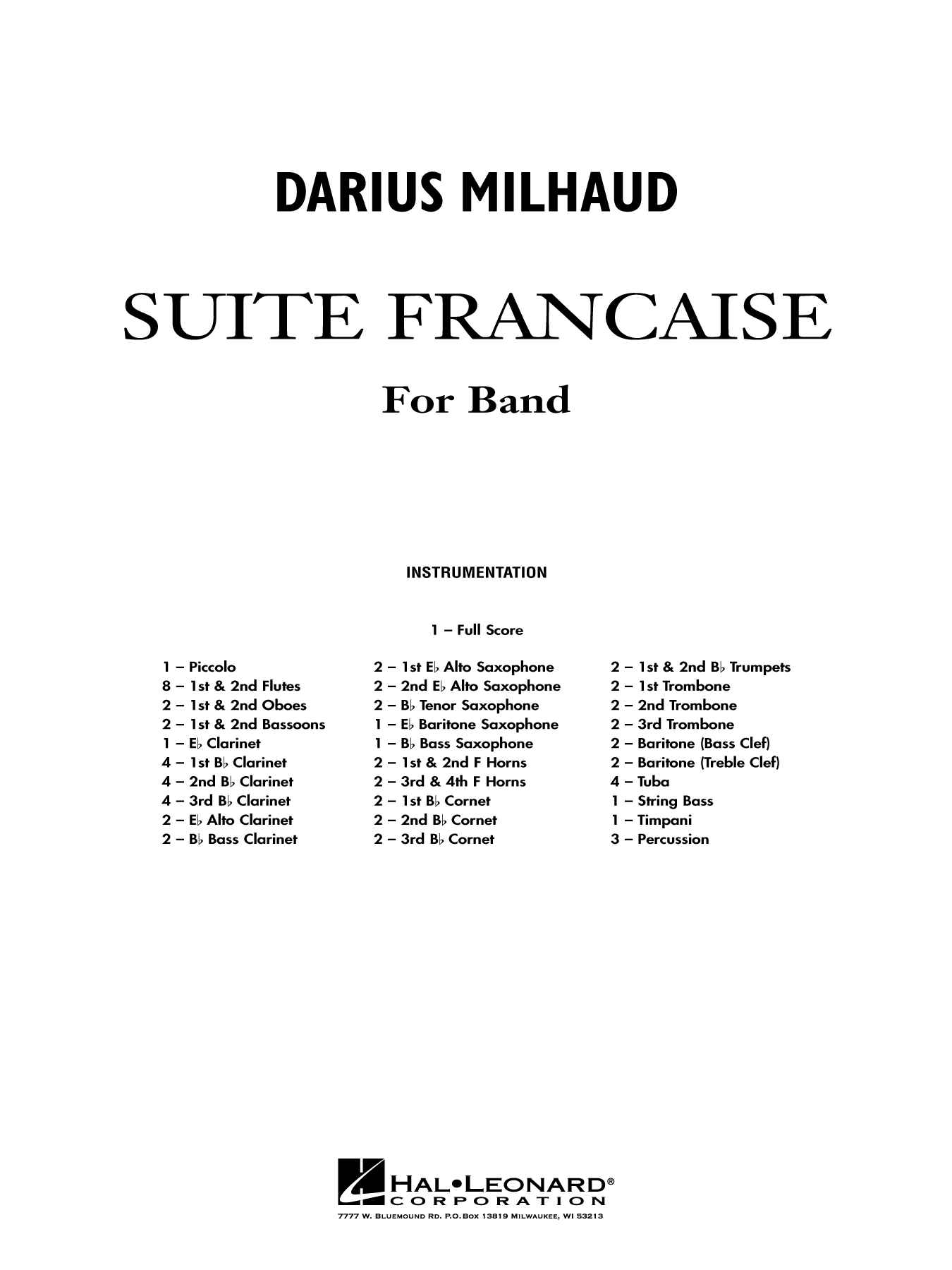

Suite Francaise: Concert Band Conductor Score & Parts
By Darius Milhaud
Item: 35-PK01924114
$145.00
Pickup currently not available
Buy Extra Parts (Digital PDF Download)
Parts Added to Cart!
Description
It is rare that a composition is conceived first for winds then later transcribed for orchestra, but such is the case with Suite Francaise. Premiered by the famed Goldman Band in 1945, this magnificent work in five movements is one of the enduring classics of the symphonic band repertoire, and continues to be a popular choice for contests and festivals.


Suite Francaise: Concert Band Conductor Score & Parts isn't in MakeMusic Cloud just yet...but it could be. Let us know you'd like to see it, and you'll help shape what comes next. In the meantime, start a free trial and dive into thousands of interactive titles your students can play along with today.
Request This Title
Tell us you want it.
Start Your Free Trial
Explore everything that's ready to play right now.
Sample Audio
No sample audio found.
Sample Video
No sample videos found.
Additional Details
Publisher:
Hal Leonard
SKU:
35-PK01924114
More about this title
About the Composer: Darius Milhaud
Darius Milhaud (1892-1974) was a French composer of astonishing prolificacy whose works span virtually every medium. He studied at the Paris Conservatory and became a central figure in Les Six, the influential group of French composers who rejected Romantic excess in favor of clarity and directness. His concert band writing reveals his gift for orchestration and his ability to craft music that sounds natural on wind instruments rather than merely adapted from another medium.
Millhaud's pedagogical impact on American music education is substantial. His willingness to write substantial concert works for bands (rather than treating them as secondary ensembles) helped elevate the artistic standing of the medium itself. Suite Francaise stands as proof that a composer of international stature could create a major work with winds as the primary voice.
Why we love this
Conductors return to Suite Francaise because it functions beautifully as a complete concert experience without requiring an orchestra. The five-movement structure feels architecturally sophisticated; each movement has distinct character and the overall arc rewards an attentive audience. The writing sits naturally on winds, which means your students will sound musical from the first rehearsal rather than struggling against idiomatic orchestral textures.
What to expect
Suite Francaise radiates Provençal warmth and elegance without sentimentality. The five movements flow from pastoral simplicity through rhythmic vitality, creating an experience that feels both intimate and grand. There is brightness here and a sense of celebration that audiences find immediately engaging.
Who it's for
This score serves contest and festival programs where you need a work of genuine artistic weight and proven success. It works equally well for a concert celebrating French wind music or as the centerpiece of a program that spans musical periods.
How to get the most out of it
- Anchor the French dance idioms (particularly in movements with Provençal character) with crisp articulation in the reeds; this clarity makes the harmonic language sing even at moderate tempos.
- Balance the melodic lines between upper woodwinds and brass; Milhaud distributes thematic material generously, so section leaders need clear awareness of when they carry the main voice.
- Shape through phrase direction rather than dynamic swells. The neoclassical aesthetic values line continuity, so resist the impulse to swell into cadences.
- Let the recorded accompaniment establish the character and tempo relationships between movements, especially if your ensemble needs reference points for the quicker passages.
How to use it
Program this as your major work on a concert where you want to demonstrate your ensemble's musicianship and repertoire depth. The five-movement span means it can anchor a program on its own or share a concert with shorter contemporary works. It also serves festival and contest schedules where you need substantial, crowd-pleasing repertoire that judges respect.
Skills your students will build
- Conducting gesture clarity across multiple tempos and meters
- French articulation and phrasing conventions
- Balance and blending in neoclassical harmonic textures
- Sustained melodic line in ensemble settings
- Stylistic distinction between dance forms and lyrical sections