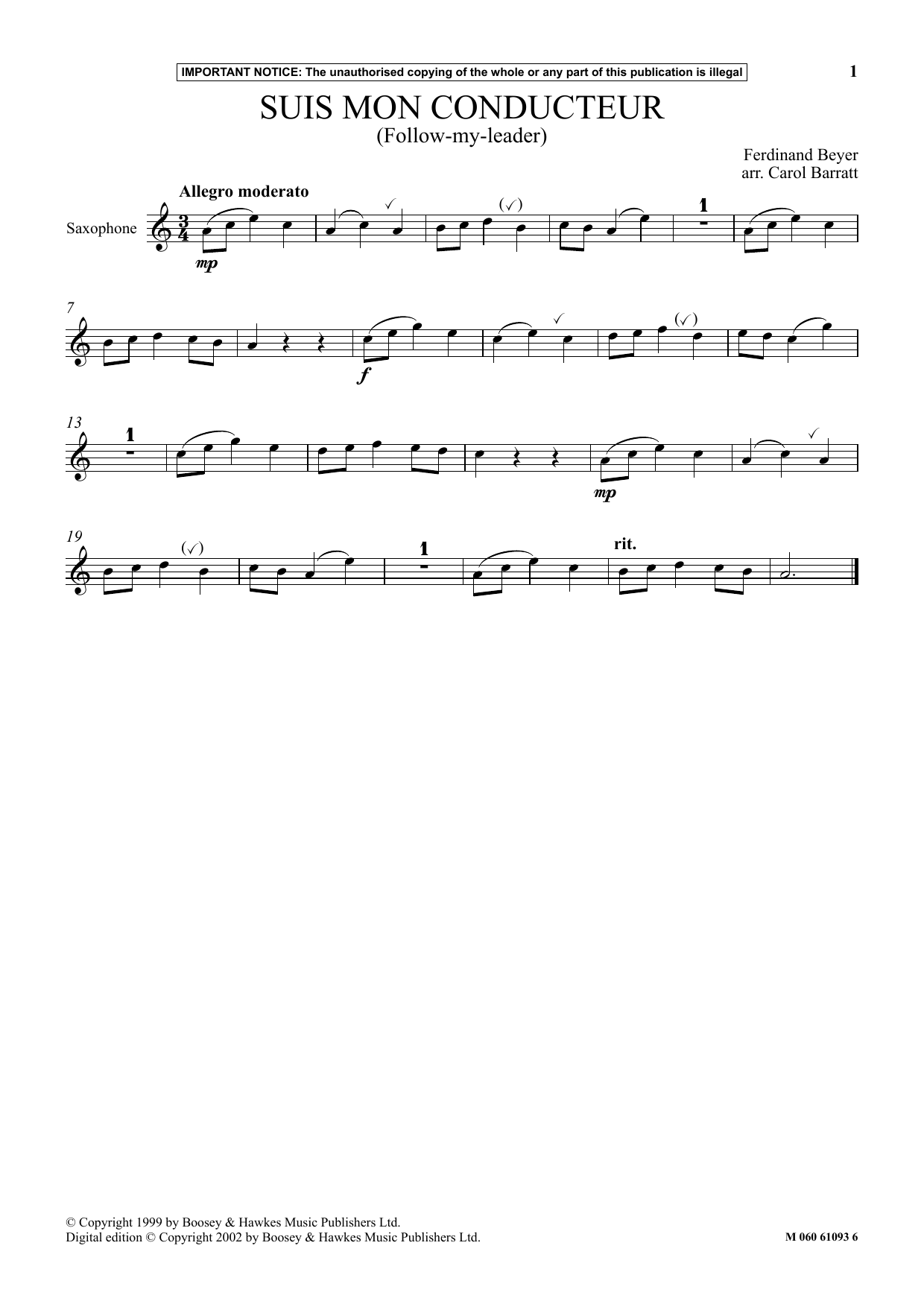
Suis Mon Conducteur (Follow-My-Leader) Sheet Music Preview

Suis Mon Conducteur (Follow-My-Leader): Instrumental Solo

As performed by Ferdinand Beyer / Arranged by Carol Barratt

Item: 35-DS00239208

Digital Download
$3.99
One moment…
Description

Discover MakeMusic Cloud: thousands of interactive titles your students can play along with today.

Sample Audio
No sample audio found.
Sample Video
Additional Details
Publisher: Hal Leonard
Page Count: 2
SKU: 35-DS00239208

More about this title

About the Artist: Ferdinand Beyer

Ferdinand Beyer (1803-1863) was a German pianist and composer whose pedagogical works became foundational texts in 19th-century music education. His systematic approach to technique combined musicality with progressive difficulty, making his pieces essential stepping stones for young pianists learning to navigate the classical repertoire.

Beyer's compositions emphasize clarity of voice, careful hand positioning, and the development of independence between hands. Teachers still turn to his works because they teach real musical concepts while building the physical skills students need to advance.

Why we love this

Carol Barratt's arrangement transforms Beyer's pedagogical original into an engaging ensemble piece that keeps students connected to the melody while developing their rhythmic independence. The folk-song simplicity of "Follow-My-Leader" makes it instantly rewarding to perform together, yet the part writing ensures each student has meaningful work to do.

What to expect

Playful and infectious, with the quality of a childhood game translated into music. The piece has a folk-song simplicity that feels both familiar and fresh, with clear musical phrases that invite communication between parts.

Who it's for

This arrangement serves young band and wind ensemble students still building fundamental ensemble skills. It works equally well for choral programs looking for a short, lighthearted piece that emphasizes voice independence without overwhelming younger singers.

How to get the most out of it

  • Establish a steady pulse in rehearsal before adding the arranged layers; students who have played Beyer's original will have strong single-line instincts that need channeling into ensemble awareness.
  • Balance the melody prominence while ensuring accompaniment lines come through cleanly; the game-like quality of the piece works best when all voices are audible.
  • Shape phrases rather than playing in blocks; even simple accompaniment benefits from gentle dynamic contours that follow the melody's arc.

How to use it

Use this as a confidence builder early in the year or as a palate cleanser between heavier works in a concert. Its brevity (two pages) makes it ideal for festival programs or as a teaching demonstration of how arrangement enriches a simple melody.

Skills your students will build

  • Maintaining independent lines while listening to ensemble texture
  • Balancing accompaniment prominence within ensemble dynamics
  • Shaping phrase contours in support of a primary melodic line
  • Playing with clarity and rhythmic precision in simple meters

You May Also Like