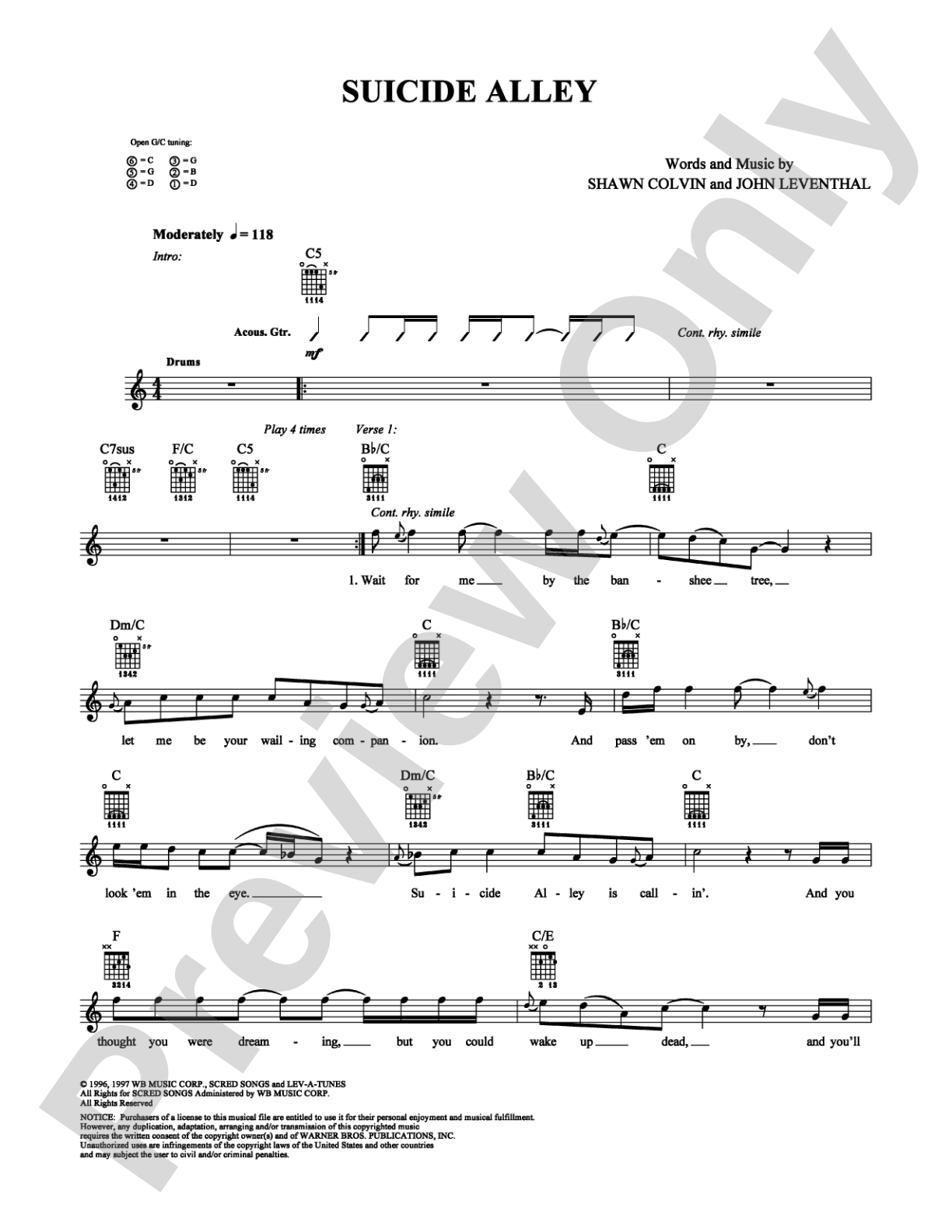
Suicide Alley: Lead Sheet Digital Sheet Music

Suicide Alley: Lead Sheet Digital Sheet Music

Shawn Colvin, John Leventhal

Item: 00-PS-0006226

Digital Download
$1.99
Description

Suicide Alley: Lead Sheet Digital Sheet Music isn't in MakeMusic Cloud just yet...but it could be. Let us know you'd like to see it, and you'll help shape what comes next. In the meantime, start a free trial and dive into thousands of interactive titles your students can play along with today.

Sample Audio
No sample audio found.
Sample Video
Additional Details
SKU: 00-PS-0006226

More about this title

About the Artist: Shawn Colvin

Shawn Colvin is a singer-songwriter and guitarist whose work spans pop rock, folk, and adult contemporary styles. A Grammy Award winner, she is known for her fingerstyle guitar technique, introspective songwriting, and warm vocal delivery. Her influence on acoustic-driven popular music and her career spanning multiple decades make her a significant figure in contemporary American songwriting.

Why we love this

This lead sheet captures a contemporary pop rock composition with the kind of melodic clarity and harmonic sophistication that rewards close attention from musicians and students alike. The song's structure offers a solid foundation for arrangement exploration, whether you're building instrumental parts, adapting it for ensemble performance, or using it as a model for songwriting study.

What to expect

The song carries the accessible melodic warmth and emotional directness typical of adult contemporary pop rock, with enough harmonic sophistication to keep musicians engaged. There's an intimacy to the writing that invites close listening and thoughtful interpretation, whether you're performing it as a solo vocalist or building out a fuller arrangement.

Who it's for

This lead sheet works well for pianists, guitarists, and singers developing their skill with contemporary pop rock songwriting and arrangement. It's equally valuable for music students studying the craft of melody writing, harmonic function, and song form in a commercial context.

How to get the most out of it

  • Sing through the melody multiple times before adding accompaniment to internalize phrasing and understand where the lyrical intent shapes the musical line.
  • Pay attention to the chord symbols and their rhythmic placement; lead sheet notation often reveals the harmonic rhythm that shapes the groove.
  • Experiment with different accompaniment styles (fingerstyle guitar, piano, rhythm section) to hear how the same melody and harmony respond to different instrumental approaches.
  • Use the lead sheet as a springboard for improvisation or melodic variation; this is how working musicians develop ownership of a song.

How to use it

Include this in a student recital or coffee house concert where contemporary songwriting is celebrated alongside classical and traditional repertoire. You might also use it in a songwriting unit or arrangement class, where students can analyze the lead sheet, create their own instrumental voicings, or study how melody and harmony interact in a commercially successful song.

Skills your students will build

  • Reading and interpreting lead sheet notation
  • Recognizing harmonic function in popular music contexts
  • Adapting melodic phrasing to different instrumental textures
  • Understanding song form in contemporary pop rock
  • Developing accompanying skills from chord symbols

You May Also Like