
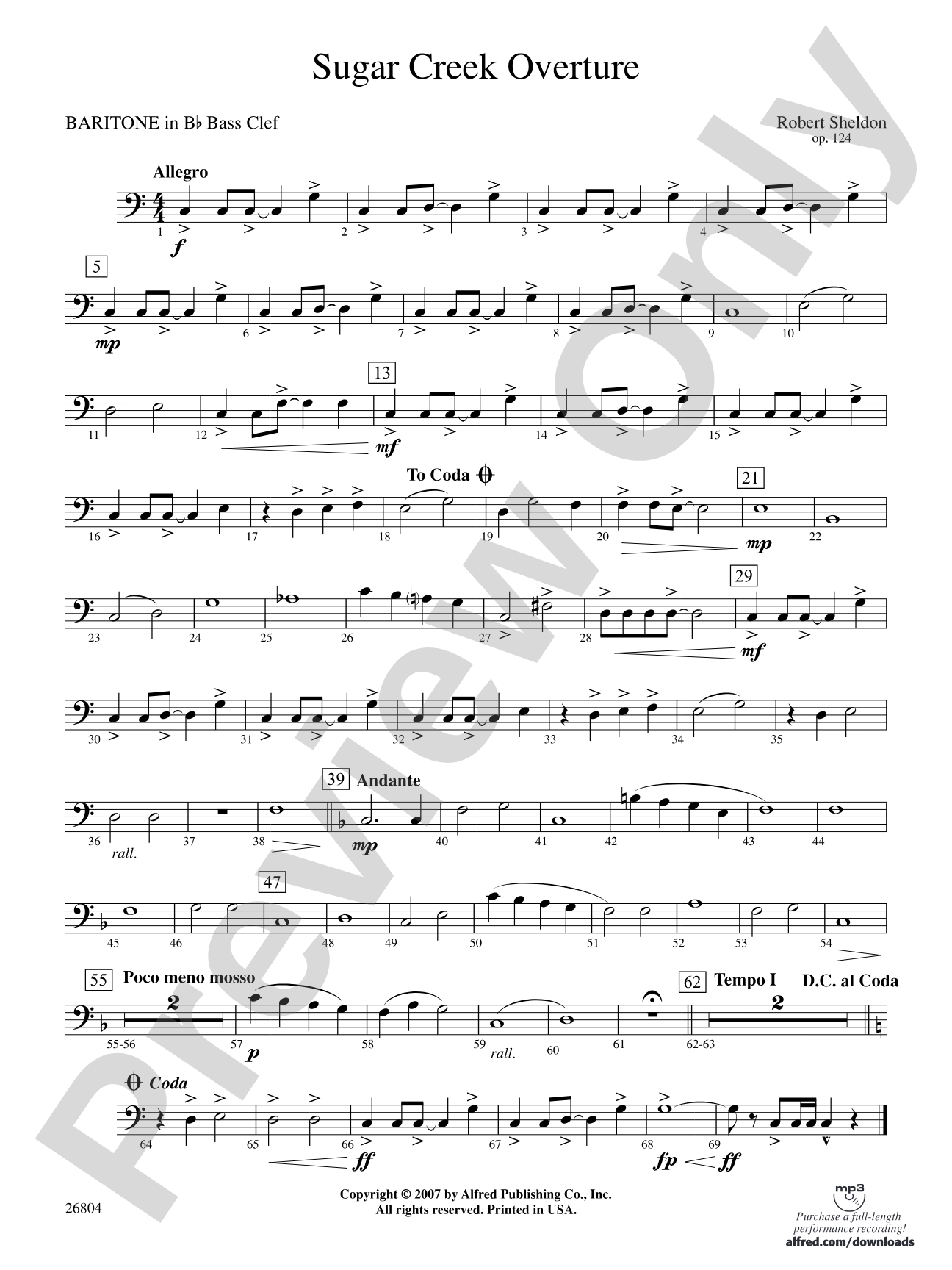

Sugar Creek Overture: (wp) B-flat Baritone B.C.
By Robert Sheldon
Grade: 1.5 (Easy)
Item: 00-PC-0001242_wpBBBC
$3.00
Pickup currently not available
Description
This lively concert overture features wonderful melodic lines with colorful harmonies and orchestration. The rhythmic opening yields to a lyrical contrasting section sure to evoke higher levels of expressive playing from the ensemble. An excellent choice for contest and festival programs! This title is available in MakeMusic Cloud.


Don't just read it, hear it, play along with it, and watch your students grow with it. In MakeMusic Cloud, Sugar Creek Overture: (wp) B-flat Baritone B.C. comes alive with professional accompaniment, adjustable tempo, and built-in practice tools that turn solo practice into real progress.
Open in the Player
Jump straight in and assign it today.
Start Your Free Trial
Open this title and explore the full library in minutes.
Sample Audio
1
Audio File
--:--
0:00
0:00
Sample Video
No sample videos found.
Additional Details
Series:
Challenger Band Series
Publisher:
Alfred Music
Page Count:
62
SKU:
00-PC-0001242_wpBBBC
More about this title
About the Composer: Robert Sheldon

Robert Sheldon stands among the most frequently performed composers in wind band repertoire. His works appear regularly on contest and festival programs worldwide, and he has conducted performances of his compositions in some of the world's most prestigious venues, from Carnegie Hall to the Sydney Opera House. Sheldon's list of honors includes recognition from the American School Band Directors Association, Phi Beta Mu, and ASCAP, reflecting the respect his music commands among music educators and peers.
Beyond composition, Sheldon shapes the field through teaching and mentorship. He authored Sound Innovations for Concert Band and maintains an active schedule as a guest conductor for All-State and Regional Honor Bands. His clinician work spans the United States and internationally, including appearances in Japan, Canada, Italy, Germany, Australia, and China. In 2020, VanderCook College of Music awarded him an honorary doctorate in recognition of his contributions to music education.
Why we love this
Sugar Creek Overture captures everything that makes Sheldon's writing so effective for developing ensembles: a clear dramatic arc that builds musician confidence while staying accessible, melodic material that rewards careful phrasing, and orchestration colorful enough to keep every section engaged. The contrast between the energetic opening and the lyrical middle section gives your band genuine musical substance to work with at a grade level where that's not always guaranteed.
What to expect
Sugar Creek Overture opens with immediate forward momentum and rhythmic drive, establishing an optimistic, almost celebratory mood. The music then shifts into a lyrical section that invites players to sing through their instruments, revealing the warm harmonies and melodic grace underneath the initial excitement. The overall effect is one of musical maturity wrapped in accessibility, rewarding both the ensemble and the listeners with genuine musical satisfaction.
Who it's for
This piece fits grade 1.5 bands ready to perform concert and festival repertoire with substance. Directors of developing ensembles will find the accessible ranges and part writing manageable while still requiring genuine musicianship. It works equally well for bands preparing for contest or building a concert program that entertains audiences.
How to get the most out of it
- Shape the rhythmic opening with precision and energy to establish the overture's character right away; this material sets expectations for articulation clarity throughout.
- Bring out the melodic lines in the lyrical section by allowing inner voices to breathe and support without overwhelming the principal voice.
- Balance the colorful harmonies by listening carefully across all four parts; Sheldon's orchestration rewards blend and intonation work at this level.
- Use tempo consistency as your baseline, but invite expressive flexibility in the contrasting section where the music naturally asks for it.
How to use it
Program this as an opening number on a concert to set an engaging, confident tone for the audience. Its contest and festival credentials make it a natural choice for music performance events, and its contrasting sections work well when placed next to either heavier dramatic fare or lighter novelty pieces. The overture structure also makes it an ideal bridge between different sections of a longer concert program.
Skills your students will build
- Articulation clarity and consistency across the ensemble in rhythmic passages
- Phrase shaping and expressive control in legato, lyrical sections
- Intonation balance across all parts in colorful harmonic contexts
- Tempo stability and musicianship within a traditional overture form