
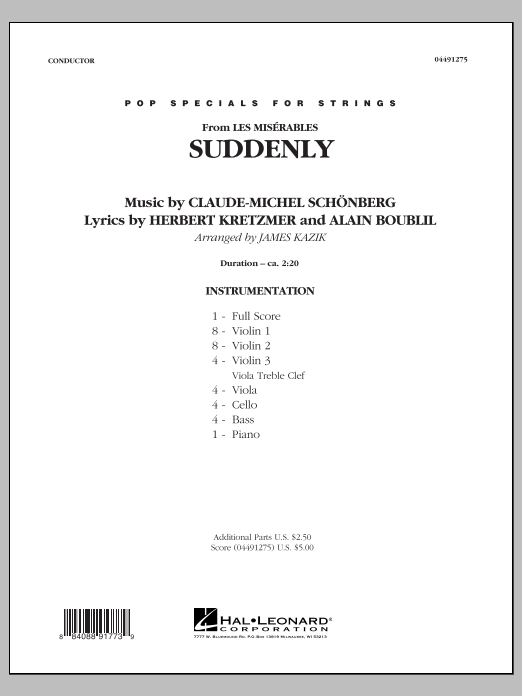

Suddenly (from Les Miserables): String Orchestra Conductor Score & Parts
By Alain Boublil / By Claude-Michel Schonberg / Arranged by James Kazik
Grade: 3-4
Item: 35-PK00276950
$45.00
Pickup currently not available
Buy Extra Parts (Digital PDF Download)
Parts Added to Cart!
Description
Composed especially for the film adaptation of "Les Miserables" and sung by Hugh Jackman ("Jean Valjean"), this song offers a beautiful and tender moment. Nicely scored for strings, this arrangement will sound full and confident with Jim Kazik's impressive arrangement. Dur: 2:20


Suddenly (from Les Miserables): String Orchestra Conductor Score & Parts isn't in MakeMusic Cloud just yet...but it could be. Let us know you'd like to see it, and you'll help shape what comes next. In the meantime, start a free trial and dive into thousands of interactive titles your students can play along with today.
Request This Title
Tell us you want it.
Start Your Free Trial
Explore everything that's ready to play right now.
Sample Audio
No sample audio found.
Sample Video
No sample videos found.
Additional Details
Publisher:
Hal Leonard
SKU:
35-PK00276950
More about this title
About the Composer: Alain Boublil
Alain Boublil stands as one of musical theater's most consequential lyricists and composers. His partnership with Claude-Michel Schönberg produced Les Misérables, the longest-running musical in Broadway history and a work that fundamentally changed what musical theater audiences expected from ambitious storytelling.
For music educators, Boublil's output offers a distinctive gift: songs built on melody lines that sing naturally for voices of all ranges, harmonies that reward careful listening, and emotional directness that resonates across age groups. His music refuses to condescend to younger performers or audiences.
Why we love this
Kazik's arrangement captures the intimate vulnerability of the original while giving string sections real texture and independence. Directors working with intermediate ensembles often struggle to find repertoire that feels substantial without demanding virtuosic technical facility; this hits that mark precisely, delivering a moment of genuine pathos that an audience will feel rather than simply witness.
What to expect
A quiet moment stolen from a larger story; the kind of scene where a character speaks truth and the world stops to listen. The strings create an almost chamber-like intimacy despite the full orchestration, with warmth rather than grandeur carrying the emotional weight.
Who it's for
String orchestras at the intermediate level who want to program contemporary musical theater without sacrificing musicality or depth. Teachers seeking a legitimate concert piece that students recognize and care about will find this assignment genuine rather than gimmicky.
How to get the most out of it
- Shape the opening phrases with a long, patient breath. This arrangement asks violins to carry the melody in a narrow register, so slight dynamic swells at phrase endings prevent the line from disappearing.
- Balance the inner voices carefully in measures where violas and cellos support the melodic line. They're not accompaniment here; they're harmonic partners that ground the tenderness.
- Resist the urge to rush. The 2:20 duration depends on allowing space and silence to matter. A tempo that feels slightly slow in rehearsal will feel exactly right to an audience.
- Use the final bars to let the ensemble breathe together. The way Kazik closes this piece should feel like a mutual decision to let go, not a trailing fade.
How to use it
Pair this with instrumental arrangements of other contemporary songs to build a concert around "modern voices in classical forms," or use it as an emotional centerpiece in a mixed repertoire program, particularly one that might otherwise skew toward light classical work. It also serves well as an encore after a more technically demanding piece, allowing the ensemble and audience a moment of repose.
Skills your students will build
- Sustaining long melodic lines across multiple phrase units while maintaining a consistent vibrato and tone quality
- Balancing independent inner voices within a harmonic structure
- Reading contemporary string writing that combines traditional notation with film scoring sensibilities
- Controlling dynamic subtlety in a piece that lives primarily in mezzo-piano to mezzo-forte
- Responding to emotional content as an interpretive ensemble rather than relying on tempo markings alone