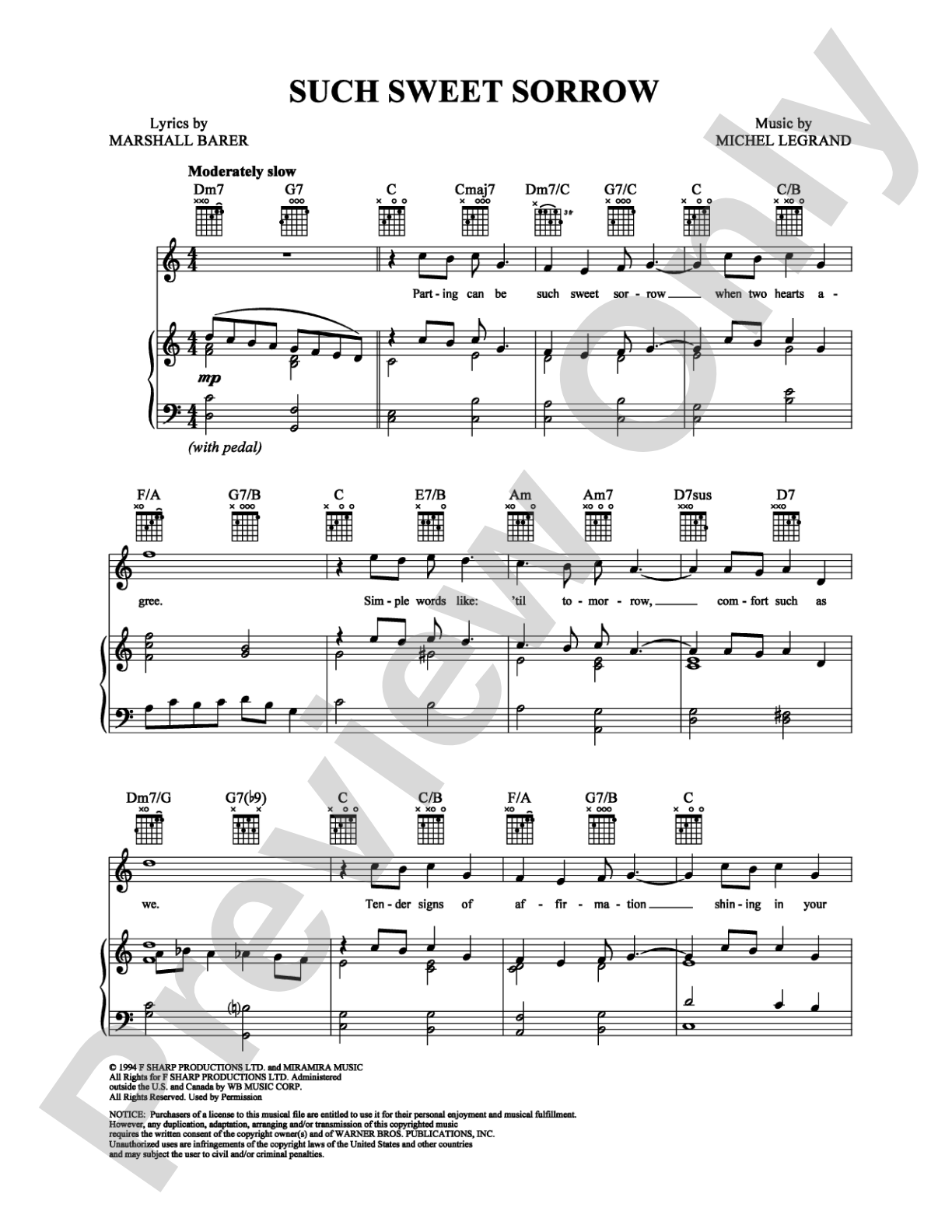
Such Sweet Sorrow: Piano/Vocal/Chords Digital Sheet Music

Such Sweet Sorrow: Piano/Vocal/Chords Digital Sheet Music

Michel Legrand, Michael Feinstein

Item: 00-PS-0009604

Digital Download
$2.95
Description

Such Sweet Sorrow: Piano/Vocal/Chords Digital Sheet Music isn't in MakeMusic Cloud just yet...but it could be. Let us know you'd like to see it, and you'll help shape what comes next. In the meantime, start a free trial and dive into thousands of interactive titles your students can play along with today.

Sample Audio
No sample audio found.
Sample Video
Additional Details
SKU: 00-PS-0009604

More about this title

About the Artist: Michael Feinstein

Michael Feinstein is a pianist and vocalist whose career centers on the Great American Songbook. His interpretations of standards from the 1920s through 1950s combine scholarly knowledge of the repertoire with warm, conversational delivery that makes classic songs feel immediate and personal rather than nostalgic.

Why we love this

This piano/vocal arrangement gives singers and pianists direct access to Feinstein's recorded interpretation without requiring transcription or guesswork about voicings and accompaniment style. The chords are all mapped out, making it ideal for collaborative rehearsal and for students learning how standards are typically performed in jazz and cabaret contexts.

What to expect

This standard carries a bittersweet, introspective quality befitting its title. The melody sits in an intimate range, and Feinstein's arrangement supports that intimacy with accompaniment that listens as much as it plays.

Who it's for

Pianists and singers preparing for jazz standards repertoire, vocal recitals, or cabaret-style performances will find this arrangement especially useful. Voice students and piano students working on accompaniment skills can both benefit from the clear chord notation and Feinstein's idiomatic voicings.

How to get the most out of it

  • Pay attention to the chord changes rather than fighting them; this song's elegance comes from harmonic movement, so let your voice ride over the accompaniment instead of doubling it.
  • Listen closely to phrasing in the recorded version if available; Feinstein's interpretations often stretch or compress phrases slightly for lyrical effect, and those choices become clear when you're working from his arrangement.
  • Balance the vocal line so it stays on top of the piano part even in passages where the left hand supports thick harmonies.

How to use it

Program this alongside other Great American Songbook standards in a vocal recital or jazz vocal concert. It works equally well as a solo feature or as part of a standards-focused curriculum unit exploring how classic songs transition from their original contexts to contemporary interpretation.

Skills your students will build

  • Reading lead sheet notation with chord symbols
  • Balancing melody and accompaniment in piano/vocal texture
  • Interpreting jazz-standard harmony and voice-leading
  • Collaborating between singer and pianist using a shared score

You May Also Like