
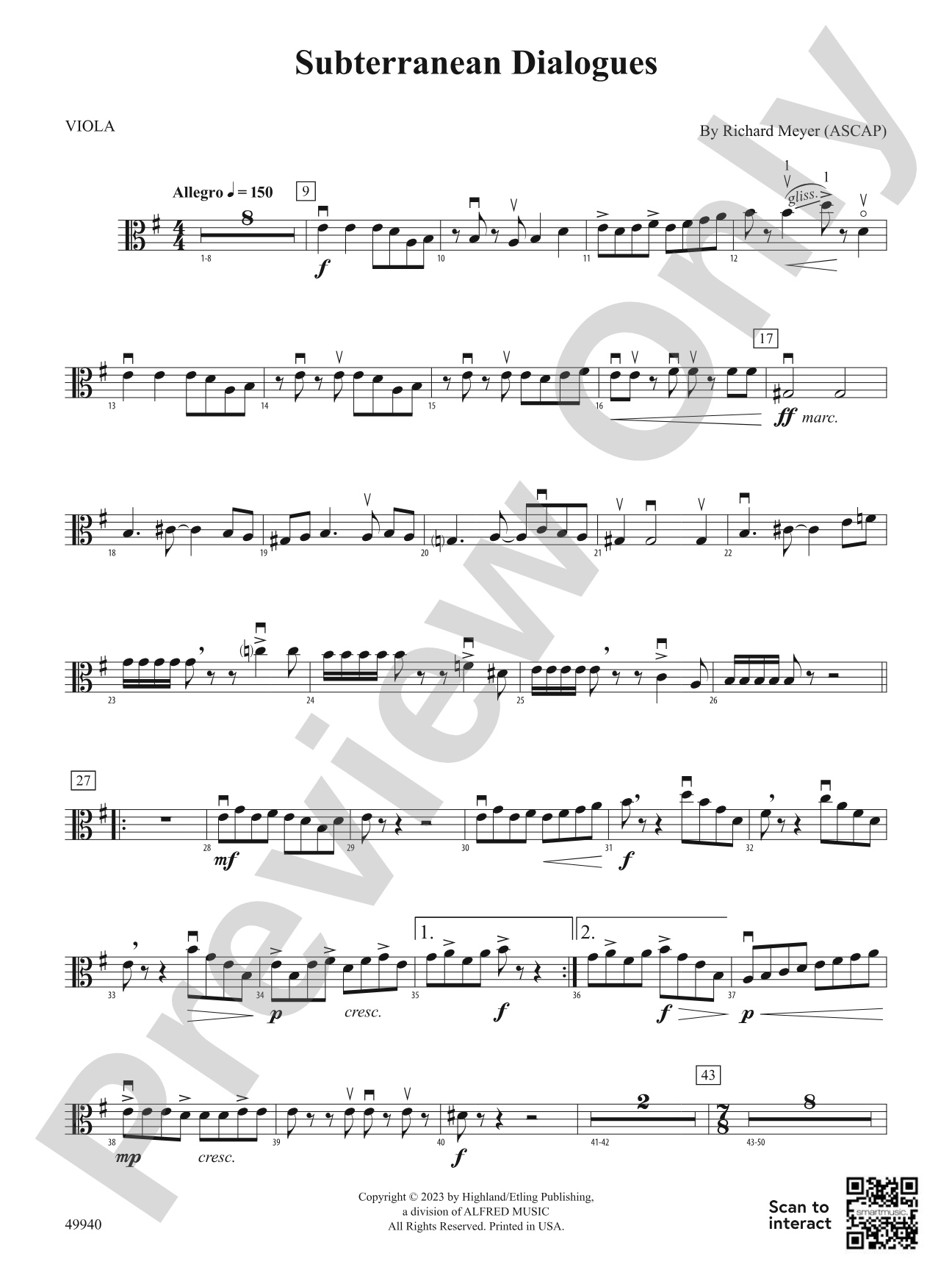

Subterranean Dialogues: Viola
By Richard Meyer
Grade: 4
Item: 00-PC-0019024_VA1
$7.99
Pickup currently not available
Description
Subterranean Dialogues, by Richard Meyer, is an edgy-sounding selection that is the perfect piece to feature your advanced string bass section while keeping all the players in your orchestra on their toes. The music unfolds as a series of dialogues, each a duet between the basses and a different section of the orchestra---violas, second violins, celli, and first violins. The wide variety of time signatures, shifting modes, and unusual orchestrations will challenge all of your musicians and delight your audience while putting the unsung heroes of your ensemble in a well-deserved spotlight. (5:00)


Don't just read it, hear it, play along with it, and watch your students grow with it. In MakeMusic Cloud, Subterranean Dialogues: Viola comes alive with professional accompaniment, adjustable tempo, and built-in practice tools that turn solo practice into real progress.
Open in the Player
Jump straight in and assign it today.
Start Your Free Trial
Open this title and explore the full library in minutes.
Sample Audio
1
Audio File
--:--
0:00
0:00
Sample Video
Additional Details
Series:
Highland/Etling String Orchestra
Publisher:
Alfred Music
SKU:
00-PC-0019024_VA1
More about this title
About the Composer: Richard Meyer

Richard Meyer has shaped string programs across Southern California for 35 years, teaching at the elementary through high school levels and directing orchestras at Oak Avenue Intermediate School in Temple City. Under his leadership, that program grew from 29 students to 200, and he expanded the city's elementary string initiative while conducting the Pasadena Youth Symphony Orchestra for 16 years, taking them on performance tours to New York, Washington D.C., Vienna, Australia, and Canada.
Beyond the rehearsal room, Meyer founded the "Giving Bach" program in 2009, an innovative concert series that has earned national recognition for bringing music to special needs and underserved students throughout Southern California. As a composer, he has over 190 works and arrangements published and served 16 years as string editor for Alfred Publishing Company. He co-authored the String Explorer Series and Sight-read It for Strings, and remains active as a guest clinician at major conferences including the A.S.T.A. National Conference and regional Honor Orchestra workshops.
Why we love this
Meyer understands the bass section's potential and writes music that refuses to let it fade into the background. The shifting time signatures and modal writing keep advanced players intellectually engaged while the conversation-based structure creates natural moments for rehearsal focus and dramatic pacing that audiences find genuinely compelling.
What to expect
The music unfolds like a series of urgent conversations underground, each one colored differently by harmonic shifts and unusual orchestrations. There's an intelligent edginess throughout, a sense that the piece knows its audience expects something more complex and rewarding than typical contest repertoire.
Who it's for
Advanced string orchestras that have the rhythmic sophistication and tonal control to navigate changing meters and modal harmony. This piece rewards programs ready to showcase mature bass players while challenging the entire ensemble beyond standard Grade 4 fare.
How to get the most out of it
- Highlight the bass line clearly in early rehearsals, especially during those opening dialogues with violas and second violins. Mark the shifts in color so basses understand when they're leading versus accompanying.
- Work the rhythmic precision around the time signature changes before layering in the full orchestration. These transitions are where the piece's edge lives, and rushing them dulls the effect.
- Balance the featured section against the basses intentionally during each dialogue. The point is conversation, not domination, so resist the urge to let the bass section overwhelm their partner voices.
- Let the unusual orchestrations breathe. Meyer's voicing choices are deliberate, so respect the spacing and resist the temptation to thicken textures beyond what's written.
How to use it
Program this as a festival or contest centerpiece that gives your advanced section the spotlight without sacrificing musical substance. Its five-minute length and distinctive character make it ideal for thematic programming around innovation or reimagining ensemble roles, and it serves as strong evidence of your program's technical maturity.
Skills your students will build
- Reading multiple time signatures in rapid succession
- Performing in and recognizing modal harmonic language
- Balancing ensemble color across unconventional orchestrations
- Sustaining rhythmic precision during shifting meters
- Understanding and executing sectional dialogue and call-and-response structures