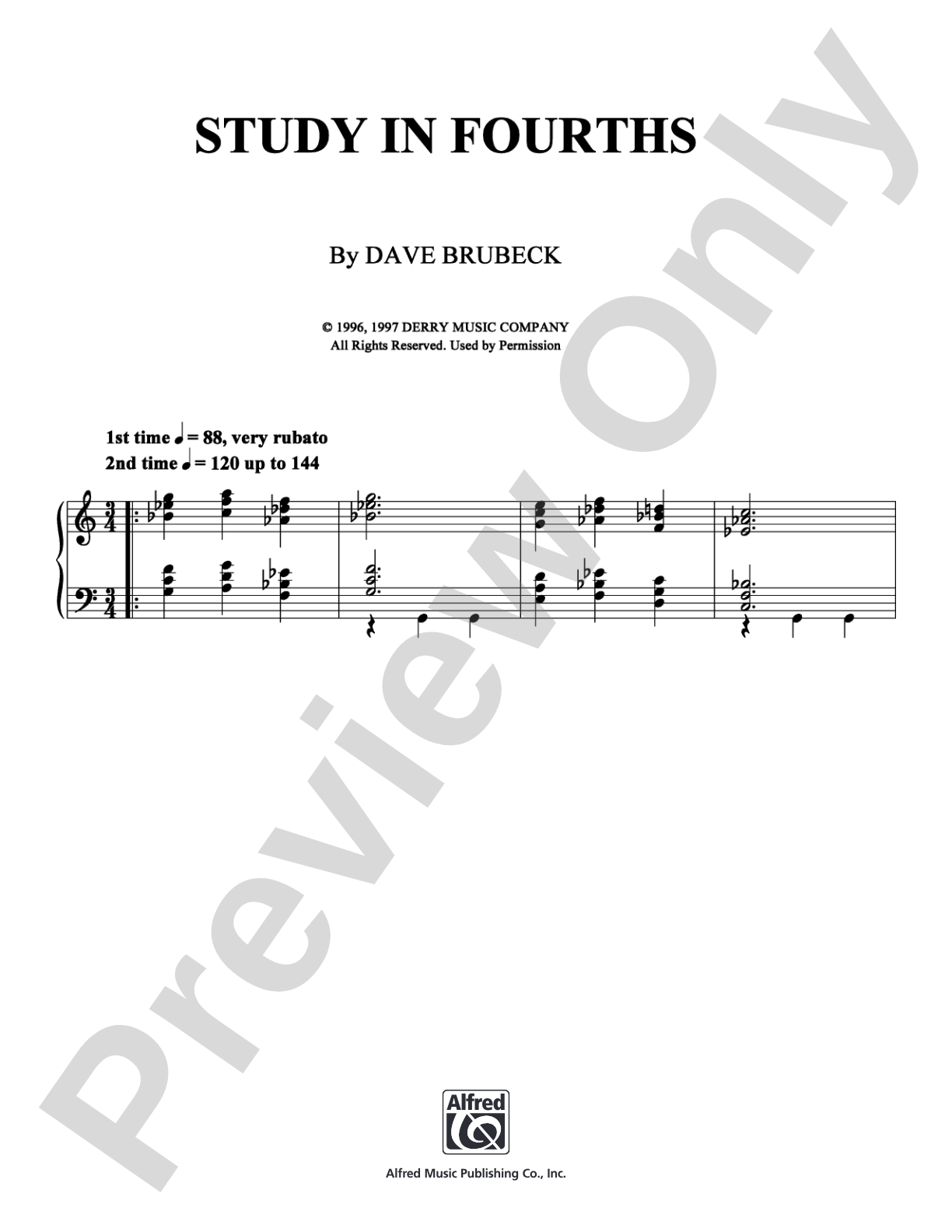
Study in Fourths: Piano Digital Sheet Music

Study in Fourths: Piano Digital Sheet Music

Dave Brubeck

Item: 00-PS-0008012

Digital Download
$3.99
Description

Study in Fourths: Piano Digital Sheet Music isn't in MakeMusic Cloud just yet...but it could be. Let us know you'd like to see it, and you'll help shape what comes next. In the meantime, start a free trial and dive into thousands of interactive titles your students can play along with today.

Sample Audio
No sample audio found.
Sample Video
Additional Details
SKU: 00-PS-0008012

More about this title

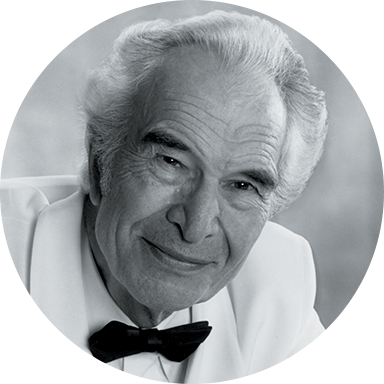
About the Artist: Dave Brubeck

Dave Brubeck

Dave Brubeck stands as one of jazz's most consequential pianists, equally fluent in improvisation and formal composition. His education under Darius Milhaud at Mills College shaped a compositional voice that wove jazz idioms into classical structures, resulting in works spanning choral pieces, chamber music, ballets, and large-scale orchestral projects. His album "Time Out" became the first jazz recording to sell over a million copies, and "Take Five" remains a cultural landmark. Beyond his musical innovations, Brubeck was a pioneering force for racial integration in mid-20th-century American music.

His serious classical works have been recorded by the London Symphony Orchestra and performed internationally, from Russia to Austria to Washington's National Cathedral. In 2003, he was elected to the American Classical Music Hall of Fame. His contributions to both jazz and concert music earned him the Presidential Medal of the Arts from President Clinton and a Grammy Lifetime Achievement Award, cementing his legacy as a musician who transcended genre boundaries.

Why we love this

Brubeck's "Study in Fourths" offers pianists a composition rooted in jazz language but constructed with disciplined harmonic thinking. This piece lets advanced students explore the intervallic implications of fourths in a real musical context rather than as an abstract exercise, making it particularly valuable for pianists developing jazz vocabulary alongside classical technique.

What to expect

The quartal harmony creates a modern, open sound that feels both introspective and forward-looking. Brubeck's compositional clarity keeps the piece moving with purpose, avoiding the diffuse quality quartal harmony can sometimes produce, resulting in a focused yet exploratory musical statement.

Who it's for

Advanced pianists seeking to bridge classical and jazz vocabularies will find this study essential. It works especially well for students preparing jazz auditions or those whose practice includes both concert repertoire and jazz styles.

How to get the most out of it

  • Listen closely to how fourths create harmonic ambiguity; resist over-resolving them in ways that classical harmony would demand, and instead let them breathe as stable sonorities in their own right.
  • Pay attention to the rhythmic freedom jazz allows while maintaining metric precision. The written notation captures Brubeck's voice, but your interpretation should honor the swing and inflection implied by the jazz idiom.
  • Balance the study's technical demands with its musical substance. This is neither pure finger work nor pure expression; approach it as composed jazz that rewards both precision and personality.

How to use it

Program this alongside other twentieth-century piano works to demonstrate how American composers absorbed jazz into concert music. It also works as a recital opener or closer for a program exploring harmonic modernism, and serves as an excellent study piece for the jazz-curious pianist building a more eclectic practice routine.

Skills your students will build

  • Harmonic thinking centered on quartal and quintal sonorities
  • Jazz articulation and inflection in a notated context
  • Reconciling rhythmic freedom with metric precision
  • Improvisation within Brubeck's compositional framework
  • Understanding harmonic substitution and modern jazz harmony

You May Also Like