
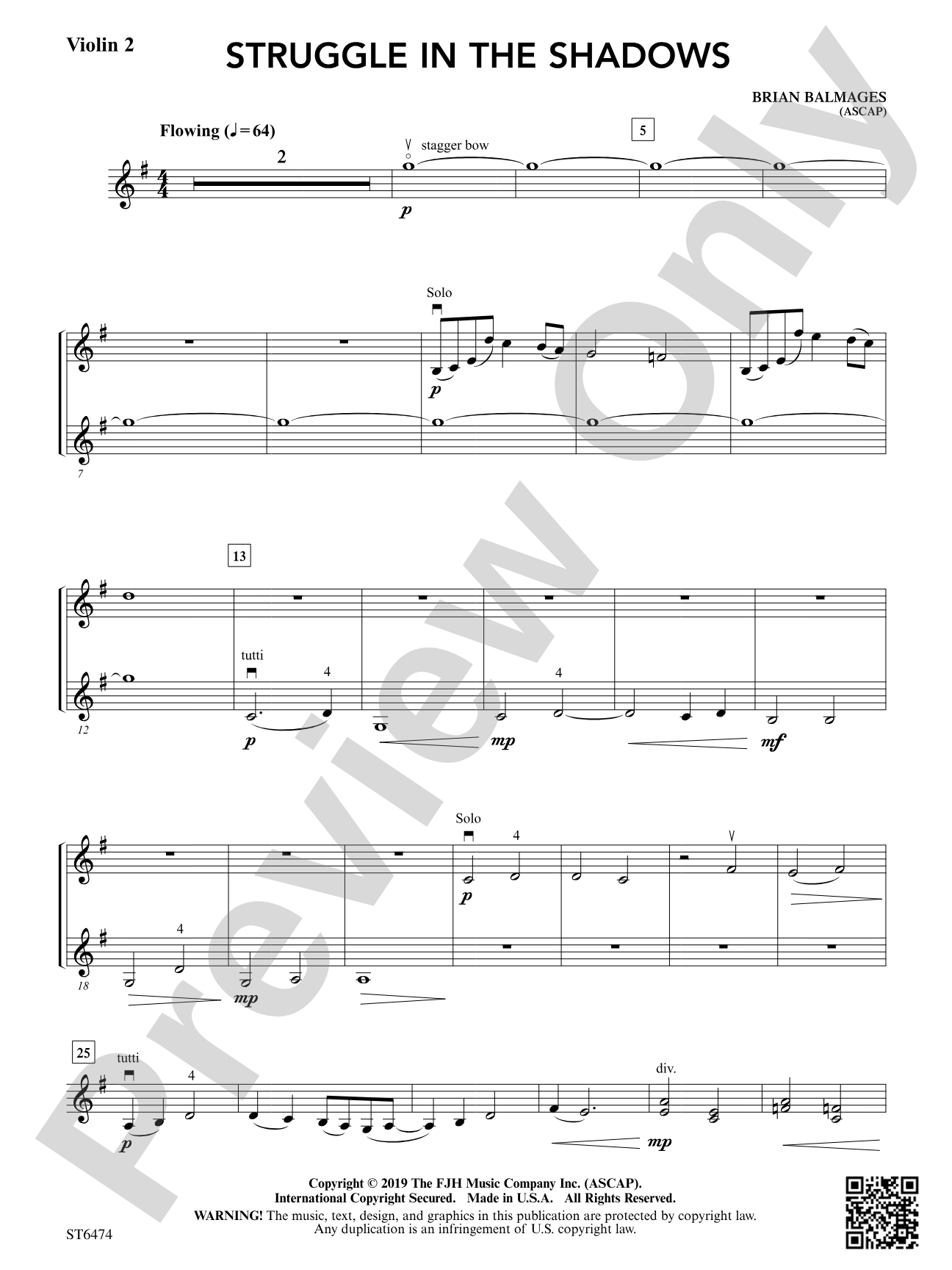

Struggle in the Shadows: Violin 2
By Brian Balmages
Grade: 3
Item: 98-PC-DST6474_VN2
$7.00
Pickup currently not available
Description
This powerful work tackles the issue of bullying in schools from the perspective of a student. Making use of a quartet within the ensemble (either a standard quartet or an option of using a second cellist instead of viola), the piece moves between the voices of the lonely and their experiences. From moments of solitude to anguish and hope, this piece seeks to bring light to an issue that continues to plague schools worldwide.


Struggle in the Shadows: Violin 2 isn't in MakeMusic Cloud just yet...but it could be. Let us know you'd like to see it, and you'll help shape what comes next. In the meantime, start a free trial and dive into thousands of interactive titles your students can play along with today.
Request This Title
Tell us you want it.
Start Your Free Trial
Explore everything that's ready to play right now.
Sample Audio
1
Audio File
--:--
0:00
0:00
Sample Video
Additional Details
Series:
FJH String Orchestra
Publisher:
The FJH Music Company, Inc.
SKU:
98-PC-DST6474_VN2
More about this title
About the Composer: Brian Balmages

Brian Balmages brings equal fluency to orchestral, band, and chamber music composition, having earned performances by everyone from professional symphony orchestras to elementary school ensembles across venues including Carnegie Hall, the Kennedy Center, and the Sydney Opera House. His honors include the A. Austin Harding Award from the American School Band Directors Association, the 2020 NBA William D. Revelli Composition Contest for Love and Light, and membership in the American Bandmasters Association. He received the inaugural James Madison University Distinguished Alumni Award and was later commissioned by the University of Miami to compose for the inauguration of its 6th president.
As a conductor, Balmages maintains a robust schedule guest conducting all-state ensembles, university groups, and professional orchestras worldwide, with notable appearances at the Midwest Clinic, Western International Band Clinic, and state ASTA conferences. His compositions have reached audiences at the 2013 Presidential Inaugural Prayer Service and continue to be programmed by serious student and professional ensembles. He currently serves as Director of MakeMusic Publications and Digital Education for Alfred and MakeMusic.
Why we love this
Balmages writes for strings with genuine orchestral voice and emotional depth, making this Grade 3 work substantial enough to matter musically while remaining accessible to developing orchestras. The flexible instrumentation option (second cello instead of viola) shows respect for real-world ensemble challenges, and the contest/festival designation signals that students will rise to the occasion when the subject matter feels important.
What to expect
The music moves between moments of quiet vulnerability and intense emotional turbulence, with solo quartet passages that feel almost exposed against the backdrop of the full ensemble. There is genuine urgency in the writing without melodrama, and a sense of growing resilience as the piece unfolds toward its conclusion.
Who it's for
String orchestras at the Grade 3 level looking for a serious work that engages students emotionally and musically without oversimplifying the subject matter. This piece serves conductors seeking repertoire that opens conversations about mental health and peer relationships while building ensemble musicianship.
How to get the most out of it
- Shape the quartet passages with particular attention to balance and intonation; these moments carry the narrative weight, so rehearse them as chamber musicians first, then reintegrate into the full texture.
- Establish the dynamic arc across entire sections rather than phrase-by-phrase, allowing the music's emotional progression from isolation through struggle to hope to build without constant resets.
- Ensure the second violin and viola parts lock rhythmically in the accompanying figures so the quartets' melodic voices stay clearly audible regardless of ensemble size.
- Use the conductor score to map where the emotional centers shift between instrument groups, then guide the ensemble to these focal points through gesture and eye contact rather than constant verbal instruction.
How to use it
Program this work as a centerpiece for a concert devoted to music with social meaning, pairing it with pieces that celebrate connection or resilience. Its contest/festival status makes it ideal for spring competitions, and the subject matter pairs naturally with assemblies or educational programming focused on student wellness.
Skills your students will build
- Reading and balancing quartet texture against full ensemble accompaniment
- Sustaining emotional focus through extended passages of dynamic and tonal variation
- Executing clean articulations and intonation in both exposed and dense orchestral contexts
- Responding to conductor direction that shapes longer narrative arcs rather than isolated phrases
- Understanding how orchestration choices serve dramatic and emotional content