
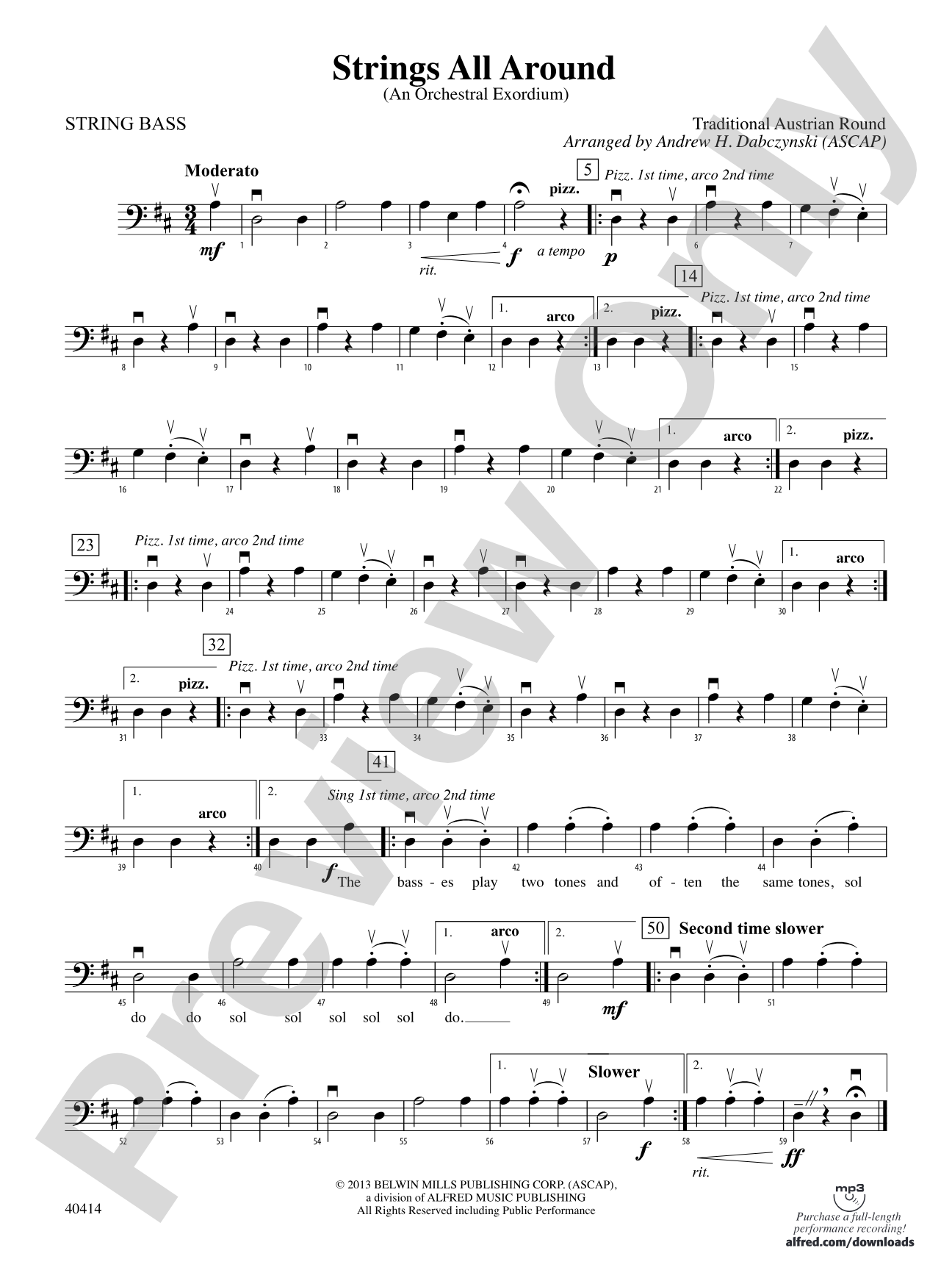

Strings All Around: String Bass
An Orchestral Exordium
Traditional Austrian Round / arr. Andrew H. Dabczynski
Grade: 1.5
Item: 00-PC-0015948_SB
$5.99
Pickup currently not available
Description
A light-hearted piece for introducing, recruiting, or simply featuring string players, every section is highlighted---even the second violins! This arrangement of an old favorite Austrian round is perfect for students within their first two years of study. Reproducible optional music pages allow for a sing-along with the audience or a choir. For the perfect "exordium" (introduction), Strings All Around is the right selection!


Don't just read it, hear it, play along with it, and watch your students grow with it. In MakeMusic Cloud, Strings All Around: String Bass comes alive with professional accompaniment, adjustable tempo, and built-in practice tools that turn solo practice into real progress.
Open in the Player
Jump straight in and assign it today.
Start Your Free Trial
Open this title and explore the full library in minutes.
Sample Audio
1
Audio File
--:--
0:00
0:00
Sample Video
No sample videos found.
Additional Details
Series:
Belwin Beginning String Orchestra
Publisher:
Alfred Music
Page Count:
82
SKU:
00-PC-0015948_SB
More about this title
About the Arranger: Andrew H. Dabczynski

Andrew H. Dabczynski has shaped string education across multiple institutions and roles. He founded and directed the BYU New Horizons Orchestra, a beginning ensemble that doubled as a training laboratory for string teachers, and received BYU's Joseph E. White Fellowship in recognition of that contribution. His career spans leadership positions at the Eastman School of Music, public school administration in Michigan and New York, and service on national committees with the American String Teachers Association, which honored him as Utah's Higher Education Teacher of the Year in 2005.
As both educator and performer, Dabczynski brings firsthand ensemble experience to his pedagogical work. He performed as violist with regional orchestras including the Rochester Philharmonic and Hartford Symphony, and served six years as a member of the Colden String Quartet at Western Michigan University. His scholarly interests in folk music and traditional music transmission inform his arranging, while his authorship of the String Explorer method series has made him widely recognized for expertise in string pedagogy.
Why we love this
This arrangement spotlights what makes beginning string orchestras work: every player gets a moment. Second violins and lower strings are genuinely featured, not buried, which builds confidence in students who haven't yet earned the principal chair. The familiar Austrian round gives students an immediate sense of ownership, and the optional sing-along pages let you blur the line between rehearsal and performance in a way that audiences will love.
What to expect
Warm and encouraging, with a folk tune's naturalness and accessibility. The arrangement sparkles with the energy of young players discovering they can make real music, and there's genuine humor in giving the "less showy" parts their turn in the spotlight. It feels like a celebration of ensemble membership itself.
Who it's for
Beginning string orchestras in their first or second year, whether in public schools, private academies, or community programs. Conductors seeking a morale-building piece that validates every section and gives reluctant second violins and cellists a genuine solo moment. Excellent for recruitment concerts, family concerts, or any program that needs to celebrate what beginning players can already accomplish together.
How to get the most out of it
- Balance the independent lines carefully during rehearsals. Because each section gets highlighted material, uneven tone or intonation in any voice will suddenly be noticeable. Use sectional work to lock each part's character before adding the full orchestra sound.
- If you add the audience sing-along option, conduct the string parts with clarity and precision so singers can follow without drowning out the ensemble. The reproducible pages give you flexibility to choose verses, so plan this in advance.
- Lean into the lightness of the piece. This is the right moment to teach phrasing and shape without the weight of a complex harmonic structure getting in the way. Subtle dynamic shaping will make the familiar tune feel fresh.
How to use it
Open a concert or recruitment event with this piece as the perfect exordium. Its familiarity and upbeat character immediately engage audiences and parents, while the highlighted sections signal to observers that every student in the orchestra has value. The optional sing-along feature transforms it into a participatory moment that families remember long after the curtain falls.
Skills your students will build
- Balanced ensemble listening and blend across all four string voices
- Confident solo playing in a full-orchestra setting
- Shaping phrase contours and responding to conductor gestures
- Reading and executing parts that shift between accompanied and featured roles