
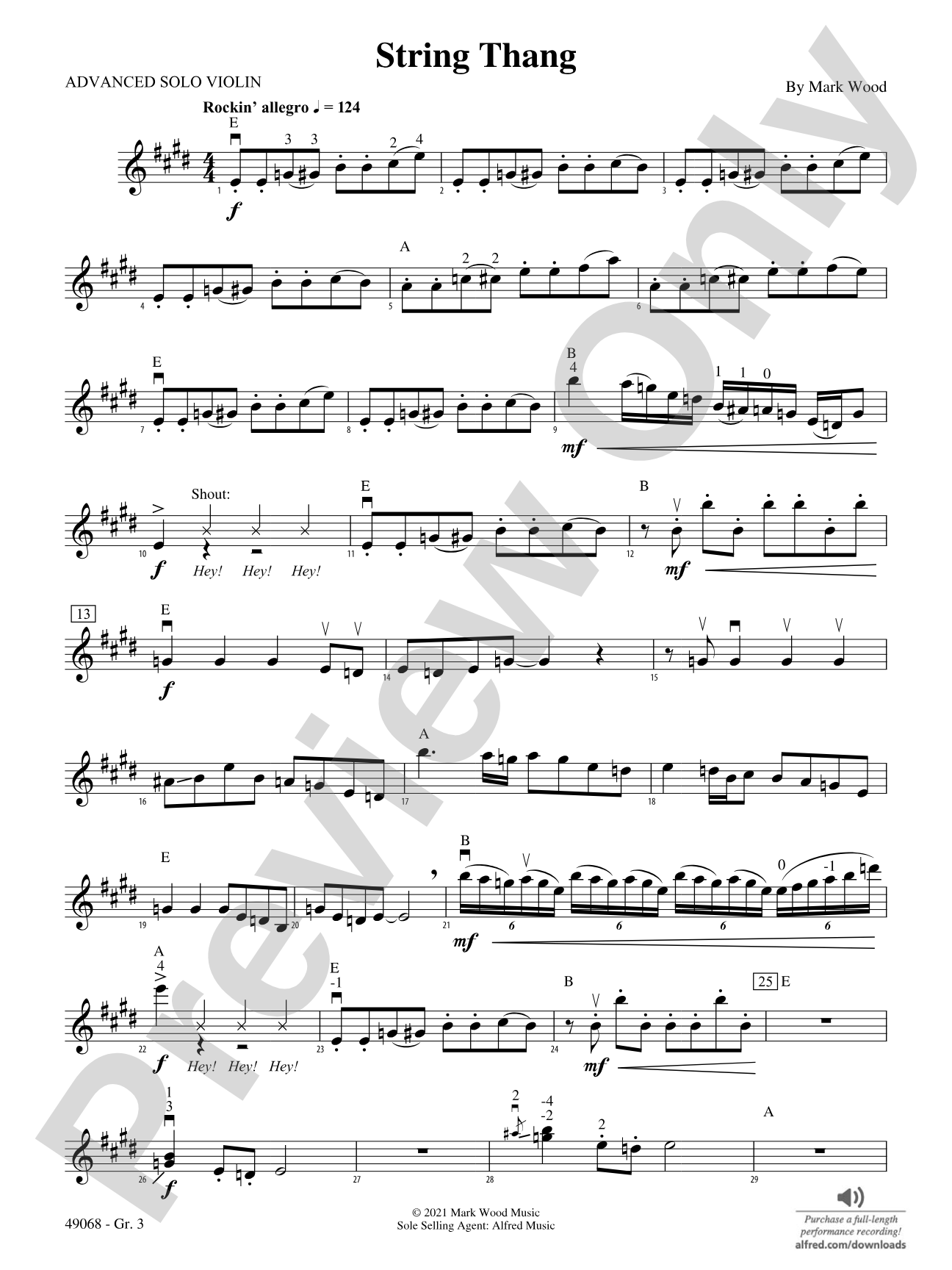

String Thang: Advanced Solo Violin
By Mark Wood
Grade: 2 & 3
Item: 00-PC-0019152_ASVN
$3.00
Pickup currently not available
Description
This multi-level piece includes a full set of parts for grade 2 as well as a full set for grade 3 ensembles. Mix and match the parts as you need---perfect for mixed-ability ensembles!
String Thang by Mark Wood is based on the twelve-bar blues. The blues has deep roots in American history, developed out of the work songs and chants of African-American slaves. The Great Migration of the first half of the 20th century saw freed slaves and their descendants move to northern and eastern parts of the U.S., taking their music with them. The blues took on different forms; in turn it helped to create rock, jazz, hip-hop, and other popular genres. A twelve-bar blues uses a repeating chord progression which allows musicians to express themselves creatively with each recurrence. If anything defines the blues, it is the use of "blue notes"---pitches that don't usually belong in a given key---and elements of improvisation. String Thang uses both blue notes in the main tune and the solo violin's part, as well as improvisational principles in the solo. For string orchestra with optional rock rhythm section parts. (2:45)
Download Play-Along Track


String Thang by Mark Wood is based on the twelve-bar blues. The blues has deep roots in American history, developed out of the work songs and chants of African-American slaves. The Great Migration of the first half of the 20th century saw freed slaves and their descendants move to northern and eastern parts of the U.S., taking their music with them. The blues took on different forms; in turn it helped to create rock, jazz, hip-hop, and other popular genres. A twelve-bar blues uses a repeating chord progression which allows musicians to express themselves creatively with each recurrence. If anything defines the blues, it is the use of "blue notes"---pitches that don't usually belong in a given key---and elements of improvisation. String Thang uses both blue notes in the main tune and the solo violin's part, as well as improvisational principles in the solo. For string orchestra with optional rock rhythm section parts. (2:45)
Download Play-Along Track
String Thang: Advanced Solo Violin isn't in MakeMusic Cloud just yet...but it could be. Let us know you'd like to see it, and you'll help shape what comes next. In the meantime, start a free trial and dive into thousands of interactive titles your students can play along with today.
Request This Title
Tell us you want it.
Start Your Free Trial
Explore everything that's ready to play right now.
Sample Audio
1
String Thang (level 2)
--:--
2
String Thang (level 3)
--:--
String Thang (level 2)
0:00
0:00
Sample Video
Additional Details
Series:
Mark Wood Series
Publisher:
Alfred Music
SKU:
00-PC-0019152_ASVN
More about this title
About the Composer: Mark Wood

Mark Wood has spent four decades transforming the orchestra world through his innovative approach to the electric violin. A founding member of Trans Siberian Orchestra and a prolific composer for film and television, Wood has earned an Emmy Award and collaborated with artists across multiple genres, from Paul McCartney to Lenny Kravitz. PBS dubbed him "The Eddie Van Halen and Jimi Hendrix of The Violin World" for his role in pioneering the electric violin as a solo and ensemble instrument.
Beyond his touring and recording career, Wood is deeply committed to music education and accessibility. His compositions for young orchestras bring the energy and innovation he's known for into the rehearsal room, introducing students to contemporary musical styles and demonstrating how classical training intersects with popular genres. His work with The Juilliard School and his extensive educational outreach reflect his belief that orchestral music thrives when it speaks to young musicians' lived experience.
Why we love this
String Thang walks into the rehearsal room with real cultural weight. Rather than treating the twelve-bar blues as background, Wood centers it, teaches it, and lets students feel how it became the foundation for rock, jazz, and hip-hop. The dual-level scoring also solves the genuine challenge of mixed-ability ensembles without resorting to simplified arrangements; both parts hold their own musically, and the flexibility to mix and match means every player stays engaged.
What to expect
Gritty, energetic, and rooted. The twelve-bar blues progression creates a hypnotic, groove-based foundation while the solo violin soars with blues inflections and attitude. The piece moves with the swagger of rock music but the sophistication of orchestral arrangement, making students feel like they're playing something that matters in the real musical world.
Who it's for
String orchestras with mixed ability levels who want to engage students with authentic American musical traditions. The dual-grade scoring makes it accessible for groups where Grade 2 and Grade 3 players rehearse together, while the optional rock rhythm section (if your ensemble has drums, bass, and keyboard) opens doors for interdisciplinary collaboration.
How to get the most out of it
- Isolate the blue notes in rehearsal before combining parts. The flattened pitches will feel unfamiliar to students trained in major and minor scales; naming them and singing them separately clarifies their function in the progression.
- Use the solo violin section as a teaching moment about improvisation. Even if your soloist plays the written part exactly, discuss what it represents—the freedom and personal expression that defines blues tradition—so students understand the style, not just the notes.
- Balance the ensemble parts so the main tune carries over the rhythm section. The blues progression repeats and hypnotizes; the melody is what hooks the listener. Check levels at rehearsal to ensure clarity.
- Lean into the rock character. This isn't a classical piece wearing a blues costume. The rhythm section parts should groove with the confidence of a rock band, not the precision of a classical ensemble.
How to use it
Program String Thang as a bridge between classical and contemporary music in a concert context, or use it as an ensemble-builder early in the year when motivation runs high and complexity can stay manageable. It also works beautifully as a teaching tool when you're studying American music history, blues, or the roots of contemporary genres; the piece demonstrates ideas directly rather than explaining them.
Skills your students will build
- Reading and performing blue notes within a major/minor tonal context
- Understanding twelve-bar blues chord progressions and harmonic structure
- Playing with rhythmic independence in rock/groove settings
- Balancing ensemble texture (melody, harmony, rhythm section roles)
- Responding to stylistic cues beyond classical notation (swing feel, groove placement)