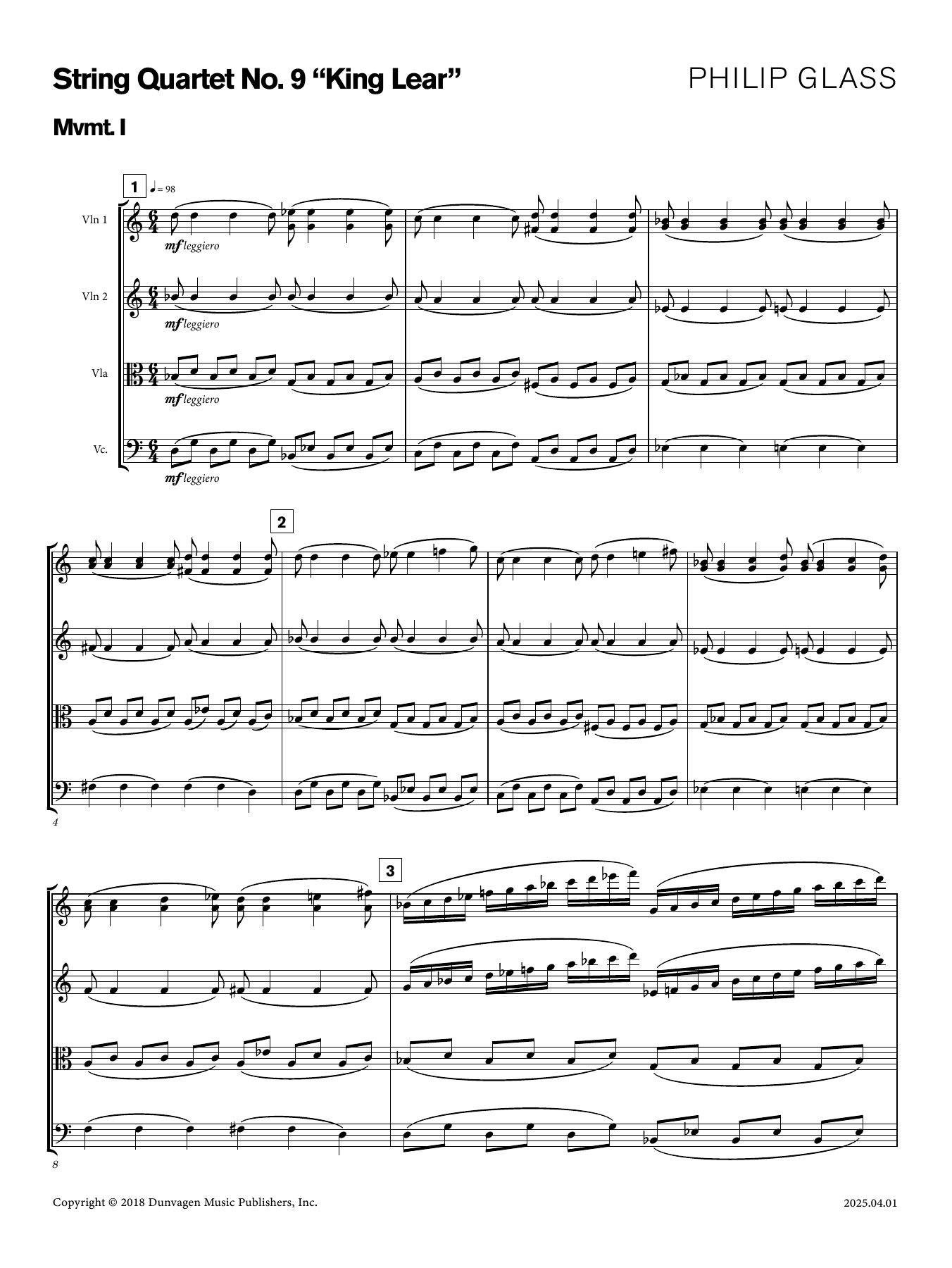
String Quartet No. 9 (Score) Sheet Music Preview

String Quartet No. 9 (Score)

By Philip Glass

Item: 35-PK01644868

Digital Download
$22.99
Description
String Quartet No. 9 (Score)

String Quartet No. 9 (Score) isn't in MakeMusic Cloud just yet...but it could be. Let us know you'd like to see it, and you'll help shape what comes next. In the meantime, start a free trial and dive into thousands of interactive titles your students can play along with today.

Sample Audio
No sample audio found.
Sample Video
Additional Details
Publisher: Hal Leonard
SKU: 35-PK01644868

More about this title

About the Composer: Philip Glass

Philip Glass is a composer whose minimalist approach has fundamentally reshaped how we think about form, harmony, and repetition in contemporary music. His work across opera, symphony, and chamber music demonstrates that systematic processes and mathematical structures can generate profound emotional resonance. For string quartets specifically, Glass's mature works reveal an evolution from pure minimalist rigor toward greater harmonic richness and expressive nuance, making his later quartets essential repertoire for ensembles seeking to engage meaningfully with late 20th-century composition.

Why we love this

Glass's later string quartets occupy rare territory: they're intellectually rigorous enough to sustain serious musicians yet accessible enough that audiences hear melody and emotional shape immediately. This score opens a conversation about what minimalism actually is, inviting your ensemble to move beyond stereotypes and discover how constraint becomes liberation.

What to expect

The work unfolds with hypnotic clarity, building momentum through gradual harmonic and textural evolution rather than dramatic contrast. You'll encounter moments of crystalline beauty alongside passages of structural inevitability, creating an experience that feels both meditative and intellectually present.

Who it's for

String quartets with experience in contemporary repertoire and comfort with systematic compositional approaches. This score works best for ensembles ready to engage audiences in extended listening, whether in recital or as part of a survey of late 20th-century chamber writing.

How to get the most out of it

  • Establish unwavering ensemble pulse from the first measure; Glass's architecture depends on absolute rhythmic precision from all four players.
  • Resist the impulse to shape phrases through traditional rubato. Instead, find expressive depth through consistent tone quality and dynamic clarity.
  • Map the harmonic shifts carefully in rehearsal so that even subtle chord changes register with your ensemble. The power lies in these transitions, not in overt gesture.
  • Balance collective sound so that each voice remains audible. Glass's orchestration rarely doubles parts; every line matters.

How to use it

Pair this with earlier Glass works or with other minimalist composers to trace aesthetic development, or use it as the centerpiece of a concert exploring how constraint shapes contemporary chamber music. It also serves well as a closing piece, leaving audiences in reflective space.

Skills your students will build

  • Ensemble intonation across extended harmonic shifts
  • Rhythmic precision within cyclical structures
  • Reading and interpreting minimalist notation
  • Sustaining consistent tone quality across repetitive figures
  • Harmonic analysis of non-traditional progression

You May Also Like