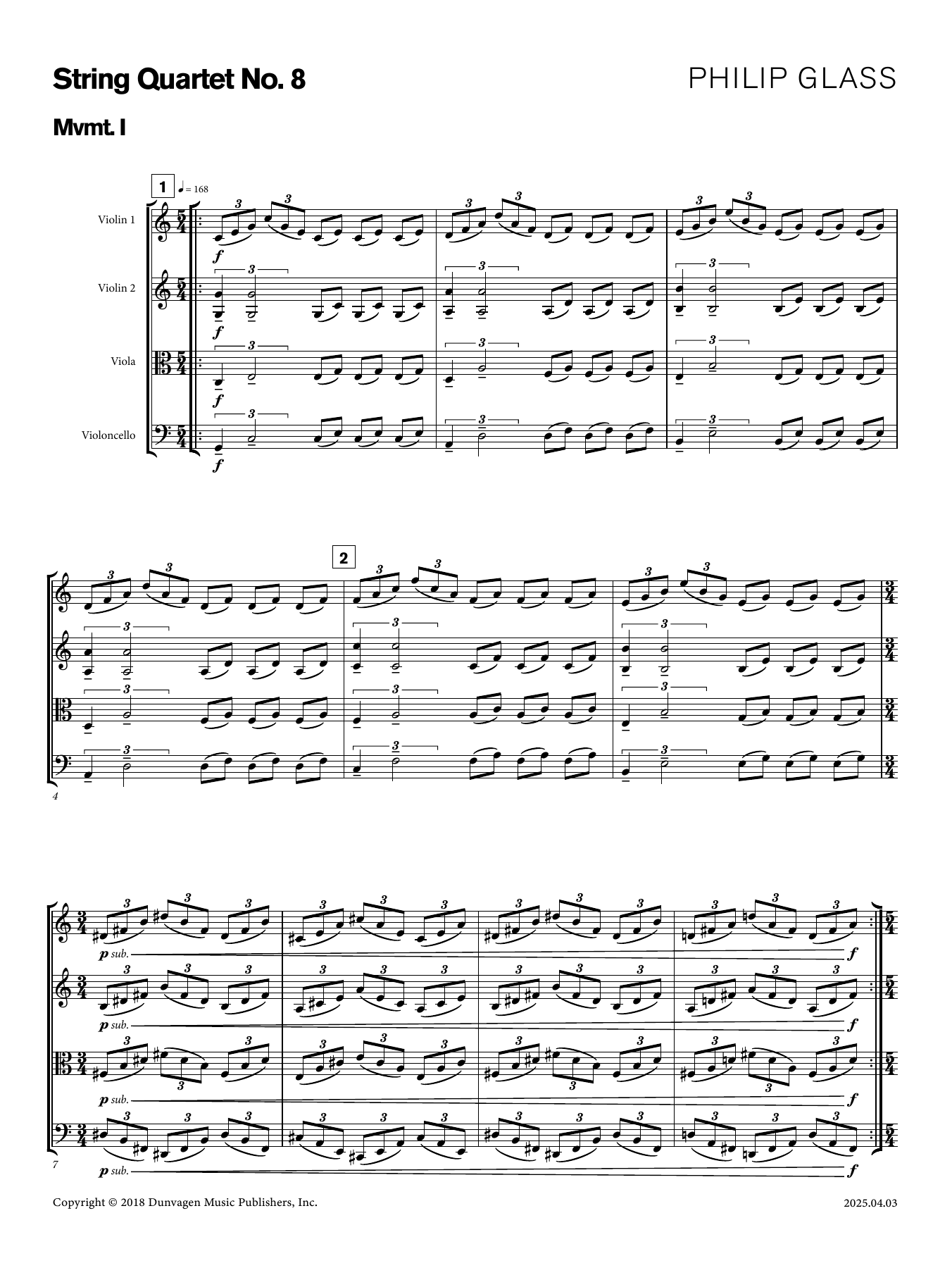
String Quartet No. 8 (Score) Sheet Music Preview

String Quartet No. 8 (Score)

By Philip Glass

Item: 35-PK01644867

Digital Download
$16.99
Description
String Quartet No. 8 (Score)

String Quartet No. 8 (Score) isn't in MakeMusic Cloud just yet...but it could be. Let us know you'd like to see it, and you'll help shape what comes next. In the meantime, start a free trial and dive into thousands of interactive titles your students can play along with today.

Sample Audio
No sample audio found.
Sample Video
Additional Details
Publisher: Hal Leonard
SKU: 35-PK01644867

More about this title

About the Composer: Philip Glass

Philip Glass stands as one of the most influential composers of the late 20th century, fundamentally reshaping how musicians think about structure, repetition, and harmonic movement. His minimalist approach, developed through decades of experimentation with additive processes and arpeggiated figures, has influenced composers across classical, jazz, and popular music. For music educators, Glass represents a vital bridge between traditional concert music and contemporary listening habits, offering students a concrete model of how constraint breeds creativity.

Why we love this

Glass's chamber works demand that players internalize a fundamentally different relationship to pulse and phrasing than the Romantic quartets that dominate the canon. Programming this score gives your ensemble genuine exposure to minimalist structure while remaining acoustically and technically manageable, without sacrificing artistic depth or audience engagement.

What to expect

Hypnotic yet propulsive, like watching light refract through shifting layers of glass. The repeated figures create a meditative forward momentum that accumulates emotional weight through gradual harmonic transformation rather than dramatic gesture.

Who it's for

String quartets ready to expand their repertoire beyond the standard classical and romantic works, and ensemble directors seeking literature that develops precision, collective listening, and comfort with contemporary harmonic language. This score works for accomplished high school quartets through professional ensembles.

How to get the most out of it

  • Establish the pulse early in rehearsal using a metronome, then gradually wean the group from it once the internal sense of timing locks in. Glass's repetitive figures are only effective when the ensemble truly owns the tempo rather than fighting it.
  • Isolate the arpeggiated patterns by parts in separate rehearsals. Each instrument has a distinct rhythmic profile that may feel counterintuitive until the players understand their role in the larger texture.
  • Experiment with dynamics more than you might initially expect. While Glass favors economy of gesture, subtle shifts in volume and tone color are what prevent the music from becoming static across longer sections.
  • Resist the urge to accelerate unconsciously during repeated figures. Many ensembles naturally rush through minimalist textures; deliberate attention to tempo stability makes the harmonic shifts far more audible.

How to use it

Pair this with another 20th or 21st century work to frame a concert around contemporary approaches to form and tonality, or feature it as a solo quartet piece in a chamber series where audiences expect artistic risk. This score also works as an educational centerpiece for a concert or rehearsal exploring minimalism's impact on classical music.

Skills your students will build

  • Maintaining absolute rhythmic stability within repetitive figures
  • Recognizing and executing additive harmonic processes
  • Balancing individual lines within a complex textural composite
  • Performing with precision across extended durations without relying on traditional phrase architecture
  • Listening acutely for subtle harmonic shifts in minimalist contexts

You May Also Like