String Quartet No. 6 Pluie Oblique: Épigrammes Pessoëns Sheet Music Preview

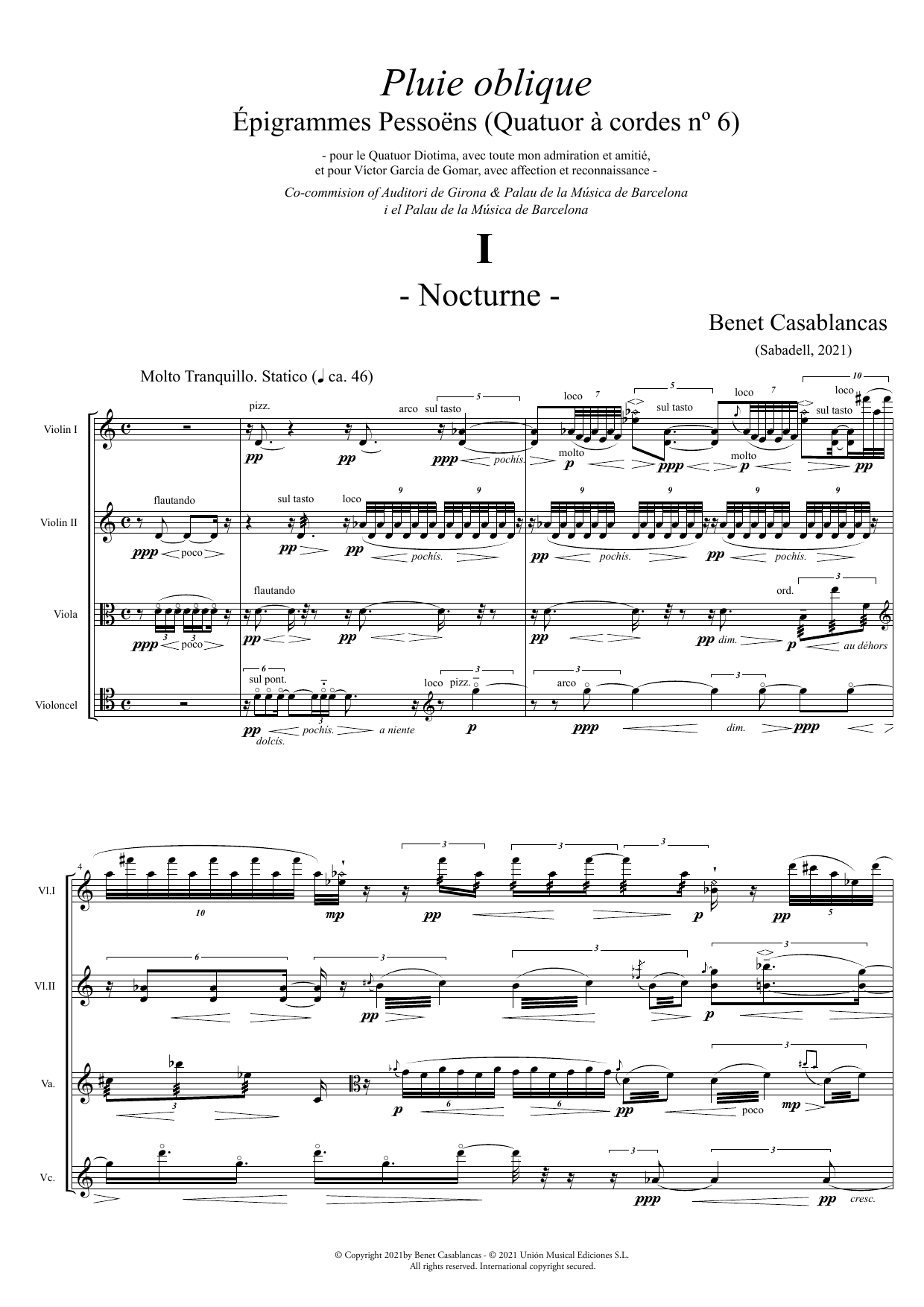
String Quartet No. 6 Pluie Oblique: Épigrammes Pessoëns

By Benet Casablancas

Item: 35-PK01776124

Digital Download
$40.00
Description
Score and parts

String Quartet No. 6 Pluie Oblique: Épigrammes Pessoëns isn't in MakeMusic Cloud just yet...but it could be. Let us know you'd like to see it, and you'll help shape what comes next. In the meantime, start a free trial and dive into thousands of interactive titles your students can play along with today.

Sample Audio
No sample audio found.
Sample Video
Additional Details
Publisher: Hal Leonard
SKU: 35-PK01776124

More about this title

About the Composer: Benet Casablancas

Benet Casablancas is a Spanish composer whose work sits at the intersection of contemporary classical writing and deep engagement with literary modernism. His compositional voice combines rigorous structural thinking with poetic sensibility, often drawing inspiration from text and philosophical ideas to shape instrumental form.

Why we love this

This quartet refuses easy answers. The subtitle references Fernando Pessoa's epigrammatic fragments, and Casablancas mirrors that aesthetic through music that is concise, contemplative, and densely imagined. Programming it signals serious musicians engaged with twentieth-century string writing.

What to expect

Sparse and introspective, with moments of sudden intensity. The music moves with deliberation, building impressionistic texture through careful layering rather than traditional development. There is a quality of observation here: less about narrative arc and more about capturing a precise moment of experience.

Who it's for

Quartets with experience in post-tonal and contemporary repertoire who are ready for intellectual rigor alongside technical demands. This works for advanced chamber programs, academic settings, and contemporary music ensembles looking to expand their Spanish and Catalan repertoire.

How to get the most out of it

  • Balance the ensemble carefully across all four voices; Casablancas layers independent lines that demand equal sonic presence rather than traditional hierarchy.
  • Study the score as a literary object first. Understanding what Pessoa's epigrammatic mode demands will clarify the musical phrasing and gesture.
  • Resist the urge to over-romanticize. The oblique rain of the title suggests something precise and angled, not swept or sentimental.
  • Mark breath points and fermatas with rehearsal care. They function as punctuation and silence matters as much as sound.

How to use it

Pair this with other twentieth-century chamber works to create a program focused on modernist aesthetics in music. It also serves as a valuable teaching piece for quartets preparing for contemporary music festivals or academic competitions. The modest duration makes it an excellent opener for a concert themed around brevity and concentration.

Skills your students will build

  • Reading contemporary notation and extended techniques
  • Independent voice leading in post-tonal harmony
  • Ensemble balance in non-traditional textures
  • Interpretive choices in music without traditional cadential or harmonic anchors
  • Intonation in microtonal or chromatic passages

You May Also Like