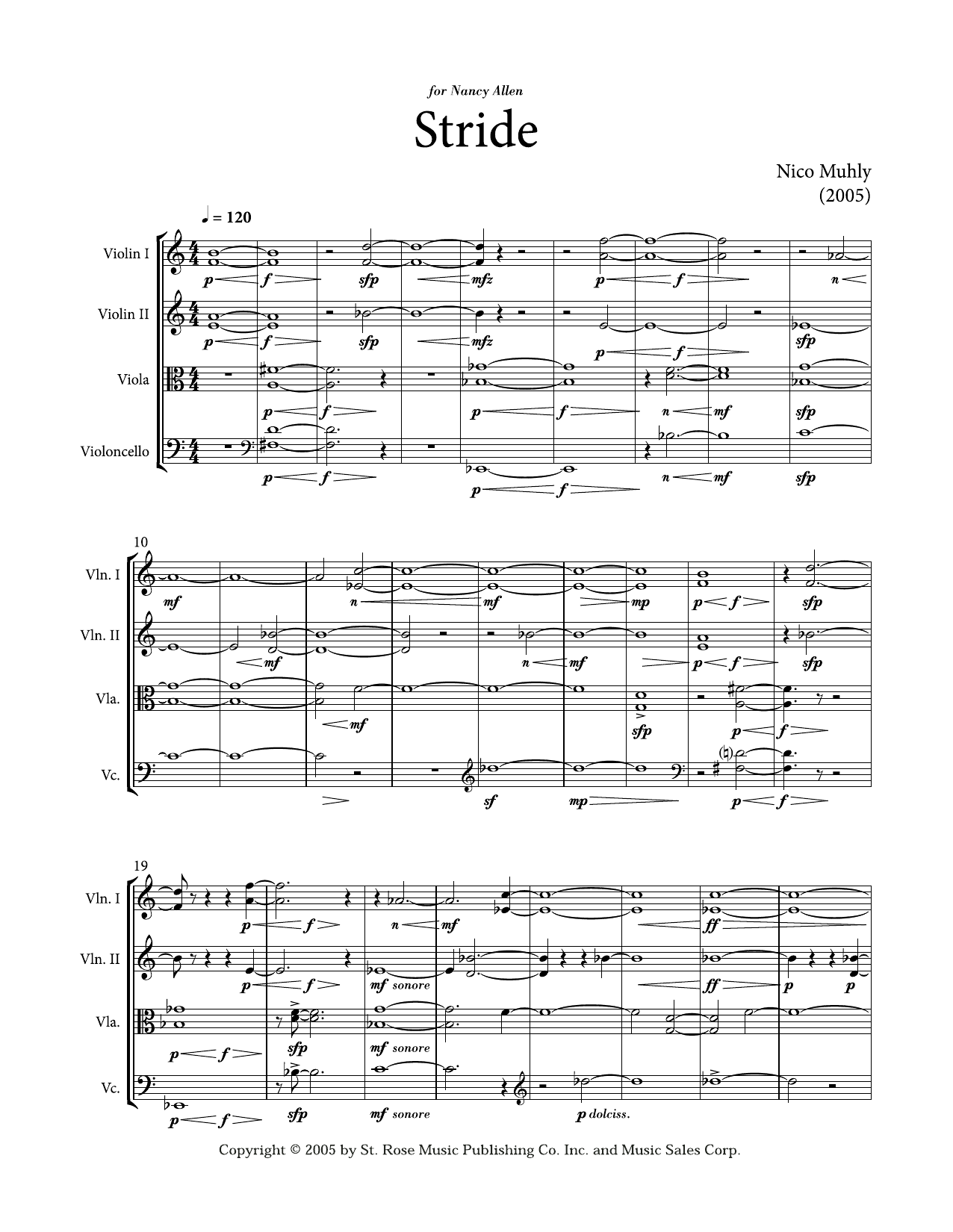
Stride (Score and Parts)

By Nico Muhly

Item: 35-PK00495043

Digital Download
$23.99
Description
Stride (Score and Parts)

Stride (Score and Parts) isn't in MakeMusic Cloud just yet...but it could be. Let us know you'd like to see it, and you'll help shape what comes next. In the meantime, start a free trial and dive into thousands of interactive titles your students can play along with today.

Sample Audio
No sample audio found.
Sample Video
Additional Details
Publisher: Hal Leonard
SKU: 35-PK00495043

More about this title

About the Composer: Nico Muhly

Nico Muhly is an American composer whose output spans opera, orchestral works, chamber music, and choral writing. He studied at Columbia University and has become one of the most performed contemporary composers in the United States, with commissions from major orchestras, opera companies, and ensembles across the country.

Muhly's compositional voice balances structural rigor with emotional directness. His work often engages with minimalist traditions while pushing toward lyrical, accessible writing that doesn't sacrifice sophistication. He has composed for performers ranging from professional orchestras to student musicians, bringing the same care to each context.

Why we love this

Muhly writes with genuine understanding of what makes music come alive in performance. Stride feels immediately playable while maintaining the kind of harmonic and rhythmic interest that keeps rehearsals engaging and prevents student musicians from checking out during repeated run-throughs.

What to expect

The title suggests motion and energy, a sense of purposeful forward movement. This is music that propels itself; it has the clarity of contemporary minimalism without feeling static or repetitive. There's intelligence in the orchestration and a directness of emotional expression that feels immediate rather than opaque.

Who it's for

Stride works for chamber ensembles, wind groups, or orchestral sections looking to program contemporary music that sounds fresh without requiring extended techniques or unusual instrumentation. It suits musicians comfortable with modern harmonic language and rhythm who want repertoire beyond standard classical staples.

How to get the most out of it

  • Establish the rhythmic foundation early by having the ensemble lock the pulse together before adding melodic or harmonic layers. Muhly's writing rewards precision in timekeeping.
  • Balance transparency with shape. The piece likely moves through multiple sections; resist the urge to make each one sound identical in weight or texture. Allow the music to breathe.
  • Listen for unexpected harmonic shifts or voice leading details. Contemporary composers often hide engaging material in inner voices that gets lost if players focus only on their own line.

How to use it

Use this piece to create contrast within a concert built around a central theme or era. It pairs well alongside early 20th century repertoire or as a bridge between classical and more experimental works. Stride also makes an effective standalone offering for concerts specifically showcasing contemporary American composition.

Skills your students will build

  • Reading and performing modern harmonic language
  • Maintaining ensemble cohesion through minimal or non-traditional conducting cues
  • Balancing individual line independence with collective rhythmic precision
  • Listening across voices to understand vertical sonority and voice leading

You May Also Like