
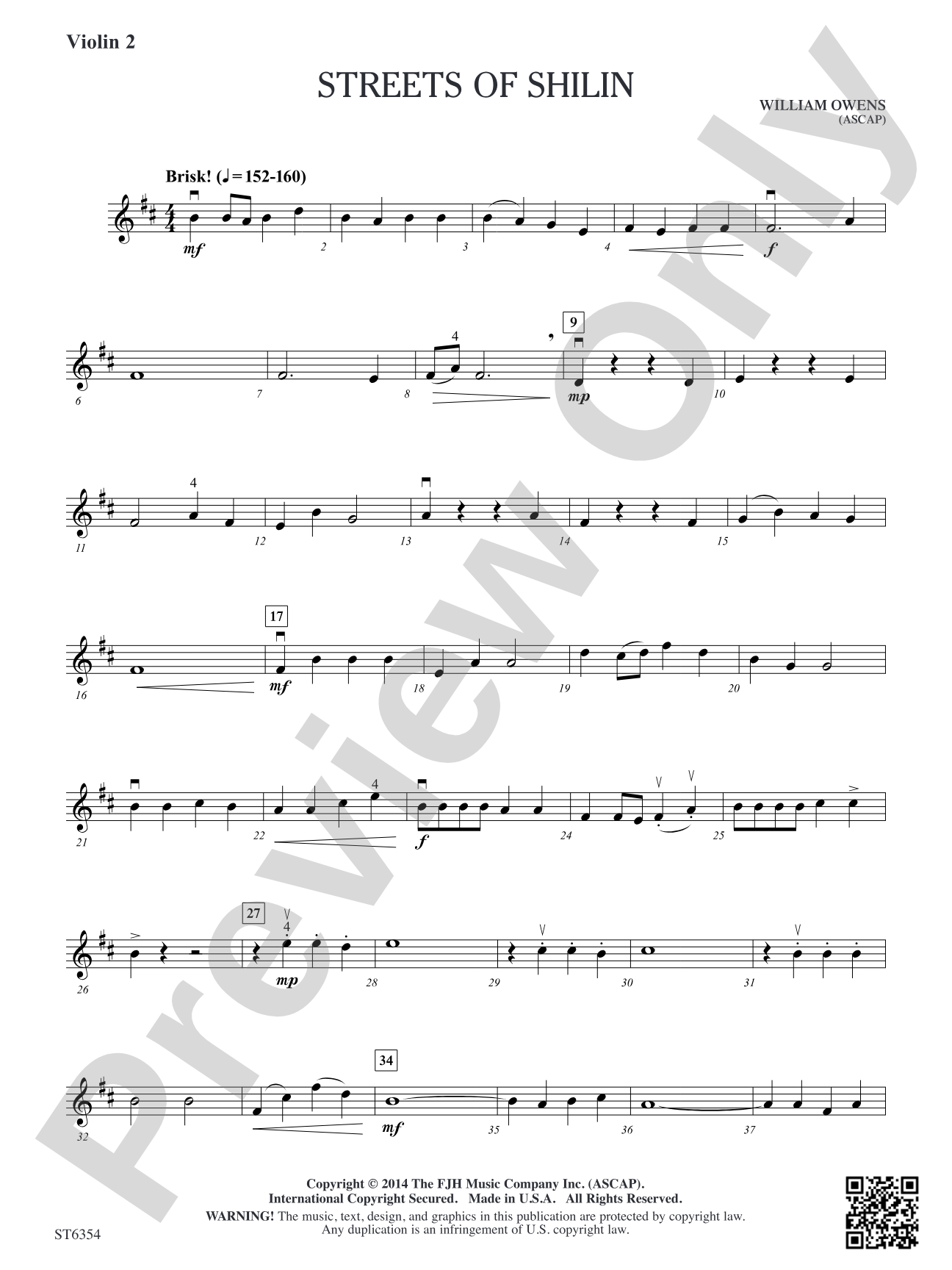

Streets of Shilin: Violin 2
By William Owens
Grade: 2
Item: 98-PC-DST6354_VN2
$7.00
Pickup currently not available
Description
Experience the energy and excitement of the world famous Taiwanese night markets with this highly spirited work! Largely in minor mode, Streets of Shilin covers a wide scope of styles and will be an instant favorite with young musicians. The optional percussion part will lend a special quality to your performance. Authentic sounding and very accessible!


Don't just read it, hear it, play along with it, and watch your students grow with it. In MakeMusic Cloud, Streets of Shilin: Violin 2 comes alive with professional accompaniment, adjustable tempo, and built-in practice tools that turn solo practice into real progress.
Open in the Player
Jump straight in and assign it today.
Start Your Free Trial
Open this title and explore the full library in minutes.
Sample Audio
1
Audio File
--:--
0:00
0:00
Sample Video
No sample videos found.
Additional Details
Series:
FJH Developing Strings
Publisher:
The FJH Music Company, Inc.
SKU:
98-PC-DST6354_VN2
More about this title
About the Composer: William Owens

William Owens brings three decades of classroom experience to his compositions for young ensembles. A VanderCook College of Music graduate, he has established himself as a prolific voice in music education, with over 300 published works spanning concert band, string orchestra, and chamber settings since 1993. His writing reflects deep knowledge of what young musicians need to grow: achievable challenges, engaging musical content, and parts that reward careful playing.
Owens spent 30 years directing bands in Texas before retiring to focus on composition and clinician work across North America. His works appear on festival and contest lists nationwide and have been featured in music education texts. He holds memberships in ASCAP, TMEA, and Phi Beta Mu International, and was honored as a Distinguished Alumnus by VanderCook. He currently resides in Fort Worth with his wife Georgia.
Why we love this
Owens captures the sensory chaos of a night market without sacrificing musical coherence. The minor mode foundation keeps the piece sophisticated while the varied stylistic palette holds young players' attention across a full performance, and the optional percussion part gives you flexibility in orchestration depending on what your program supports.
What to expect
Stepping into the bustling atmosphere of a Taiwanese night market: bright, layered, slightly chaotic, and utterly engaging. The minor tonality gives the piece a worldly sophistication while the varied styles and rhythmic vitality create the sense of wandering past food stalls, shops, and street performers, each with its own energy and character.
Who it's for
String orchestras in grades 2-4 seeking repertoire with genuine cultural character and high-energy appeal. This work suits ensembles ready to move beyond foundational material but still building technical facility; the accessibility of the writing frees musicians to focus on style, intonation, and ensemble balance rather than note-reading challenges.
How to get the most out of it
- Balance the energy throughout by treating each stylistic shift as a distinct market stall rather than rushing between sections; let the minor tonality create continuity beneath the surface variety.
- If using the optional percussion part, position those players where they can hear the string section clearly, since authentic market textures depend on tight rhythmic coordination between the sections.
- Bring out character details in individual string parts rather than smoothing everything into a single dynamic; the accessible Grade 2 writing contains small melodic gems that reward expressive playing.
How to use it
Program this as a contrast piece on a concert featuring Western European repertoire, or use it as a centerpiece for a multicultural themed concert that explores music from across Asia. The festive character and strong audience appeal also make it compelling for school assemblies or community performances where you want to showcase young musicians playing with style and confidence.
Skills your students will build
- Playing in minor tonality with secure intonation and phrasing
- Maintaining rhythmic precision while balancing multiple stylistic approaches within a single work
- Responding to expressive conducting cues that shift the character and energy between sections
- Blending and balancing as an ensemble in passages with varied orchestration and texture