Street of Dreams: Solo & Small Ensemble Digital Sheet Music

Street of Dreams: Solo & Small Ensemble Digital Sheet Music

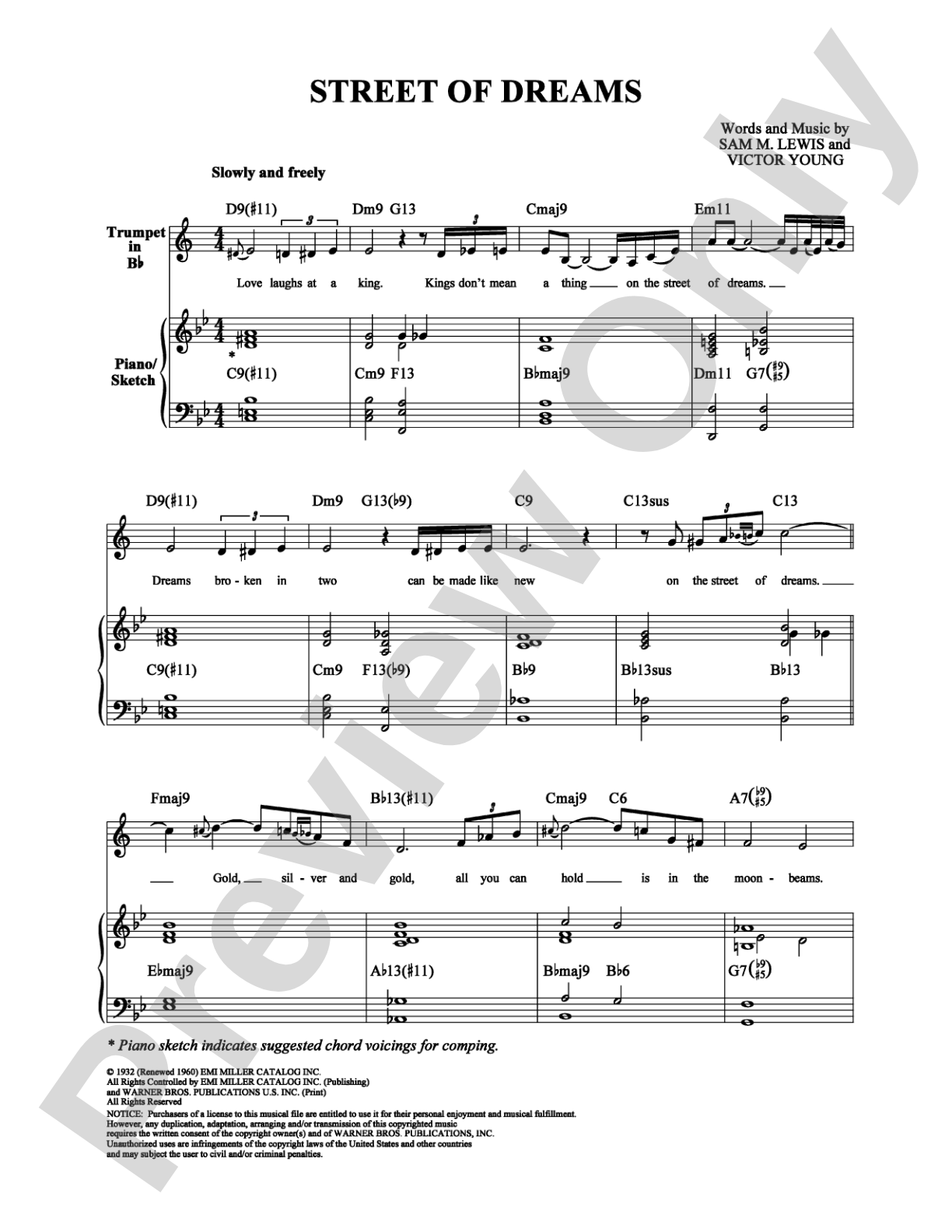
Victor Young, Wynton Marsalis, Sam M. Lewis

Item: 00-PS-0007351

Digital Download
$2.99
Description

Street of Dreams: Solo & Small Ensemble Digital Sheet Music isn't in MakeMusic Cloud just yet...but it could be. Let us know you'd like to see it, and you'll help shape what comes next. In the meantime, start a free trial and dive into thousands of interactive titles your students can play along with today.

Sample Audio
No sample audio found.
Sample Video
Additional Details
SKU: 00-PS-0007351

More about this title

About the Artist: Wynton Marsalis

Wynton Marsalis stands as one of the most influential jazz musicians and educators of the past four decades. His work spans classical trumpet performance, jazz composition and improvisation, and a deep commitment to music pedagogy through the Preservation Hall Foundation and Jazz at Lincoln Center, where he serves as artistic director. Marsalis has shaped how contemporary musicians understand the lineage between classical technique and jazz expression, demonstrating that mastery in one idiom strengthens command of the other.

As both a performer and advocate, Marsalis has championed jazz as America's classical music while maintaining the highest standards of musicianship across genres. His recordings, writings, and teaching have made him a central figure in jazz education, influencing how teachers and students approach improvisation, harmonic thinking, and the oral tradition that defines jazz learning.

Why we love this

Marsalis brings the authority of a master improviser and bandleader to this standard, and his interpretation offers students and semi-professional musicians a clear model for how to inhabit a jazz tune with intent and sophistication. The arrangement for solo and small ensemble gives flexibility for different ensemble sizes and settings while maintaining the harmonic and rhythmic integrity that characterizes his approach to repertoire.

What to expect

Street of Dreams carries the reflective, lightly nostalgic character of a great American standard, with harmonic sophistication that rewards close listening and careful harmonic navigation. The tune has an intimate quality even in ensemble contexts, inviting musicians to play with warmth and conversational phrasing rather than surface display.

Who it's for

This arrangement suits advanced high school jazz ensembles, college jazz programs, and semi-professional small groups seeking authentic jazz repertoire performed at a high standard. Solo performers with intermediate-to-advanced jazz trumpet or other lead instruments will find a model arrangement that shows how to navigate this standard with musicality and structural clarity.

How to get the most out of it

  • Study how Marsalis balances strict time-keeping with the slight rhythmic flexibility that gives jazz its conversational quality; anchor your placement relative to the rhythm section rather than rushing ahead.
  • Listen to multiple recordings of this standard before performing your own interpretation; understanding the tune's history across different eras and styles will deepen your phrasing choices.
  • In small ensemble settings, establish clear communication about solo order and harmonic reharmonizations before the performance so comping instruments and soloists can support each other effectively.
  • Use space and silence as actively as you use notes; Marsalis's playing demonstrates how restraint and well-placed rests make thematic material land with more weight.

How to use it

Program this during a jazz concert segment where you can highlight the interplay between soloists and rhythm section; the standard's familiarity to adult audiences paired with Marsalis's interpretive authority makes it an accessible entry point for listeners new to jazz. Use it in a jazz history or standards unit where students can study how different artists have shaped the tune across decades, with Marsalis's version anchoring a conversation about modern jazz approach to classic material.

Skills your students will build

  • Navigating jazz harmony and chord changes with accurate intonation
  • Phrasing and rhythmic placement within a swing feel
  • Call-and-response and comping skills in small ensemble contexts
  • Understanding solo form and structure in standard jazz repertoire
  • Listening and adaptation skills when performing alongside improvising musicians

You May Also Like