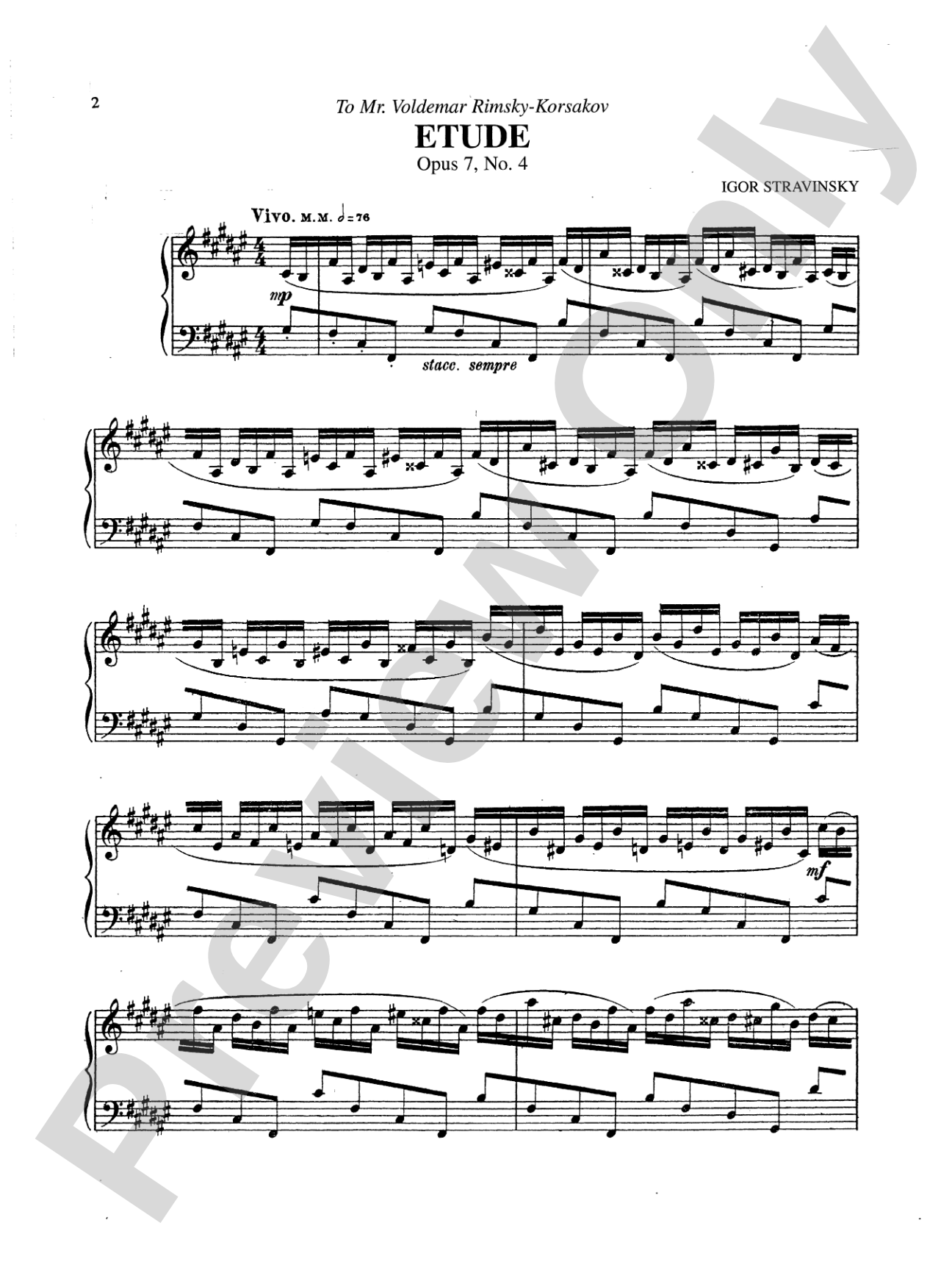
Stravinsky: Etude, Op. 7, No. 4 Sheet Music Preview

Stravinsky: Etude, Op. 7, No. 4

By Igor Stravinsky

Item: 00-PC-0009480

Digital Download
$6.99
Description
Expertly arranged piano solo from our Kalmus Edition.

Don't just read it, hear it, play along with it, and watch your students grow with it. In MakeMusic Cloud, Stravinsky: Etude, Op. 7, No. 4 comes alive with professional accompaniment, adjustable tempo, and built-in practice tools that turn solo practice into real progress.

Sample Audio
No sample audio found.
Sample Video
Additional Details
Series: Kalmus Edition
Publisher: Alfred Music
Page Count: 8
SKU: 00-PC-0009480

More about this title

About the Composer: Igor Stravinsky

Igor Stravinsky (1882-1971) fundamentally reshaped twentieth-century music through his rhythmic innovation, harmonic daring, and relentless formal experimentation. His early ballets for Diaghilev's Ballets Russes established him as a major voice, but his influence extended far beyond the stage into symphonic, chamber, and keyboard works that challenged every assumption about how music could be organized and heard.

Stravinsky's piano works occupy a distinctive place in his catalog. Rather than treating the keyboard as a vehicle for Romantic virtuosity, he explored its mechanical precision and percussive potential, often writing with the clarity and directness of his orchestral thinking. His etudes and other solo keyboard pieces remain essential repertoire for pianists seeking to understand modern musical language.

Why we love this

This etude demands real engagement with twentieth-century harmony and rhythm without the orchestral distraction. Students encounter Stravinsky's raw compositional voice through the keyboard's transparency, making each harmonic shift and metric gesture unmistakable. For a teacher building a program that spans classical, romantic, and modernist eras, this eight-page work offers substantial musical substance at a manageable scope.

What to expect

Stravinsky's etude balances intellectual rigor with genuine lyricism. The music feels simultaneously mechanical and expressive, with angular harmonic turns that shift the emotional ground beneath carefully shaped melodic lines. There's an almost athletic quality to the writing, yet moments of quiet reflection emerge between passages of rhythmic intensity.

Who it's for

Advanced intermediate to advanced pianists ready to engage with twentieth-century compositional language and rhythmic complexity. This etude suits students preparing for competitions, building a recital program beyond the standard romantic canon, or developing fluency with modern musical syntax.

How to get the most out of it

  • Treat rhythmic precision as a musical element, not a limitation. Stravinsky's metric patterns create propulsive energy when played with clarity rather than romantic rubato.
  • Balance the layered textures by identifying the primary voice in each section and allowing accompanying figures to recede slightly without losing their articulation.
  • Listen closely to how harmonic color shifts across the piece. Slight dynamic shaping within phrases can highlight Stravinsky's unexpected chord progressions without disrupting the overall pulse.
  • Explore the recorded interpretations of this etude by twentieth-century pianists to hear how different approaches to tempo and touch shape the work's character.

How to use it

Position this work in a recital that explores evolving approaches to piano technique across centuries, perhaps pairing it with a classical sonata and a contemporary work to show stylistic trajectories. Alternatively, feature it as a standalone concert etude that demonstrates a pianist's command of modern idiom and intellectual maturity.

Skills your students will build

  • Reading twentieth-century harmonic language and non-functional chord progressions
  • Executing precise rhythmic patterns and polyrhythmic textures
  • Balancing multiple voices and textural layers with independence
  • Managing hand position and finger articulation in modernist keyboard writing
  • Interpreting music without traditional expressive markings and Romantic conventions

You May Also Like