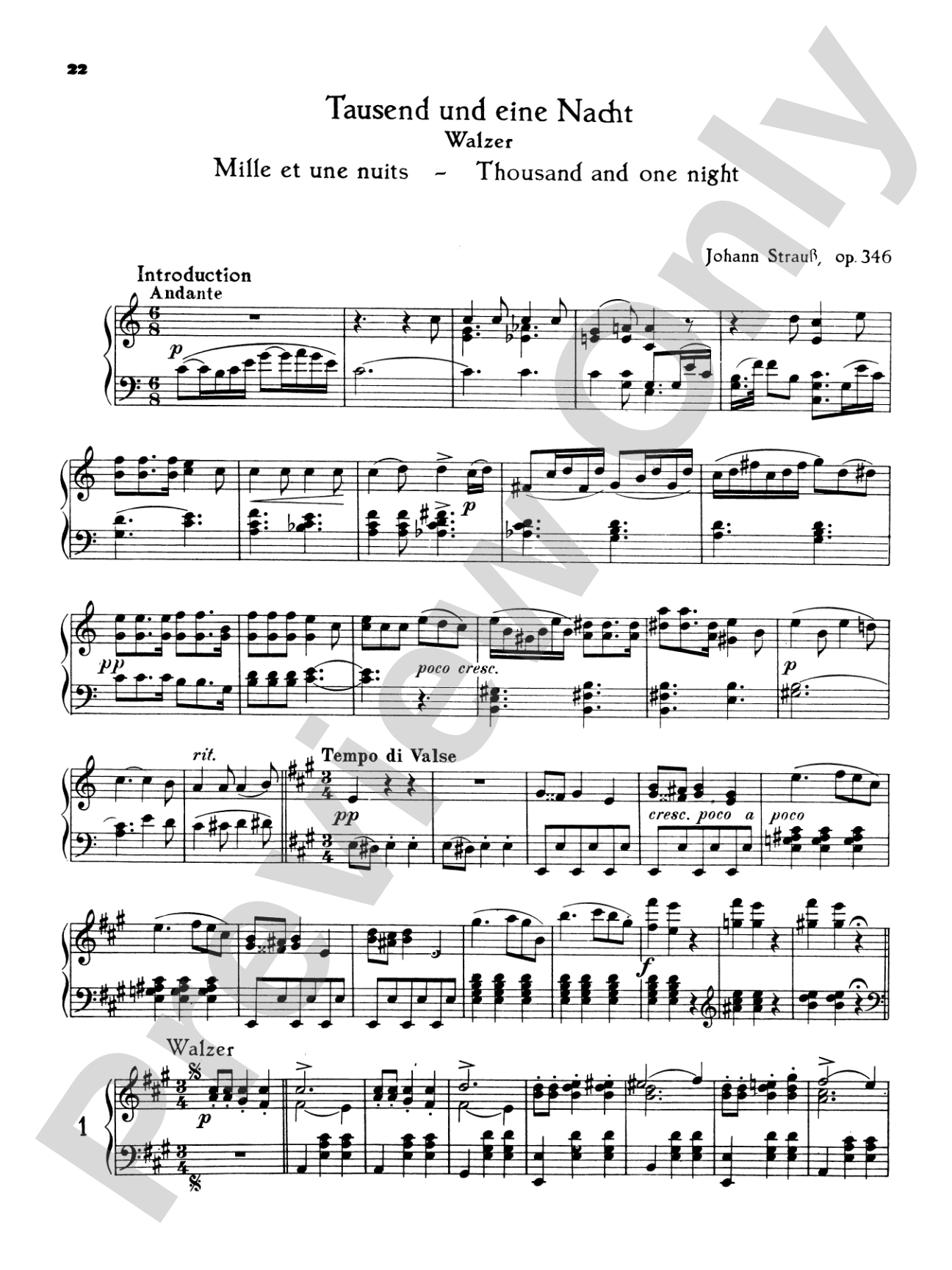
Strauss: Waltzes, Volume II Sheet Music Preview

Strauss: Waltzes, Volume II

By Johann Strauss, Jr.

Level: Intermediate / Advanced

Item: 00-PC-0009457

Digital Download
$0.99
Description
A collection of Intermediate / Advanced piano solos composed by Johann Strauss, Jr..

Don't just read it, hear it, play along with it, and watch your students grow with it. In MakeMusic Cloud, Strauss: Waltzes, Volume II comes alive with professional accompaniment, adjustable tempo, and built-in practice tools that turn solo practice into real progress.

Sample Audio
No sample audio found.
Sample Video
Additional Details
Series: Kalmus Edition
Publisher: Alfred Music
Page Count: 40
SKU: 00-PC-0009457

More about this title

About the Composer: Johann Strauss, Jr.

Johann Strauss, Jr. (1825-1899) inherited his father's mantle as Vienna's preeminent waltz composer and elevated the genre to an art form of international significance. His prolific output spans over 500 compositions, establishing the waltz as a vehicle for sophisticated orchestration, harmonic innovation, and structural refinement that influenced both light music and serious concert works.

Strauss's career extended across six decades of European musical life. His compositions were performed in concert halls and ballrooms alike, and his influence on the Romantic era extended to composers like Brahms and Ravel, who both paid homage to his melodic gift and orchestral mastery. For pianists, his works offer a bridge between virtuosic display and genuine musical substance.

Why we love this

These waltzes bring authentic Romantic-era salon music into the studio without sacrificing musical integrity. The Kalmus Edition preserves the character of the original orchestrations while making them pianistically idiomatic, giving intermediate-advanced players access to repertoire that sounds impressive and feels genuinely musical to perform.

What to expect

Elegant, buoyant, and architecturally assured. These waltzes capture the sophisticated grace of Vienna's musical culture, with lilting melodies that seem to float above rich harmonic underpinnings and the unmistakable three-beat pulse that invites motion without demanding haste.

Who it's for

Pianists working at the intermediate-advanced level who are ready to explore Romantic-era concert repertoire beyond the standard solo canon. These pieces suit both recital programming and students developing facility with nineteenth-century performance practice and orchestral textures at the keyboard.

How to get the most out of it

  • Shape each eight-bar phrase with a gentle swell rather than mechanical phrasing; Strauss waltzes breathe like dance music even when played as concert pieces.
  • Maintain rhythmic flexibility in the accompaniment without losing the waltz pulse; the right hand melody often calls for slight rubato that the left hand should support rather than constrain.
  • Balance the melodic line against inner voices and countermelodies that often appear in the middle register; this is orchestral writing translated to the keyboard, not purely treble-dominated texture.
  • Practice the hand independence required for the characteristic Viennese waltz rhythm, paying particular attention to how broken chord figures in the left hand support harmonic movement.

How to use it

Include one or two waltzes on a recital featuring Romantic-era keyboard music, or program them alongside Schubert and Chopin to show how different composers engaged with dance forms. They also work well as encores, offering audiences the immediate pleasure of recognizable, beautifully crafted melodies.

Skills your students will build

  • Pedal control and resonance in Romantic-era harmonic contexts
  • Independence between right-hand melody and left-hand waltz accompaniment figures
  • Phrasing and rubato within a metric framework
  • Reading and executing orchestrally-conceived textures at the keyboard
  • Articulation and voicing of inner melodic lines in multi-voice textures

You May Also Like