
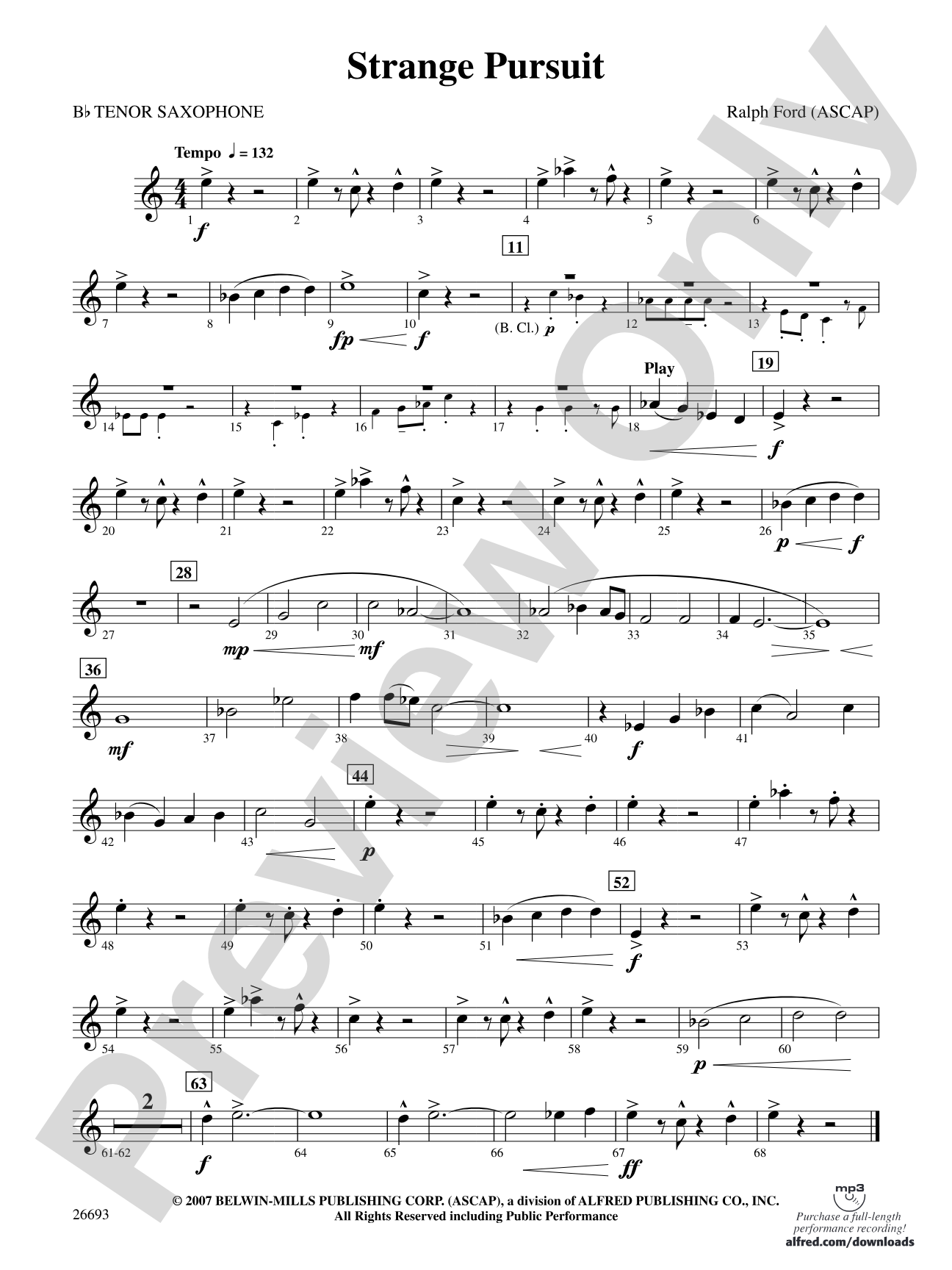

Strange Pursuit: B-flat Tenor Saxophone
By Ralph Ford
Grade: 1 (Very Easy)
Item: 00-PC-0001174_TX1
$3.00
Pickup currently not available
Description
An exciting work for beginners, Ralph Ford's Strange Pursuit will hit the mark with contrasting styles and a variety of articulations. Best of all, it's a great choice for enhancing your students' knowledge of chromatics. There'll be no question that it's an up-tempo, high-energy crowd pleaser! This title is available in MakeMusic Cloud.


Don't just read it, hear it, play along with it, and watch your students grow with it. In MakeMusic Cloud, Strange Pursuit: B-flat Tenor Saxophone comes alive with professional accompaniment, adjustable tempo, and built-in practice tools that turn solo practice into real progress.
Open in the Player
Jump straight in and assign it today.
Start Your Free Trial
Open this title and explore the full library in minutes.
Sample Audio
1
Audio File
--:--
0:00
0:00
Sample Video
No sample videos found.
Additional Details
Series:
Belwin Beginning Band
Publisher:
Alfred Music
Page Count:
71
SKU:
00-PC-0001174_TX1
More about this title
About the Composer: Ralph Ford

Ralph Ford brings three decades of creative work across composition, arranging, conducting, and education. Starting his career as an arranger at age fifteen, he earned both his undergraduate and master's degrees from Troy State University, where he served on the faculty for fifteen years teaching orchestration, arranging, theory, and applied brass alongside his work as staff arranger and jazz ensemble director.
Ford has established himself as a prolific composer and arranger for Alfred Music's Belwin division, with over 250 published works for concert band, orchestra, jazz ensemble, and marching band performed by school, university, military, and professional ensembles worldwide. His compositional and arranging experience extends beyond music education into media production, broadcast, and commercial work, bringing a dynamic, accessible approach to every piece he creates.
Why we love this
Strange Pursuit delivers exactly what beginning band needs: musical substance without overwhelming complexity. Ford constructs this piece around contrasting sections and deliberate articulation work, making it an ideal teaching tool for chromatic literacy while keeping the energy infectious enough to sustain student engagement from rehearsal through performance.
What to expect
Strange Pursuit captures the feel of a musical mystery unfolding in real time. Rhythmic momentum and shifting articulations create a sense of pursuit and discovery, with contrasting musical gestures that keep listeners and performers engaged throughout the piece's high-spirited journey.
Who it's for
Beginning concert band students who thrive on immediate musical gratification and directors seeking pieces that teach real concepts without excessive technical demands. This work suits ensembles preparing for concert or festival performance and those building foundational skills in chromatic reading and style differentiation.
How to get the most out of it
- Establish the tempo confidently in rehearsal. The up-tempo character depends on a steady foundation; lock in the pulse with your rhythm section before addressing articulation details in the winds.
- Isolate the contrasting sections and drill the stylistic shifts separately. Students need to hear and feel how each section differs before combining them at full tempo.
- Emphasize clean articulation changes throughout. Ford uses varied articulation as a primary compositional tool here, so mark these clearly on parts and give specific verbal cues for what "articulated" versus "flowing" means for your band.
- Balance the energy without sacrificing clarity. High-energy doesn't mean rushing; maintain rhythmic precision even as the excitement builds.
How to use it
Anchor this piece as the centerpiece of a concert showcasing your band's range and personality. Its accessibility and crowd-pleasing energy make it ideal for an opener or closer, and the chromatic focus allows you to program it alongside repertoire that emphasizes different technical or tonal priorities.
Skills your students will build
- Reading and performing chromatic passages accurately
- Executing articulation changes (legato, staccato, accent) with consistent technique
- Responding to style changes and contrasting musical sections
- Maintaining steady tempo during energetic passages
- Balancing individual voice clarity within full band texture