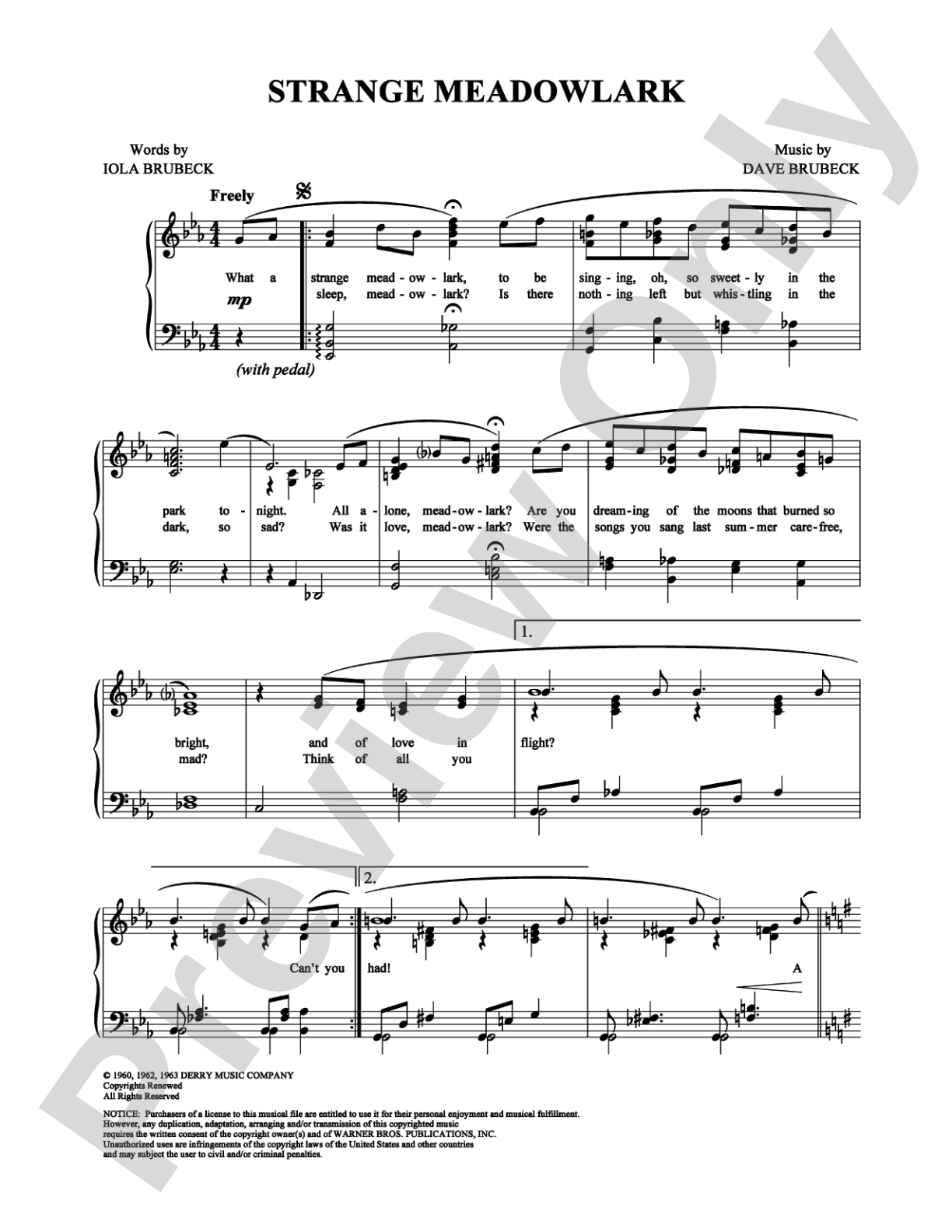
Strange Meadowlark: Piano/Vocal/Chords Digital Sheet Music

Strange Meadowlark: Piano/Vocal/Chords Digital Sheet Music

Dave Brubeck

Item: 00-PS-0000788

Digital Download
$3.99
Description

Strange Meadowlark: Piano/Vocal/Chords Digital Sheet Music isn't in MakeMusic Cloud just yet...but it could be. Let us know you'd like to see it, and you'll help shape what comes next. In the meantime, start a free trial and dive into thousands of interactive titles your students can play along with today.

Sample Audio
No sample audio found.
Sample Video
Additional Details
SKU: 00-PS-0000788

More about this title

About the Artist: Dave Brubeck

Dave Brubeck

Dave Brubeck shaped modern jazz through both performance and composition, bringing together improvisational freedom and classical structure in ways that challenged what jazz could be. His study with Darius Milhaud after World War II gave him tools to blend jazz language with European compositional technique, a foundation he drew from throughout a career that produced oratorios, ballets, chamber works, and solo pieces alongside his recordings. His 1959 album "Time Out" became the first jazz record to sell over a million copies, introducing millions of listeners to complex meters and sophisticated harmony through accessible, memorable melodies.

Beyond music, Brubeck actively broke racial barriers in mid-20th-century American culture, refusing to perform at segregated venues and integrating his quartet at a time when doing so carried real risk. His large-scale sacred works, including "To Hope!" and "Pange Lingua Variations," have been recorded by major orchestras and choirs worldwide. Late in life, he received the Grammy Lifetime Achievement Award, the Presidential Medal of the Arts, and induction into the American Classical Music Hall of Fame, cementing his influence across jazz, classical, and popular music.

Why we love this

Brubeck's ability to make sophisticated jazz harmony feel singable gives singers a genuine entry into jazz language without sacrificing musicality or complexity. This piece sits at exactly the intersection of his strengths: a composed melody that swings naturally, harmonic interest that rewards careful listening, and a structure that lets pianists engage in real accompaniment rather than merely comping.

What to expect

The piece captures a moment of quiet contemplation, moving through harmonic color without rushing. The melodic writing suggests a landscape more than a narrative; there's an open-air quality to the phrasing that feels introspective and present at once.

Who it's for

Singers comfortable with jazz standards and pianists who enjoy accompanying in a jazz context. This works equally well for a cabaret setting, a jazz recital, or a vocal chamber concert where you want to feature art song alongside popular material.

How to get the most out of it

  • Let the piano part breathe with space between phrases; jazz singing is about listening and responding to what the accompaniment suggests, not filling silence.
  • Establish the harmonic framework in rehearsal by walking through the chord progression at slow tempo to ensure the vocalist hears the harmonic movement underneath the melody.
  • Shape the melody with subtle dynamics rather than dramatic gestures; Brubeck's melodies are conversational and benefit from a singer who listens first and emotes second.
  • Experiment with the placement of the vocal line against the piano's phrasing to find moments where they lock together and moments where the voice floats slightly ahead or behind.

How to use it

Pair this with other Brubeck songs or jazz standards to create a set exploring his compositional approach beyond "Take Five." It also works as a solo recital piece that reveals different dimensions of a singer's artistry than more narrative-driven art songs.

Skills your students will build

  • Interpreting jazz swing and phrasing within composed melody
  • Reading and understanding jazz harmony symbols
  • Coordinating vocal line with piano accompaniment in jazz context
  • Building dynamic shape in a melody that avoids obvious climax points

You May Also Like