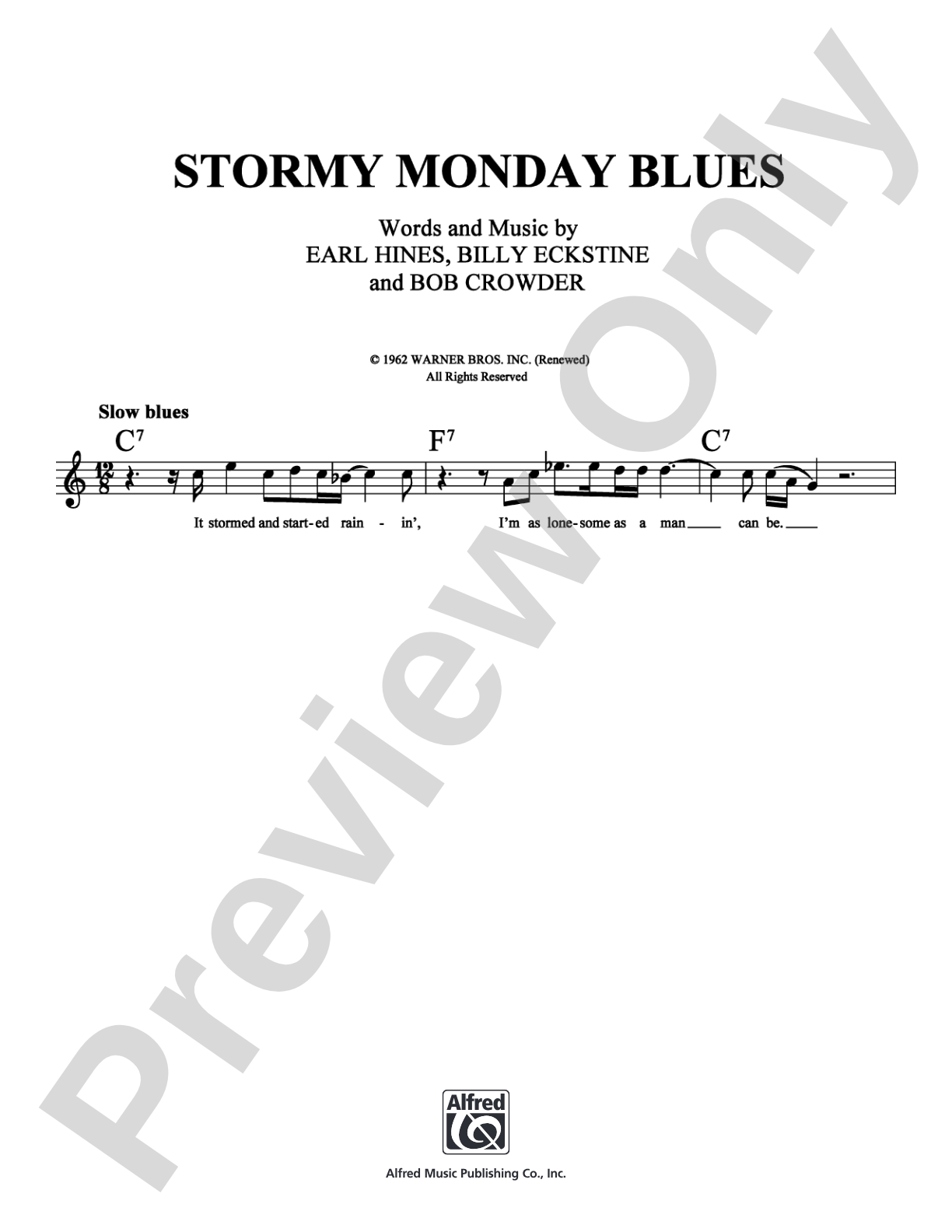
Stormy Monday Blues: Lead Sheet Digital Sheet Music

Stormy Monday Blues: Lead Sheet Digital Sheet Music

Earl Hines, Billy Eckstine, Bob Crowder

Item: 00-PS-0008738

Digital Download
$1.99
Description

Stormy Monday Blues: Lead Sheet Digital Sheet Music isn't in MakeMusic Cloud just yet...but it could be. Let us know you'd like to see it, and you'll help shape what comes next. In the meantime, start a free trial and dive into thousands of interactive titles your students can play along with today.

Sample Audio
No sample audio found.
Sample Video
Additional Details
SKU: 00-PS-0008738

More about this title

About the Artist: Earl Hines

Earl Hines (1903-1983) was a pianist and bandleader whose innovative approach to jazz piano fundamentally shaped the instrument's role in ensemble settings. Known as "Fatha," Hines developed a trumpet-influenced right hand style that allowed him to comp and solo with unprecedented clarity and independence from the rhythm section, influencing generations of jazz pianists who followed.

Why we love this

This lead sheet captures one of the jazz canon's most enduring blues standards in a format that invites reharmonization and personal interpretation. Students and working musicians alike benefit from the melodic clarity and harmonic foundation that make this tune both accessible for learning and sophisticated enough for real improvisation.

What to expect

Stormy Monday carries the weight of late-night contemplation and blue-collar resilience. The melody sits in a natural register that feels lived-in and direct, with harmonic movement that deepens the emotional terrain without ever becoming overwrought.

Who it's for

Jazz musicians working through standards repertoire, piano students learning to comp from lead sheets, and ensemble directors building a collection of accessible blues tunes for student improvisation. This is equally useful for a small combo workshop or a jazz history curriculum unit.

How to get the most out of it

  • Treat the melody as a launching point rather than a final statement. The blues form supports rhythmic displacement and phrasing variation that reflects your own time feel.
  • Pay attention to the harmonic rhythm in the changes. Small variations in when you resolve chords can dramatically shift the emotional weight of each phrase.
  • Balance between stating the melody clearly and leaving space for the ensemble to breathe. Lead sheets thrive when players respond to one another rather than rushing through the form.

How to use it

Use this as an entry point into blues form and jazz standards for intermediate ensembles. Pair it with recordings of different interpretations (Hines himself, T-Bone Walker, Etta James) to show how the same harmonic and melodic skeleton can accommodate radically different approaches to time, phrasing, and emotional emphasis.

Skills your students will build

  • Reading and interpreting lead sheet notation
  • Navigating 12-bar blues form and harmonic changes
  • Building improvisation from a given melody and chord progression
  • Comping decisions in response to ensemble texture and dynamics

You May Also Like